Quick answer
Style cushions on an armchair by working from the back forward: place the largest cushion against the backrest, add a mid-size cushion in front, then finish with a small accent cushion. Keep to two or three cushions, repeat at least one colour or texture from the room, and step back to check the arrangement from the doorway.
Measure your armchair before you buy cushions
Start with the seat width and back height. A cushion should not overhang the arms or swallow the seat; if it does, the chair looks cramped and the cushion will not sit upright. For a typical armchair, a 45cm or 50cm square works as the back layer, a 40cm square or 30x50cm rectangle sits in front, and a 30cm square or small bolster finishes the arrangement. If your chair has a low back, keep the back cushion shallow so it does not push you forward.
Choose a colour palette that connects to the room
Pick two or three colours already present in the room: a wall, a rug, a curtain, or a piece of art. Use the armchair as the base colour and let the cushions add contrast or warmth. A patterned cushion can carry the scheme, while a plain cushion gives the eye a rest. If you are unsure, choose one patterned cushion and one plain cushion in a colour pulled from the pattern.
Mix patterns with a clear hierarchy
Pattern mixing works when the scales are different. Pair a small-scale gingham or stripe with a larger floral or geometric, and keep at least one shared colour between them. Avoid combining two busy patterns at the same scale, which creates visual noise. Texture counts as pattern too: linen, velvet, and wool can sit together if the colours are calm.
Layer from largest to smallest
Place the largest cushion at the back, leaning against the armchair. Add the mid-size cushion in front, slightly overlapping. Put the smallest cushion at the front, angled or centred. This creates depth and stops the cushions from looking like a flat row. If the chair has a loose back cushion, remove it before layering, or use a smaller cushion so the seat stays comfortable.
Adjust the arrangement and check it from a distance
Once the cushions are in place, step back three or four metres and look at the chair in context. Check that the arrangement is not too tall, that the colours relate to nearby furniture, and that you can still sit down without moving everything. A quick chop to the cushion (a light karate chop to the top edge) can help it hold its shape, but only if the filling allows it.
Three-step cushion styling method
- Step 1: Place the largest cushion at the back: Choose a cushion that spans most of the seat width and lean it against the backrest. This sets the scale for everything else. Checkpoint: the cushion should not cover the armrests or push you forward when you sit.
- Step 2: Add a mid-size cushion in front: Use a cushion about 10cm smaller than the first, or a rectangular shape, and overlap it slightly. This creates depth. Common mistake: using two cushions the same size, which looks flat and can slide around.
- Step 3: Finish with a small accent cushion: Place a small square or bolster at the front, centred or slightly angled. This adds a final layer of colour or texture. Checkpoint: step back and make sure you can still see the armchair fabric underneath.
Product facts to keep in mind
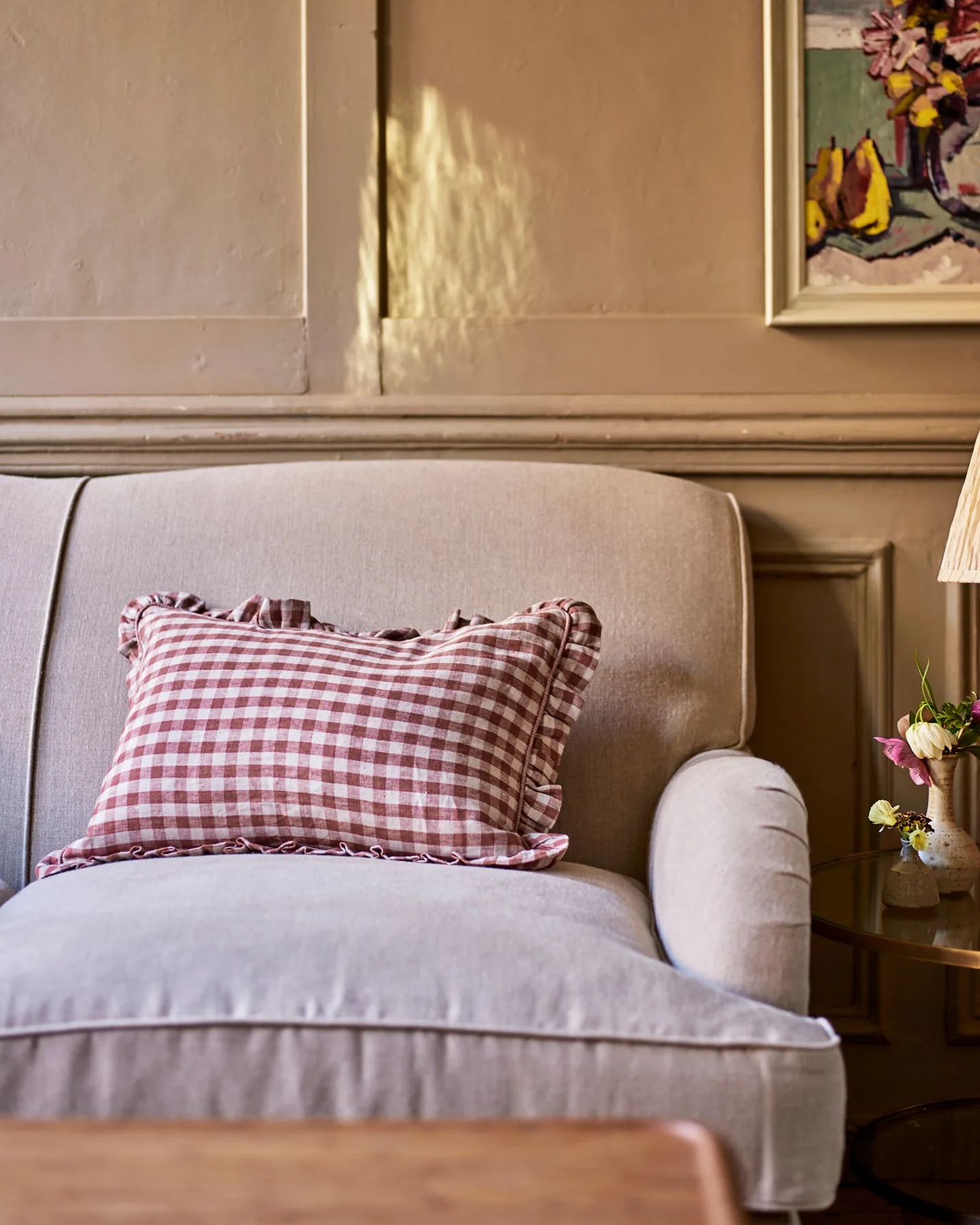
- Tilly Gingham Frill Cushion, Blush Red: Tilly Gingham Frill Cushion, Blush Red is made from 100% linen with a frilled edge and plain piping at the front. Linen has a relaxed, slightly textured look that works well as the patterned layer in a mixed arrangement. The frill adds softness, so pair it with a plain cushion to avoid competing details.
- Remy Armchair, Sage Stripe: Remy Armchair, Sage Stripe is upholstered in a broad sage green stripe with a foam core filling and feather jacket. A striped armchair already provides pattern, so choose cushions that echo one of the stripe colours or use a larger-scale pattern to avoid a clash.