Quick Answer
Use a busy board by letting your toddler explore at their own pace, then guide them through simple activities like turning locks, sliding latches, and pressing buttons to build fine motor skills and problem-solving.
Why Busy Boards Work for Toddler Development
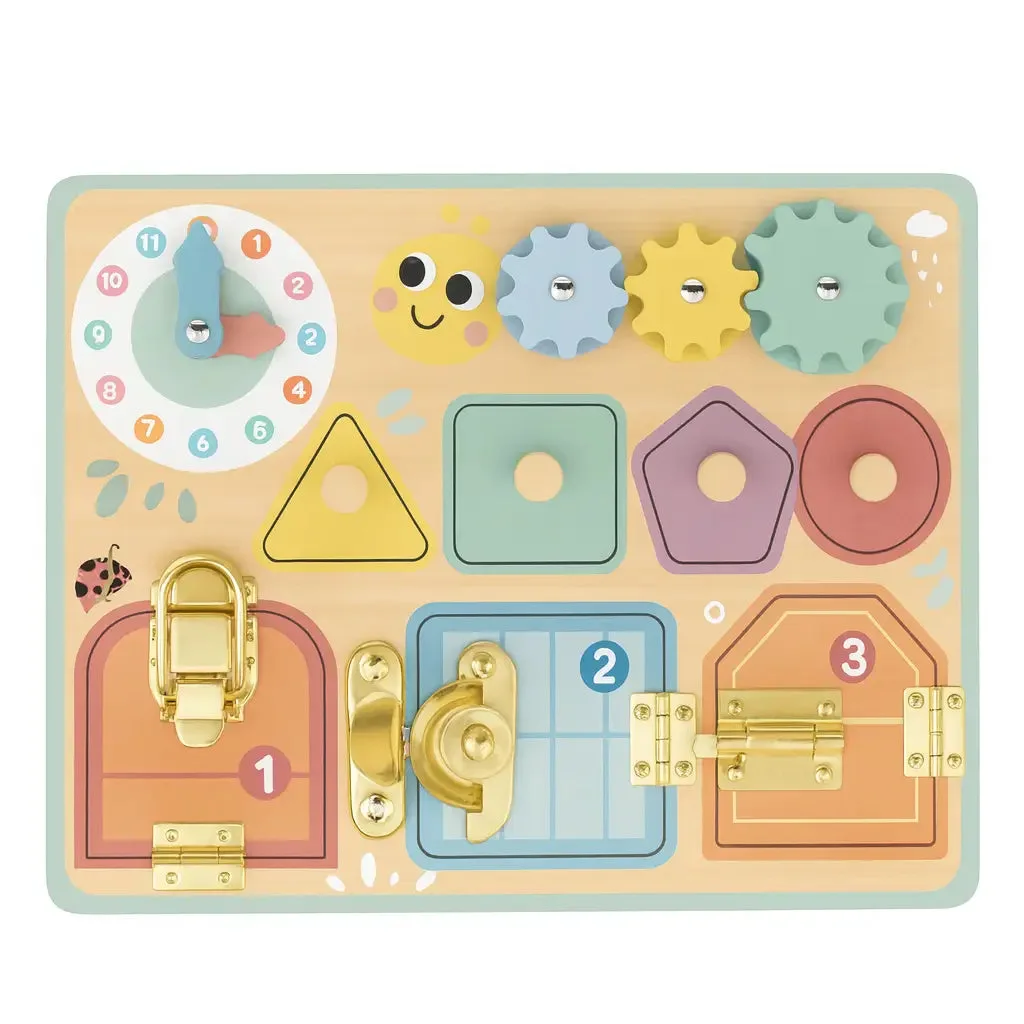
Busy boards are a Montessori-inspired tool that encourages hands-on learning through everyday objects. Unlike flashy electronic toys, a busy board requires your child to figure out cause and effect by themselves — turning a latch to open a door, sliding a gear, or pressing a button that clicks. This kind of open-ended play builds concentration, patience, and fine motor control.
The wooden Busy Board from 123 Baby Box includes switches, locks, gears, and buttons, all sized for small hands. Because it has no batteries or screens, it relies entirely on your toddler's curiosity and physical effort, which is exactly what developing brains need.
When to Introduce a Busy Board
Most toddlers are ready for a busy board around 12 to 18 months, when they start showing interest in how things work and can grasp and manipulate objects. If your child is still mouthing everything, wait a few months — small parts may pose a choking hazard, and the board's real value comes from intentional manipulation, not tasting.
The board's size (11.81 × 8.86 × 1.38 inches) makes it easy to mount on a wall or place on a low table. For younger toddlers, start with it flat on the floor so they can explore safely.
Step-by-Step Busy Board Activities
- Let your toddler explore freely first: Place the busy board on a flat surface or mount it at eye level. Don't demonstrate anything initially — just let your child touch, turn, and push whatever catches their attention. This builds independent problem-solving. Common mistake: jumping in to show how everything works. Let them struggle a little; that's where learning happens.
- Introduce one mechanism at a time: After a few minutes of free play, point to one element — for example, the latch. Say, "Can you slide this?" and slowly demonstrate the motion. Let them try it themselves. Repeat with the gear or switch only after they've mastered the first one. Overloading a toddler with too many options can lead to frustration. One mechanism per session keeps focus high.
- Narrate the action and cause-effect: As your child turns a knob or flips a switch, describe what's happening: "You turned the lock — now the door opens!" This builds language skills and reinforces the connection between action and result. Avoid long explanations. Short, simple phrases work best for toddlers under 2.
- Graduate to multi-step challenges: Once your toddler can operate two or three mechanisms independently, create a sequence: "First slide the latch, then turn the gear, then press the button." This develops working memory and sequencing ability. If your child gets stuck, go back to one step. The goal is success, not frustration.
- Rotate the board's position or add props: Mount the board vertically on a wall for a standing challenge, or place it on a table for seated play. You can also attach a small basket of objects (like a toy key) to extend the play. Changing the setup renews interest without buying a new toy. A busy board doesn't need to be used the same way every time. A simple position change can make it feel brand new.
Product Facts
-
Busy Board: This wooden Busy Board features switches, locks, gears, and buttons that encourage fine motor skills, problem-solving, and sensory exploration. The variety of mechanisms means your toddler gets multiple types of hand-eye coordination practice from one toy, making it a versatile developmental tool.
Busy Board