Quick answer
Yes, you can use a jelly roll for quilt binding. The 2.5-inch width is ideal for double-fold binding, and the coordinated fabrics give your edge a cohesive, scrappy look.
Why a jelly roll works for binding
Jelly roll strips are already cut to 2.5 inches wide, which is the standard width for double-fold (French) binding. This saves you the cutting step and gives you a variety of prints that match your quilt top without extra shopping.
What to watch for
Jelly roll strips are 44 inches long on average, so you will need to join many strips to get enough length for your quilt perimeter. The seams can add bulk if not pressed correctly. Also, if you want bias binding, you must cut the strips on the bias yourself—jelly rolls are cut on the straight grain.
How to turn a jelly roll into quilt binding
- Calculate how many strips you need: Measure the perimeter of your quilt and add 12 inches for corners and overlap. Divide that number by 40 (the usable length of one strip) to get the number of strips. Round up to the nearest whole number. A common mistake is forgetting the extra 12 inches for joining and turning corners. Always add that buffer.
- Join the strips end to end: Place two strips right sides together at a 90-degree angle, offset by 1/4 inch. Sew a diagonal seam from the top left to bottom right intersection. Trim the excess to a 1/4-inch seam allowance and press the seam open. Sewing a straight seam instead of a diagonal one creates bulk at the seam intersection. Always use the diagonal method for a flatter join.
- Press the entire strip in half lengthwise: Fold the joined strip wrong sides together, aligning the raw edges. Press firmly along the entire length with a hot iron. This creates the double-fold binding ready for attaching. If you skip pressing, the binding will be uneven when you sew it to the quilt. Press every few inches as you go.
- Attach binding to the quilt edge: Starting in the middle of one side, align the raw edges of the binding with the raw edge of the quilt. Sew with a 1/4-inch seam allowance, stopping 1/4 inch from the corner. Fold the binding up and then down to create a mitered corner, then continue sewing. A common mistake is sewing all the way to the corner edge. Stop exactly 1/4 inch away so you have room to fold the miter.
- Fold binding to the back and hand stitch: Wrap the binding around the quilt edge to the back side. Use a blind stitch to hand sew the folded edge to the quilt back, covering the machine seam. Miter the corners on the back as well. Machine stitching the binding on the front and back can be tricky for beginners. Hand stitching gives you control and a professional finish.
Product facts
-
Letters to Cupid Rolie Polie 2.5" Strips, 40pcs - Jelly Roll: Each strip is 2.5 inches wide and 44 inches long, with 40 strips per roll. The width is perfect for double-fold binding, and the 40 strips give you enough length for a large quilt without buying extra fabric.
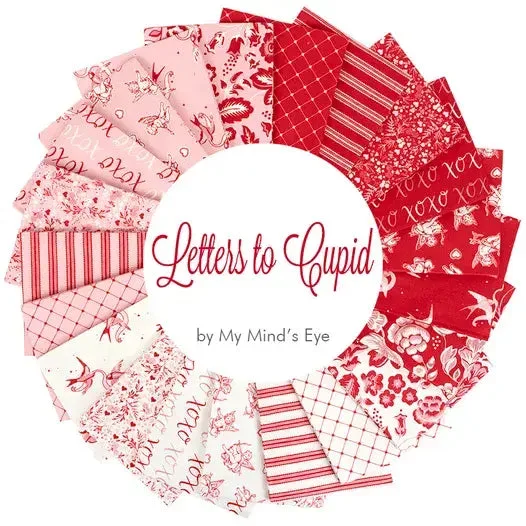
Letters to Cupid Rolie Polie 2.5" Strips, 40pcs - Jelly Roll