Quick answer
Use conversation cards like eeBoo's How Am I Feeling? set to help children name and understand emotions through guided play. The 48 illustrated cards turn abstract feelings into a concrete, shareable activity.
Why conversation cards work for emotional vocabulary
Young children often struggle to put feelings into words. Conversation cards give them a visual and verbal starting point. Instead of asking "How do you feel?" (which can feel vague or intimidating), you can point to a card and say "This face looks worried. Have you ever felt worried?" The card does the heavy lifting of naming the emotion, so the child can focus on connecting it to their own experience.
The structured format also reduces pressure. A child who might shut down during a direct question often opens up when the conversation is framed around a picture or a story. Over time, this repeated practice builds a richer emotional vocabulary and stronger social skills.
Choosing the right set for your child
Not all conversation cards are the same. Some focus on facial expressions (like eeBoo's How Am I Feeling? cards), while others emphasize social scenarios and inference (like eeBoo's What's Going On Here? cards). For building emotional vocabulary, start with a set that clearly depicts a range of feelings. The How Am I Feeling? set uses award-winning fruit-and-vegetable characters to show emotions in a way that is both clear and engaging for young children.
Steps to build emotional vocabulary with conversation cards
- Start with one emotion at a time: Pick 3-5 cards that show basic emotions (happy, sad, angry, scared, surprised). Show one card and say the emotion name clearly. Ask the child to mimic the face in the mirror or on the card. This physical connection helps anchor the word. Common mistake: showing too many cards at once. Limit to 3-5 per session to avoid overwhelming the child.
- Pair the card with a personal story: After naming the emotion, share a short, simple story from your own day that matches that feeling. For example, "I felt frustrated when my coffee spilled this morning. This card looks like frustrated, doesn't it?" Then invite the child to share a time they felt the same way. Checkpoint: if the child stays silent, model again with another example rather than pushing for an answer.
- Play a feelings guessing game: Place 5-10 cards face up. Take turns picking a card without showing it, then act out the emotion while the other person guesses which card it is. This turns vocabulary practice into a playful, low-stakes game. Common mistake: correcting a wrong guess too harshly. Instead, say "Close! That face is surprised. Can you see how the eyebrows are different?"
- Use the cards during real-life moments: Keep the deck handy during daily routines. When a conflict or strong emotion arises (e.g., a sibling argument), pause and say "Let's find a card that shows how you feel right now." This helps children practice emotional vocabulary in context. Checkpoint: only do this when everyone is calm enough to look at the cards. Trying during a meltdown backfires.
- Create a feelings check-in routine: Each morning or evening, have the child pick a card that matches their mood and explain why. Over time, this builds a habit of naming and reflecting on emotions. You can track patterns: "You picked 'excited' three mornings this week. What's making you feel that way?" Common mistake: treating the check-in as a test. Keep it casual and optional. If the child says 'I don't know,' just pick a card yourself and move on.
Product facts
-
How am I Feeling? Conversation Cards: The 48 cards deploy award winning artwork, by Saxton Freymann, delightfully demonstrating a broad range of emotional fruits and vegetables. The whimsical, recognizable characters make it easy for children to connect a facial expression to a feeling without feeling overwhelmed.
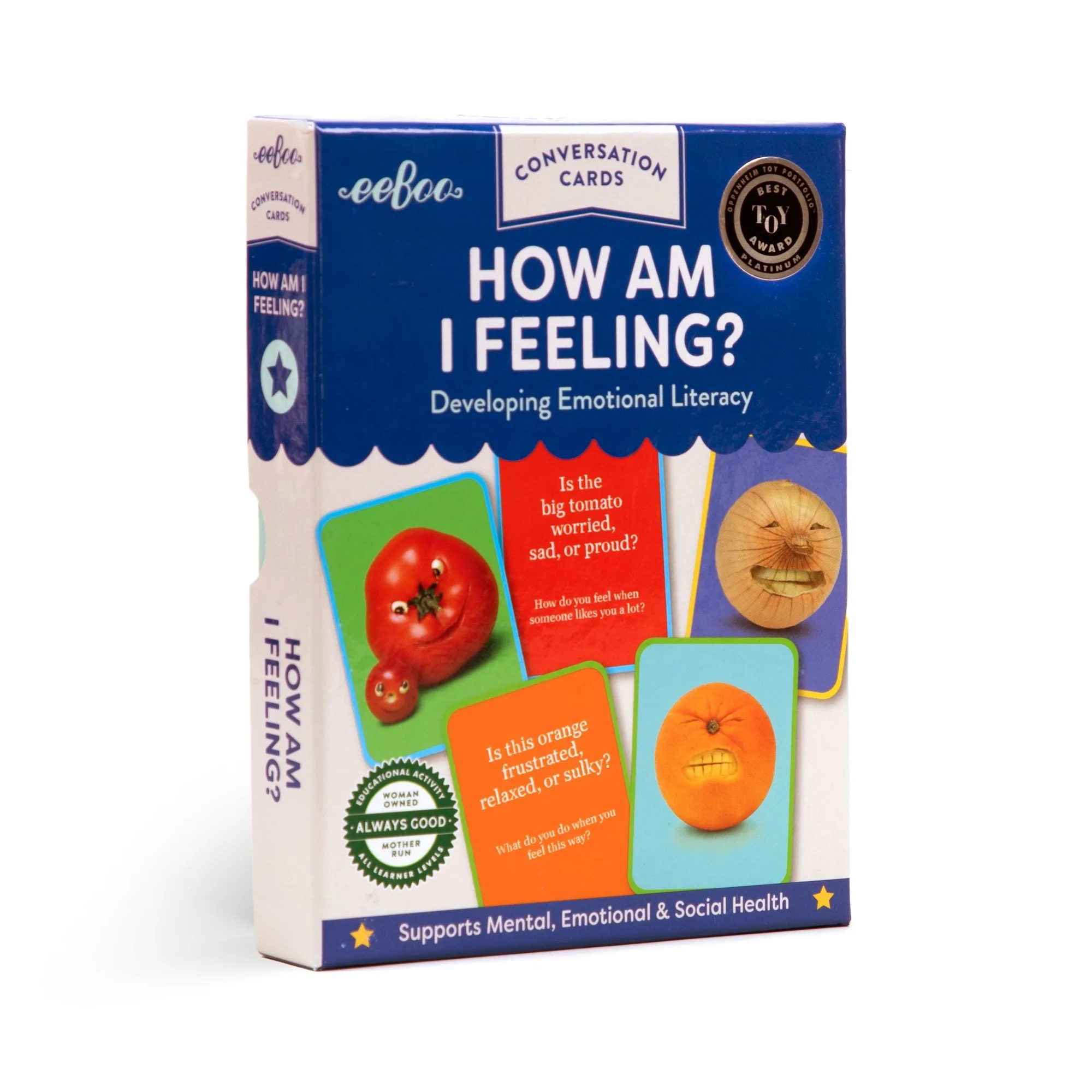
How am I Feeling? Conversation Cards
-
What's Going On Here? Conversation Cards: What's Going On Here? conversation cards help us to understand the friendly illustrations by making inferences using logic, observation, and social experience. This set is better suited for older children or as a next step after they have mastered basic emotion names, because it adds a layer of social reasoning.
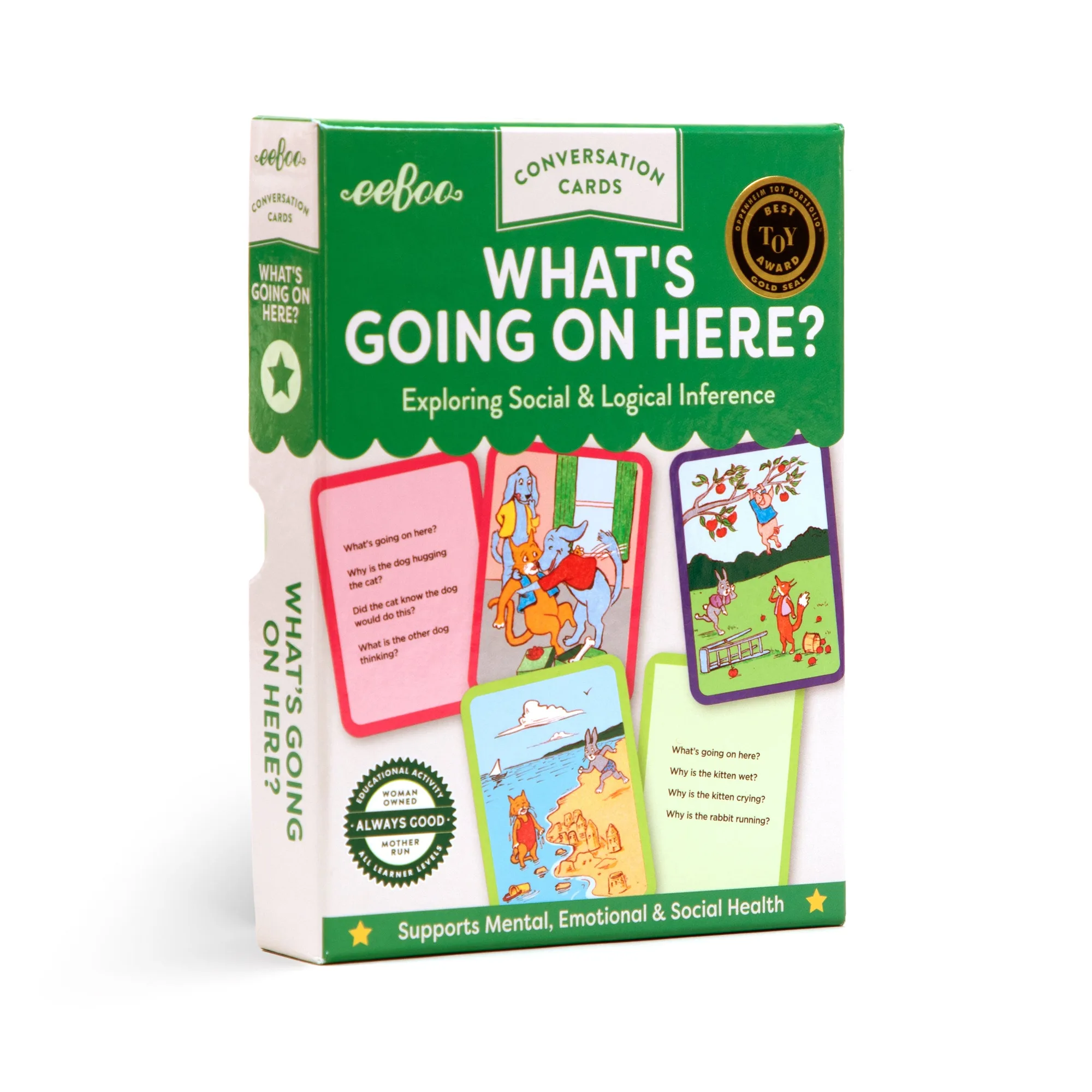
What's Going On Here? Conversation Cards