Quick answer
Use book club conversation cards as a structured yet flexible tool to guide discussion, ensuring every member has a chance to share and the conversation goes beyond surface-level opinions.
Why conversation cards work for book clubs
A good book club discussion often hinges on asking the right questions. Conversation cards provide a ready-made set of prompts that cover different aspects of a book—like characters, plot, setting, and themes—so you don't have to think up questions on the spot.
Cards also level the playing field. When discussion relies on whoever speaks first, the same voices tend to dominate. Drawing a card gives every member a turn to respond, which can draw out quieter readers and keep the conversation balanced.
Choosing the right card set
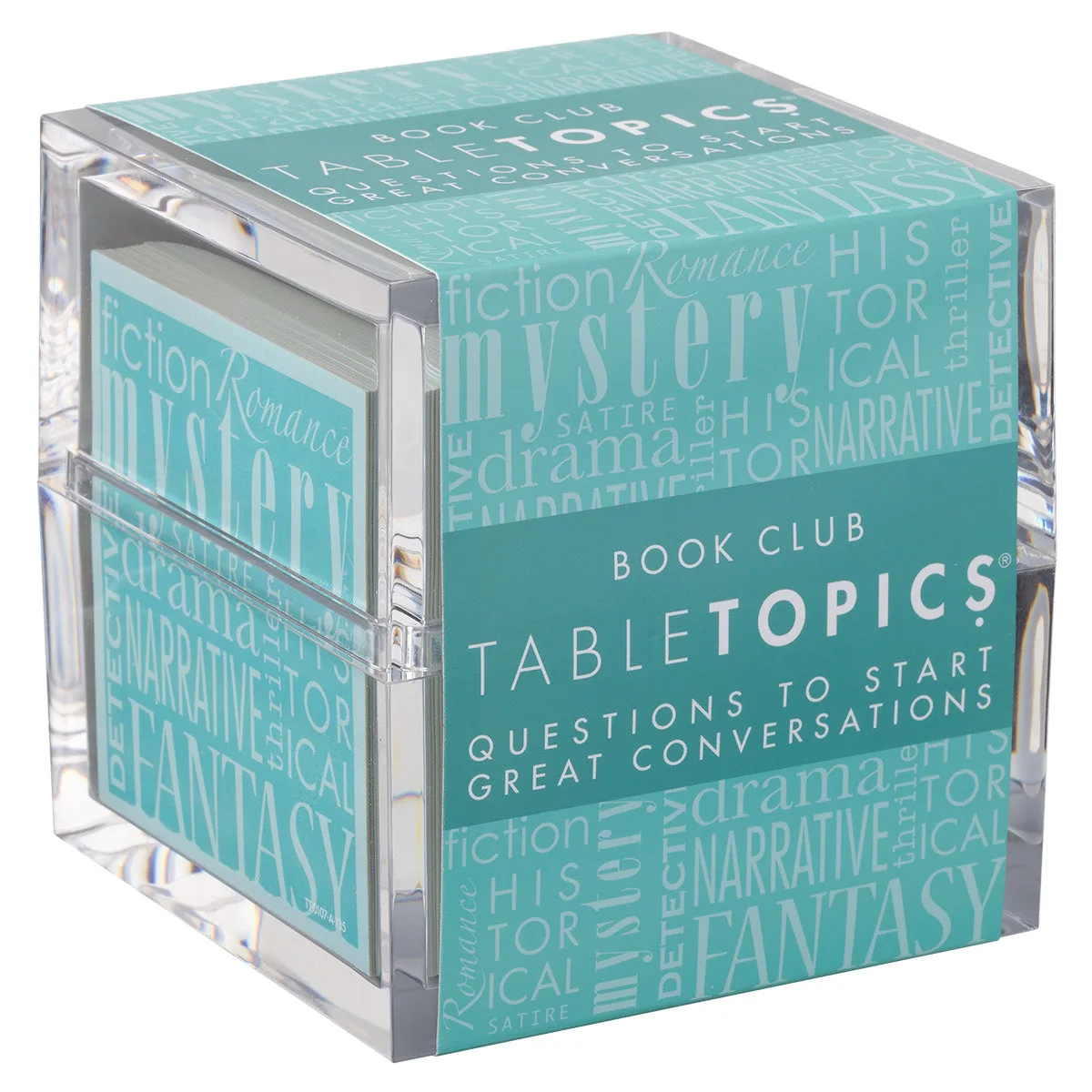
Not all conversation cards are the same. Some are designed for general social settings, while others are tailored for book discussions. If you want prompts that specifically explore writing style, characters, and themes, look for a set like TableTopics® Book Club, which includes 135 open-ended questions about these exact topics.
Consider the size of your group and how often you meet. A larger card set gives you more variety across meetings, so you won't repeat questions too soon. If your club reads across genres, a general literature-focused set will serve you better than one tied to a specific genre.
How to weave conversation cards into your book club meeting
- Set the stage: At the start of the meeting, explain that you'll use conversation cards to guide part of the discussion. Place the deck in the center of the table or pass it around. This sets a clear expectation that everyone will have a turn to draw and respond. Checkpoint: Make sure members know they can pass if they're not ready to answer, but encourage them to try.
- Draw and respond: Go around the circle. Each member draws a card, reads the question aloud, and gives their answer. This ensures everyone participates and gives quieter members a structured chance to speak. Checkpoint: If someone draws a question that feels too similar to a previous one, allow a redraw to keep the discussion fresh.
- Let the conversation flow: After a member answers, open the floor for others to react or add their own thoughts before moving to the next card. This turns a simple Q&A into a real discussion and lets related ideas surface naturally. Checkpoint: Don't rush to the next card if the group is engaged. The goal is depth, not covering every card.
- Use cards to fill gaps: If the discussion stalls or stays too surface-level, pull a card that targets a specific element like theme or character motivation. Use it to steer the conversation back to deeper analysis. Checkpoint: Keep the deck handy even during free-form discussion so you can pull a prompt when the energy dips.
- Wrap up with reflection: In the last few minutes, ask each member to share one new insight they gained from the discussion—or one question they still have. This solidifies the takeaways and gives a natural ending to the meeting. Checkpoint: Jot down any unresolved questions to revisit at the next meeting or in your club's online forum.
A card set worth considering
-
Book Club Conversation Cards: TableTopics® Book Club includes 135 thought-provoking questions about writing style, characters, plot, setting, themes, and so much more. With 135 prompts, you can rotate questions across many meetings without repeating, and the coverage of different story elements helps you lead a well-rounded discussion.
Book Club Conversation Cards