Quick Answer
Use Discovery Circles as versatile open-ended toys: let your child stack, balance, sort, and create patterns with the durable pieces, and combine them with light tables, loose parts, or blocks for extended play.
Why Open-Ended Play Matters
Open-ended play lets children lead the activity, which builds creativity, problem-solving, and confidence. Discovery Circles are especially good for this because the pieces have no single 'right' way to be used—they can be stacked, nested, laid flat, or combined with other toys.
Because the set is designed for ages 2 and up, it grows with your child: a two-year-old might just stack two or three pieces, while a preschooler can create complex patterns or use the circles as part of a pretend-play scene.
Trade-Offs to Keep in Mind
Discovery Circles are durable for indoor and outdoor use, but they are not tiny pieces—so they are not ideal for very young infants who mouth toys. Always supervise children under 3 to ensure safe play.
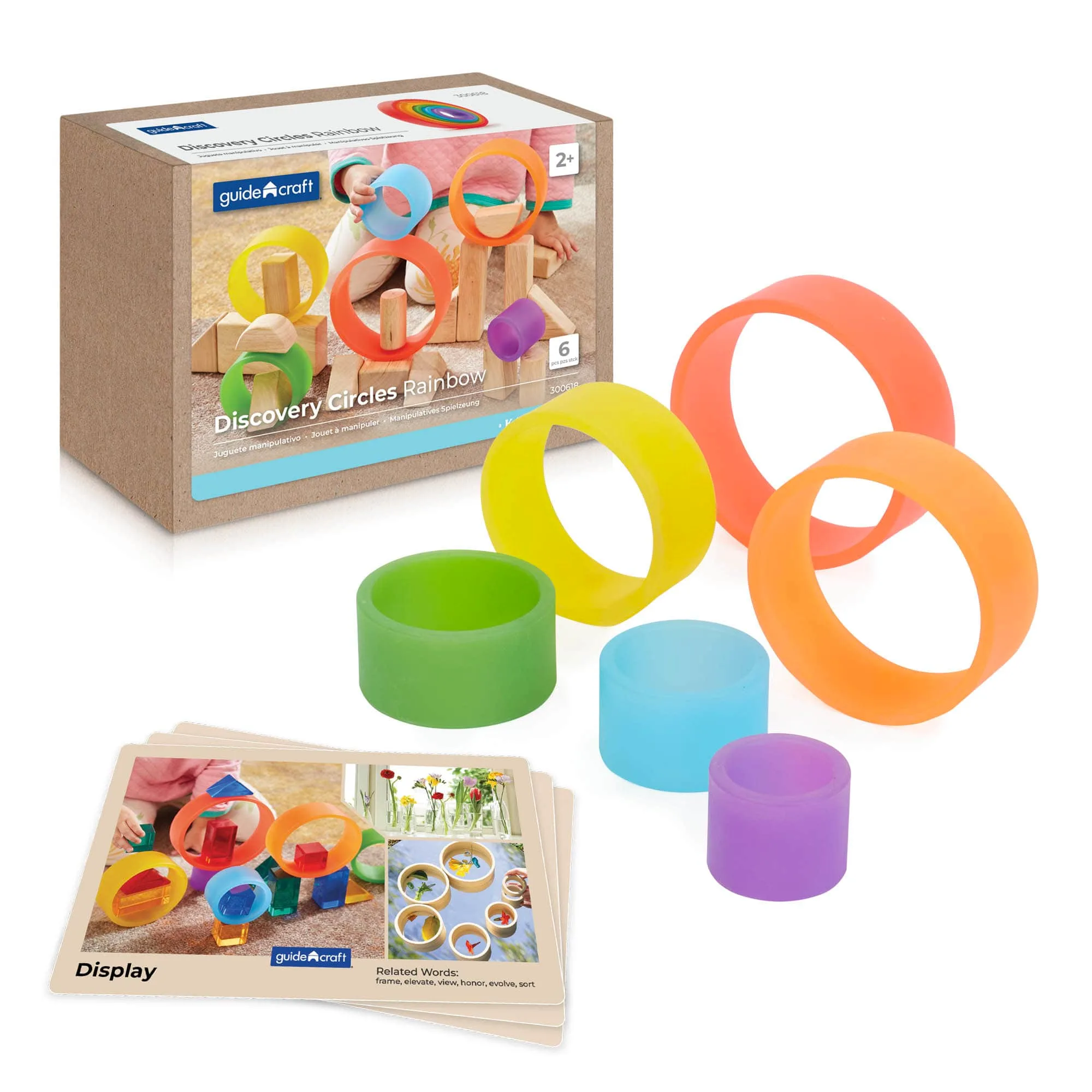
The set includes multiple colors and sizes, but the exact number of pieces is not specified in the catalog. If you need a precise piece count for a specific activity, check the product packaging or contact the store before purchasing.
5 Steps to Start Open-Ended Play with Discovery Circles
- Start with Free Stacking and Nesting: Place the circles on a flat surface and let your child stack them in any order—largest to smallest, or mixed. Show them how to nest the circles inside each other, then let them experiment. Avoid correcting their order; the goal is exploration. If your child gets frustrated when a tower falls, sit with them and rebuild together, turning the 'mistake' into a learning moment about balance.
- Add Sorting and Color Matching: Ask your child to sort the circles by color or size, or match them to objects around the room (e.g., 'find something red like this circle'). This builds early math and categorization skills. For younger toddlers, start with just two colors to avoid overwhelm. Check that your child can name at least one color before starting; if not, focus on size sorting first.
- Introduce Pattern Making: Lay the circles flat on the floor or a table and create simple patterns (red, blue, red, blue). Ask your child to continue the pattern or create their own. This supports preschool STEM learning by introducing sequencing and logic. If patterns are too hard, try a simple 'big, small, big, small' pattern instead of colors.
- Combine with Light Play: Place the circles on a light table or a sunny windowsill to explore shadows and color mixing. The translucent or bright colors (if applicable) will create interesting effects. If you don't have a light table, use a flashlight in a dim room. For a mess-free sensory activity, place a white sheet over a floor lamp and lay the circles on top—always supervise electrical items.
- Use as Loose Parts in Pretend Play: Add the circles to a play kitchen, block area, or sandbox. They can become plates, wheels, stepping stones, or parts of a building. Encourage your child to decide what they want to be—this is the essence of open-ended play. Rotate the circles with other loose parts (e.g., fabric scraps, pinecones) every few weeks to keep the play fresh and extend the toy's lifespan.
About Discovery Circles
-
Discovery Circles: The Discovery Circles – Rainbow set is an upgrade from the classic nesting toy, with extremely resilient and durable pieces that enhance open-ended play indoors and outdoors. The durable construction means you can use the pieces on a patio, in a sandbox, or on a light table without worrying about damage, making them a versatile addition to your toy collection.
Discovery Circles