Quick answer
To use the hands-free bungee belt for running, adjust it snugly around your waist, attach the leash to the belt’s D-ring, and practice a few short runs before hitting the trail.
Why a bungee belt helps your run
A hands-free bungee belt transfers the pulling force from your arm to your core, reducing arm fatigue and letting you maintain a natural running stride. The elastic bungee absorbs sudden pulls, making sudden dog detours less jarring for both of you. It’s ideal for runners who want to keep their hands free for water bottles, phones, or adjusting gear.
Trade-off: Not for training reactive dogs
If your dog pulls hard or lunges at other dogs, the bungee’s give may make corrective leash handling less precise. For training loose-leash walking, a standard short leash is more effective. Save the bungee belt for steady running partners who have reliable recall.
Step-by-step: Using your hands-free bungee belt
- Step 1: Fit the belt snugly at your waist: Put the belt on over your waist (not hips) and tighten it so it doesn’t slide up or down while you move. Aim for a snug fit—you should be able to slide two fingers under the belt, not more. Common mistake: Wearing it too loose can cause chafing or let the belt rotate, making the leash tangle around your legs. A too-loose belt feels comfortable at first but quickly becomes annoying on a run.
- Step 2: Connect the leash to the belt’s D-ring: Clip the leash carabiner to the reinforced D-ring on the front of the belt. Double-check that the carabiner is fully closed and locked. Common mistake: Clipping the leash to a side loop or belt loop instead can cause unbalanced pulling and strain on the belt’s stitching. Always use the designated D-ring—never a belt loop or accessory attachment.
- Step 3: Adjust leash length and check the bungee: For running, keep the leash short enough that your dog stays beside or slightly ahead—about 4–5 feet is typical. The bungee section should have a little slack before it tensions. Common mistake: Leaving too much slack can let your dog cross in front of you, risking a trip; too little slack removes the bungee’s shock-absorbing benefit. The bungee should compress slightly when your dog pulls ahead, but not be fully stretched at a trot.
- Step 4: Practice at a walk before running: Walk a few minutes with the belt and leash to let your dog get used to the feeling of the bungee pull around your waist. Give calm verbal cues and treats for staying in position. Common mistake: Jogging immediately can confuse or overexcite a dog that isn’t familiar with the belt’s bounce and pull, leading to weaving or sudden stops. A short walk warm-up signals to your dog that the belt means running together, not playtime.
- Step 5: Start running and monitor your dog’s pace: Begin with a slow jog and gradually increase speed. Keep the leash hand-free by tucking your thumbs into the belt loops or your pockets. Watch for signs of overexertion—heavy panting, lagging, or pulling sideways. Common mistake: Letting the dog pull constantly against the bungee can teach pulling behavior; use voice corrections to discourage it. If your dog pulls continuously, slow down and redirect—the bungee isn’t a training tool for pulling.
- Step 6: Disconnect and store the belt after use: Unclip the leash and wipe the belt with a damp cloth to remove sweat and dirt. Let it air dry away from direct heat. Common mistake: Leaving the belt bunched up in a gym bag while still damp can promote mildew and reduce the elastic’s lifespan. Quick post-run care keeps the belt weather-resistant and ready for your next outing.
Mightypaw product in this guide
-
Hands-Free Bungee Belt: Made from high-quality materials that withstand the stress of active use and is weather-resistant. This means the belt stays durable and comfortable during sweaty runs or rainy hikes, so you don’t have to worry about gear failure mid-stride.
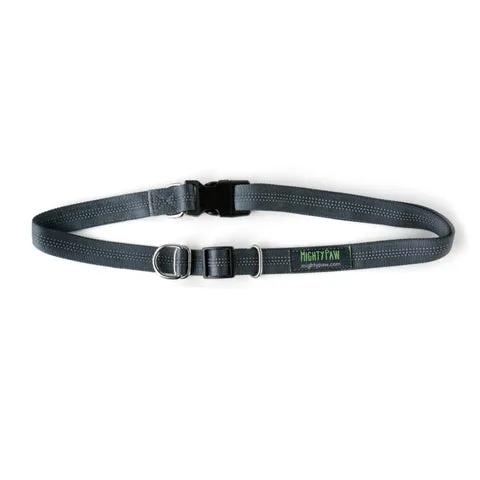
Hands-Free Bungee Belt