Quick answer
Use the Lander harness for hiking by fitting it snugly, adjusting the straps for trail movement, and attaching modular add-ons for gear or hydration. This crash-tested harness transitions from car to trail without re-adjustment.
Why the Lander works on trail
The Lander harness is built to move from backseat to backcountry. It holds over 3,300 lb of force, so it stays secure on uneven terrain. The modular add-ons let you attach a leash, ID, or small pack without buying separate gear.
Because it is crash-tested for car travel, you can leave it on your dog during the drive and step straight onto the trail. The same fit works for both environments, saving time and reducing stress for your dog.
What to watch for on the trail
The Lander is light enough for all-day wear, but check the chest strap after long descents or water crossings. Moisture and friction can loosen the fit slightly. A quick tug test every hour keeps everything secure.
If your dog pulls hard on leash, the front attachment point gives you better steering control. Use the back D-ring for casual walking or when your dog is off-leash and you just need a handle.
How to use the Lander harness for hiking
- Fit the harness before you leave: Put the Lander on your dog while they are standing. Adjust the chest and belly straps so two fingers fit flat under each strap. The harness should not shift when you tug the D-ring. Common mistake: fitting the harness while your dog is lying down, which leads to a loose fit on the trail.
- Attach your leash and modular add-ons: Clip the leash to the front ring for better control on steep sections, or to the back ring for casual walking. Add a patch or ID sleeve using the Velcro panel. If your harness has a small pouch, attach it now. Check that add-ons are secure before stepping onto the trail. A loose patch can snag on branches.
- Do a quick trail check after 10 minutes: Stop after the first 10 minutes of hiking. Slide two fingers under the chest and belly straps. If they feel tighter or looser than at the start, adjust the straps. Repeat this check after water crossings or steep climbs. A harness that fits well at the trailhead can loosen as your dog moves. A quick mid-hike check prevents chafing.
- Clean the harness after muddy or wet hikes: Rinse the Lander with fresh water and hang it to dry. Do not machine wash or use harsh detergents. Remove any add-ons before cleaning. Dirt and salt can weaken webbing over time. A simple rinse keeps the harness trail-ready.
Product facts
-
Lander™ harness: Crash-tested and holds over 3,300 lb of force. You can drive to the trailhead with the harness on, then hike without re-adjusting — one less step before your walk.
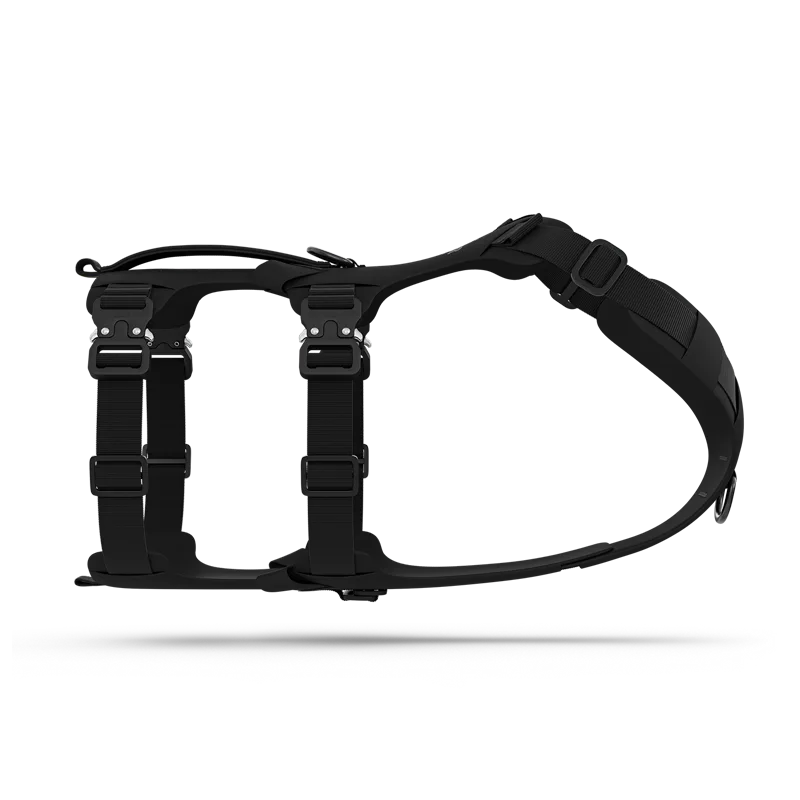
Lander™ harness
-
Lander™ harness: Adapts fast with modular add-ons. Attach a patch, ID, or small pouch directly to the harness instead of using a separate collar or pack.