Quick answer
Use the latches activity board as a short, supervised practical life activity: model one latch, hand it over, and let your toddler try. Keep sessions to 5–10 minutes, follow their interest, and stop before frustration. The board’s wooden doors, locks, and surprises build fine motor skills and problem-solving through hands-on play.
Why a latches board fits toddler hands
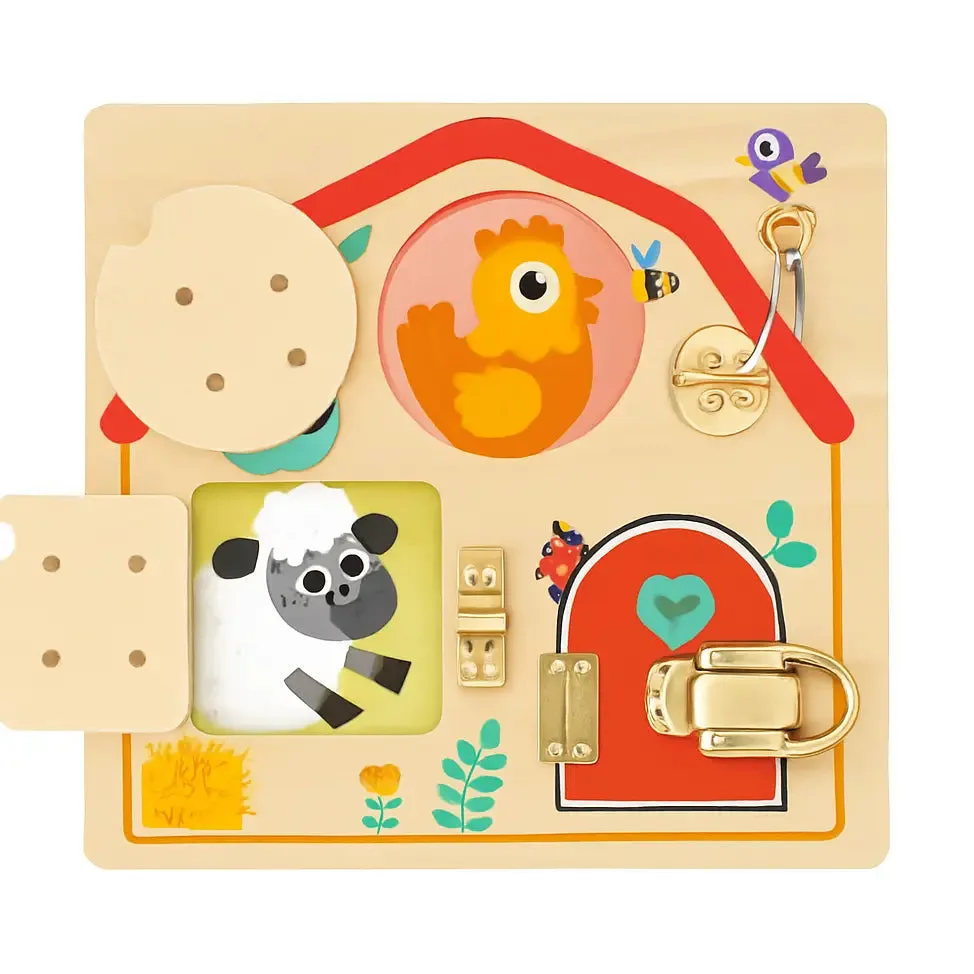
The Latches Activity Board is a wooden board that keeps little hands busy while building fine motor skills and problem-solving abilities. Its 22 × 22 × 0.9 cm (8.66 × 8.66 × 0.35 inch) size sits comfortably on a lap or low table, and the colorful doors, locks, and surprises behind each latch encourage curiosity, coordination, and imaginative exploration. This makes it a natural toddler practical life activity: your child practices real movements—turning, sliding, lifting—that mirror everyday tasks.
Set up the board for success
Before your toddler touches the board, check that all latches move smoothly and that no small parts are loose. Sit at their eye level, either on the floor or at a low table, so they can see your hands and the board clearly. Remove other toys from the immediate area to reduce competition for attention. If your child is new to the board, start with just one or two latches accessible; you can rotate which ones are open or closed to keep novelty high without overwhelming them.
Match the challenge to your child’s stage
Not every latch is equally hard. For a younger toddler, begin with a simple door that lifts or slides. As they gain control, introduce latches that require a twist or a two-step motion. The board itself does not label difficulty, so you will need to test each latch yourself and decide which to present first. If a latch is too stiff for their fingers, skip it for now and revisit in a few weeks—forcing it can turn play into a power struggle.
Step-by-step: using the latches board
- 1. Model one latch slowly: With your toddler watching, open and close a single latch two or three times. Narrate what you are doing: “Push, turn, open.” Keep your movements exaggerated and pause after each action so they can track it. Checkpoint: your child looks at your hands or the latch—if they look away, try again later.
- 2. Hand over with an invitation, not an instruction: Place the board in front of them and say, “Your turn.” Resist the urge to guide their hand. Let them explore the latch in their own way, even if it is not the “correct” motion. Common mistake: correcting their grip too early. Fine motor control develops through repetition, not perfect form.
- 3. Offer one hint if they stall: If they struggle for more than a few seconds, point to the part that moves or gently place your finger on the latch as a visual cue. Avoid doing it for them. Checkpoint: if they push your hand away, they are telling you they want to try alone—step back.
- 4. Celebrate the open, not just the close: When a latch opens, share their surprise: “You found the star!” This links the physical action to a rewarding discovery, which encourages them to try another latch. Common mistake: rushing to close the latch for them. Let them decide when to close it or move on.
- 5. End on a successful latch: Watch for signs of fatigue—dropping the latch, turning away, or fussing. Stop while they are still engaged, even if only one latch was opened. Checkpoint: 5–10 minutes is plenty for a toddler. Short, frequent sessions beat one long one.
Product facts
- Latches Activity Board: The wooden Latches Activity Board keeps little hands busy while building fine motor skills and problem-solving abilities. With colorful doors, locks, and surprises behind each latch, it encourages curiosity, coordination, and imaginative exploration through hands-on play. Size: 22 × 22 × 0.9 cm (8.66 × 8.66 × 0.35 inch). The compact size and mix of latch types make it easy to use as a lap or table activity, and the hidden surprises give toddlers a reason to repeat the movements that strengthen hand muscles.