Quick answer
Fit the martingale collar snugly behind the ears, adjust the control loop so it tightens only a couple of inches, and use gentle leash corrections during walks to discourage pulling.
Why a martingale collar works differently
Unlike a flat buckle collar, a martingale has a loop that tightens evenly around the neck when the dog pulls. This provides gentle feedback without choking, making it a popular choice for training and for dogs with narrow heads that can slip out of standard collars.
When to choose a martingale over a choke chain
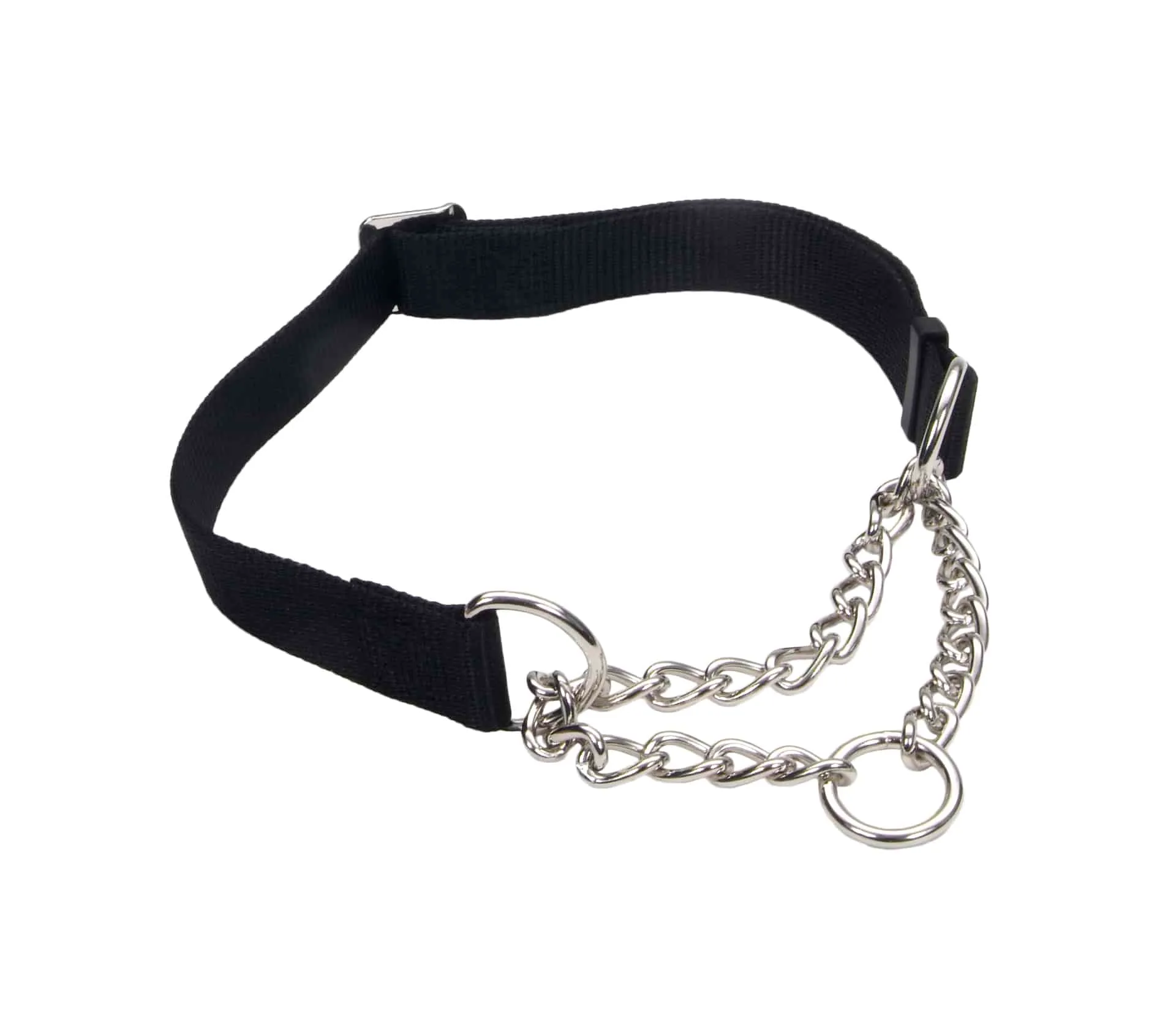
Martingale collars are safer for most pet owners because they have a built-in stop that prevents over-tightening. A check-choke style like the Coastal Check-Choke Martingale Training Collar uses a chain control loop for audible feedback while still limiting pressure.
How to fit and use a martingale collar
- 1. Choose the right size and material: Measure your dog's neck and pick a martingale that fits when the collar is snug but not tight. Nylon webbing is comfortable for everyday wear; a chain control loop adds audible feedback. A collar that is too loose can slip off; one that is too tight can chafe.
- 2. Put the collar on correctly: Slide the collar over your dog's head so the control loop sits on top of the neck, not under the chin. The buckle or clip should be on the side or back. If the control loop hangs under the throat, it can press on the windpipe instead of the sides of the neck.
- 3. Adjust for a proper fit: Tighten the collar so it sits high on the neck, just behind the ears. You should be able to fit one finger between the collar and the neck. The control loop should close no more than 1–2 inches when pulled. A martingale that closes more than 2 inches can become a choke hazard.
- 4. Attach the leash to the control loop: Clip the leash to the metal ring on the control loop, not to the D-ring on the flat portion. This ensures the tightening action works as intended. Leashing to the wrong ring disables the martingale action and defeats the purpose.
- 5. Use gentle, timed corrections: When your dog pulls, give a quick sideways or upward tug and release immediately. The collar should tighten briefly and then loosen. Do not keep constant tension on the leash. Constant pulling defeats the training and can cause discomfort or injury.
- 6. Practice in low-distraction settings first: Start indoors or in a quiet yard so your dog learns the feel of the collar without competing stimuli. Gradually add distractions as your dog responds reliably. Skipping this step can make the collar less effective and frustrate both you and your dog.
Product fact
-
Coastal Check-Choke Martingale Training Collar 3/4″: The Coastal Check-Choke Martingale Training Collar features durable nylon webbing and a chain control loop for gentle training feedback. The chain loop gives an audible click when the dog pulls, helping you time corrections without squeezing the neck too tightly.
Coastal Check-Choke Martingale Training Collar 3/4″