Quick answer
Use Nest and Stack Shapes as a short, guided routine: first let your toddler explore the pieces freely, then model one math idea at a time, such as sorting by color, ordering by size, matching a shape to its space, and counting during cleanup. Keep sessions to 5-10 minutes and stop while your child is still interested.
Why this toy works for early math
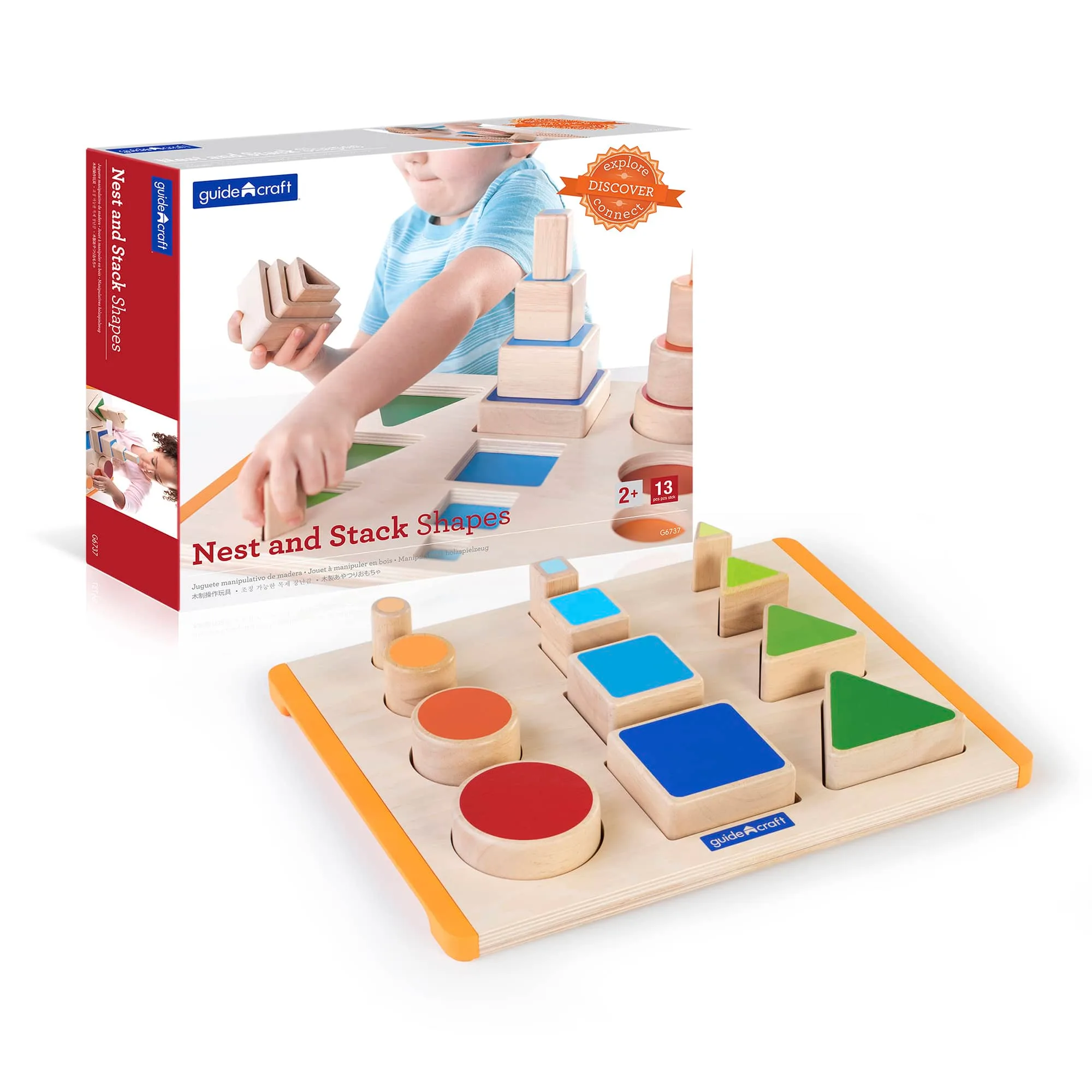
Nest and Stack Shapes combines two classic toddler activities: nesting blocks and a shape-matching puzzle board. That dual format lets you teach the same early math ideas in more than one way, which matters because toddlers often understand a concept physically before they can talk about it.
The birch plywood puzzle board gives children a defined space to match pieces, while the stackable blocks let them build vertically. You can move between the two modes as your child's attention shifts.
What to expect at different ages
With younger toddlers, focus on free exploration, carrying pieces, and dumping them out. Around age two, many children begin to sort by one attribute, usually color. Closer to three, they can often order three or four pieces by size and match shapes to spaces with less help.
If your child loses interest, drop back to free play. The goal is repeated, low-pressure exposure, not mastery in one sitting.
Set up for success
Work on a low, stable surface such as a floor mat or toddler table. Keep the pieces in a shallow basket or tray so your child can see the options without dumping everything at once.
Because the activity board is sanded smooth and has soft plastic handles, it is easy for small hands to carry. Check the pieces periodically for wear, and wipe them with a damp cloth rather than soaking the wood.
A 5-step math routine with Nest and Stack Shapes
- Start with free exploration: Place the board and blocks in front of your toddler and let them handle, stack, and nest the pieces without direction for a few minutes. Narrate what they do: 'You put the red block on top.' Common mistake: jumping straight into a lesson. Free play warms up attention and shows you what your child already notices.
- Sort by one attribute: Choose either color or size, not both. Ask your child to put all the red pieces in one pile, or all the big pieces in another. Keep the language simple and repeat the attribute word often. Checkpoint: if your child mixes attributes, switch to just two or three pieces and sort together hand-over-hand.
- Order three pieces by size: Lay out three pieces of clearly different sizes and ask your child to line them up from smallest to biggest. Model it once, then let them try. Add a fourth piece only when three is easy. Common mistake: using pieces that are too similar in size. Toddlers need obvious differences to see the pattern.
- Match shapes to the board: Give your child one piece at a time and point to the board. Ask, 'Where does this one go?' Let them try rotating the piece before you help. Name the shape as they place it. Checkpoint: if your child gets frustrated, remove all but two pieces so the choice is simpler.
- Count during cleanup: As you put pieces back in the basket, count them out loud together. Touch each piece as you say the number. Stop at three or five for younger toddlers. Common mistake: counting too fast. Slow down so your child can hear one number for each piece.
Product facts
-
Nest and Stack Shapes: Nest and Stack Shapes includes colorful stackable blocks and a birch plywood puzzle board with corresponding spaces. The board turns shape matching into a self-checking activity, so toddlers can see whether a piece fits without an adult correcting them.
Nest and Stack Shapes
-
Nest and Stack Shapes: The activity board is sanded smooth and reinforced with soft plastic handles. Smooth edges and handles make it practical for toddlers to carry the board to a play space and set it down independently.
-
Nest and Stack Shapes: The set is designed to encourage color and size seriation, spatial thinking, and fine-motor skills. Those are the same foundational skills that support later counting, comparing, and pattern recognition.