Quick answer
Seatbelt webbing makes strong, lightweight bag straps. Use polypropylene webbing like the Turquoise Seatbelt Webbing, cut to length, and attach your hardware with a simple fold-and-stitch method.
Why seatbelt webbing works for bag straps
Seatbelt webbing is woven polypropylene, which is strong, lightweight, and resists fraying when cut cleanly. Its 0.9 mm thickness is easy to sew on a home machine, and the smooth surface slides through hardware without snagging. The Turquoise Seatbelt Webbing comes in three widths (0.5", 1", 1.5"), so you can choose the right scale for your bag size.
Choosing the right width
Wider webbing (1.5") makes comfortable shoulder straps for totes and backpacks. Narrower webbing (0.5") suits small pouches or trim. The 1" width is a versatile middle ground for crossbody or handbag straps. Match your hardware opening to the webbing width so the strap fits snugly without bunching.
Steps to sew seatbelt webbing into bag straps
- Cut the webbing to length: Measure your desired strap length plus 4 inches for seam allowance and hardware folds. Use a hot knife or soldering iron to cut the webbing; this melts the cut edge and prevents fraying. Common mistake: cutting with scissors leaves loose threads that unravel over time. Always melt the cut edge with heat to seal it.
- Attach the hardware: Fold one end of the webbing over the hardware bar (e.g., a swivel hook or D-ring) by about 1.5 inches. Stitch across the fold close to the hardware, then stitch again 0.5 inches from the first line. Use a heavy-duty needle (size 90/14 or 100/16) and polyester thread. Common mistake: using a single line of stitches; the strap may slip through hardware under load. Two parallel stitch lines add security.
- Sew the strap body: If you want a flat strap, sew a straight line down the center of the webbing for a decorative effect. For a tubular strap, fold the webbing lengthwise and stitch the long edge closed. Common mistake: sewing too close to the edge on tubular straps, which causes the seam to pop when the strap is stressed. Leave at least 1/4 inch seam allowance on folded straps.
- Finish the strap ends: Fold the raw end under 1 inch and stitch across to create a clean finish. If your bag has adjustable straps, attach a slider and adjuster before finishing the second end. Common mistake: forgetting to slide the hardware onto the webbing before stitching the end closed. Check hardware order before final stitching.
Product facts
-
Turquoise Seatbelt Webbing (Precut 3 Yards): 0.5", 1”, 1.5”: Turquoise seatbelt webbing, precut in 3-yard increments, available in 0.5", 1", and 1.5" widths, 0.9 mm thick. The precut lengths save measuring time, and the 0.9 mm thickness sews easily on a standard machine without special needles or feet.
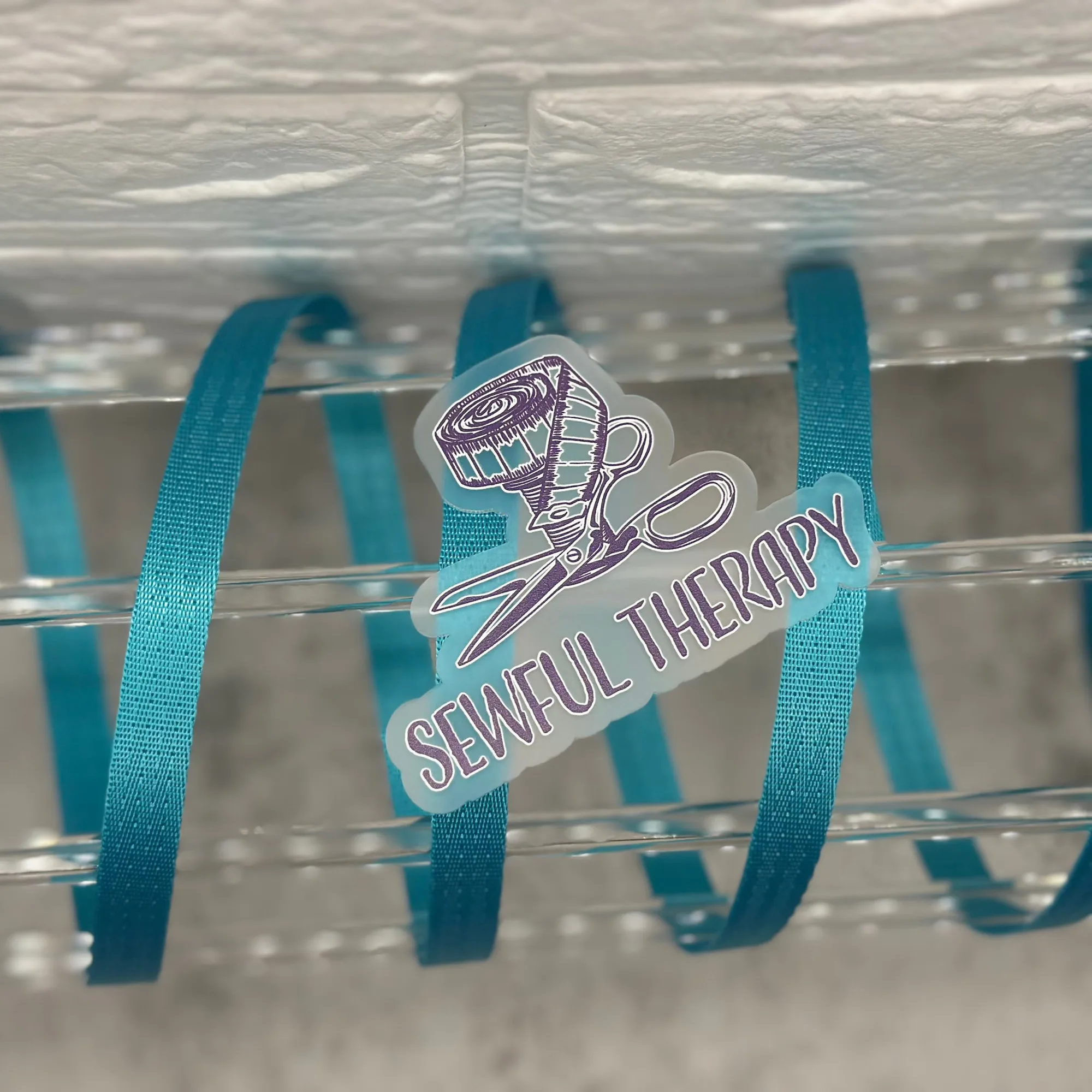
Turquoise Seatbelt Webbing (Precut 3 Yards): 0.5", 1”, 1.5”
