Quick answer
Tamiya Pla Paper is a 0.05mm flexible plastic sheet that you can cut with scissors, bend, cement, and paint just like paper. Use it to add custom panels, vents, or small structural details to your model kit without specialized tools.
Why 0.05mm thickness matters for detailing
Most plastic sheets sold for modeling are 0.3mm or thicker, which requires a hobby knife and multiple passes to cut cleanly. Tamiya Pla Paper at 0.05mm is thin enough to cut with ordinary scissors, making it ideal for small, curved, or intricate shapes that would be difficult to carve from thicker stock.
The trade-off is rigidity: 0.05mm plastic bends easily and may not hold a flat shape on its own over large spans. For structural parts like armor plates or mounting brackets, you will need to laminate layers or reinforce the back with thicker plastic.
Step-by-step: Detailing with Tamiya Pla Paper
- 1. Transfer your pattern: Place the Pla Paper over your reference drawing or template and trace the outline with a ballpoint pen or pencil. The plastic accepts pen marks easily, and the indentation gives you a cutting guide. Common mistake: pressing too hard can tear the thin sheet. Use light pressure and a fresh pen tip.
- 2. Cut the shape: Use sharp scissors to follow your traced line. For tight curves, make short, angled cuts instead of one long sweep. The material trims cleanly without cracking. Checkpoint: test-fit the piece against the kit surface before gluing. Trim any excess with scissors or a fine file.
- 3. Bend or curve the part: For gentle curves, roll the sheet around a pencil or round handle. For sharper bends, score the back side lightly with a hobby knife, then fold. The plastic holds creases well. Common mistake: scoring too deep cuts through the material. Score only enough to leave a visible line.
- 4. Cement the part in place: Apply a thin layer of plastic model cement to the kit surface and press the Pla Paper piece onto it. Hold for 10–15 seconds. The cement bonds chemically, just like with regular styrene. Checkpoint: avoid using super glue — it can fog the thin plastic and create brittle joints. Stick with styrene cement.
- 5. Paint and finish: Prime the part with a thin coat of acrylic primer, then paint with your usual model paints. Because the sheet is only 0.05mm, multiple heavy coats may warp it — spray in light passes. Common mistake: skipping primer causes paint to peel off the smooth plastic surface. Always prime first.
Product used in this guide
-
Tamiya Pla Paper 0.05mm B4 (4 Sheets) (69948): This 0.05mm plastic sheet behaves like water-resistant paper: it can be cut with scissors and is safe with plastic model cements and paints such as Tamiya Color products. You do not need a hobby knife or special adhesives — standard model cement and acrylic paints work, which lowers the entry barrier for custom detailing.
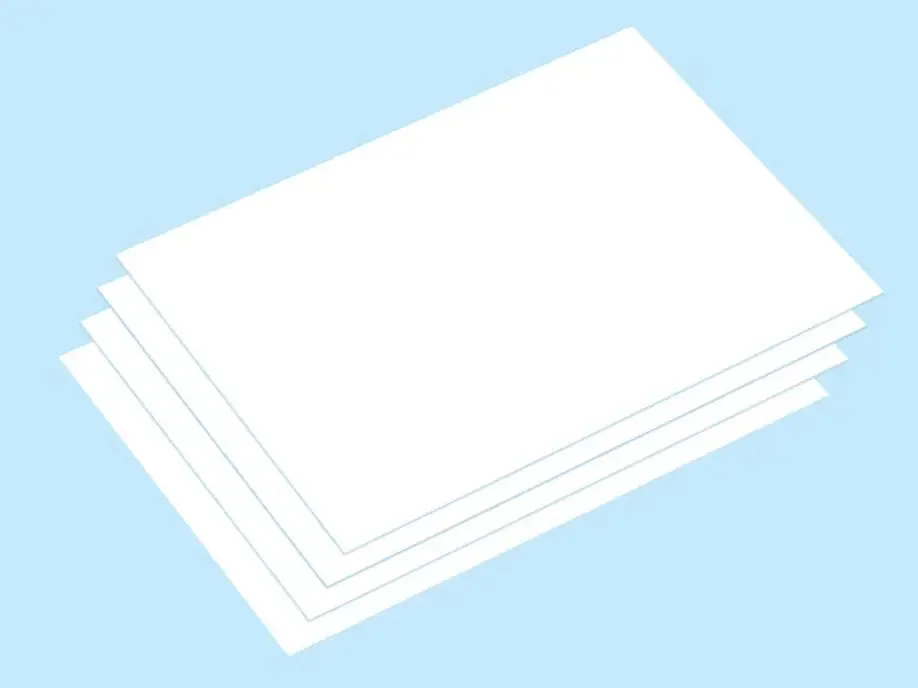
Tamiya Pla Paper 0.05mm B4 (4 Sheets) (69948)