Quick answer
Start by letting your baby explore one instrument at a time during supervised floor play. Use simple sound games to build rhythm awareness and fine motor control.
Why start with one instrument at a time
Babies under 12 months can easily become overwhelmed by too many sounds and textures at once. Offering one piece from the set lets your child focus on the shape, weight, and sound of that single instrument. This supports the Montessori principle of isolation of difficulty, helping the brain process one new skill per session.
Trade-off: supervised play is non-negotiable
While the wooden pieces are child-safe, small parts like mallets or shaker ends can become loose with heavy chewing. Always stay within arm's reach during music play. The set is designed for sensory exploration, not as a teether, so redirect mouthing to a safe teether if needed.
How to play with the music instrument set: 5 steps
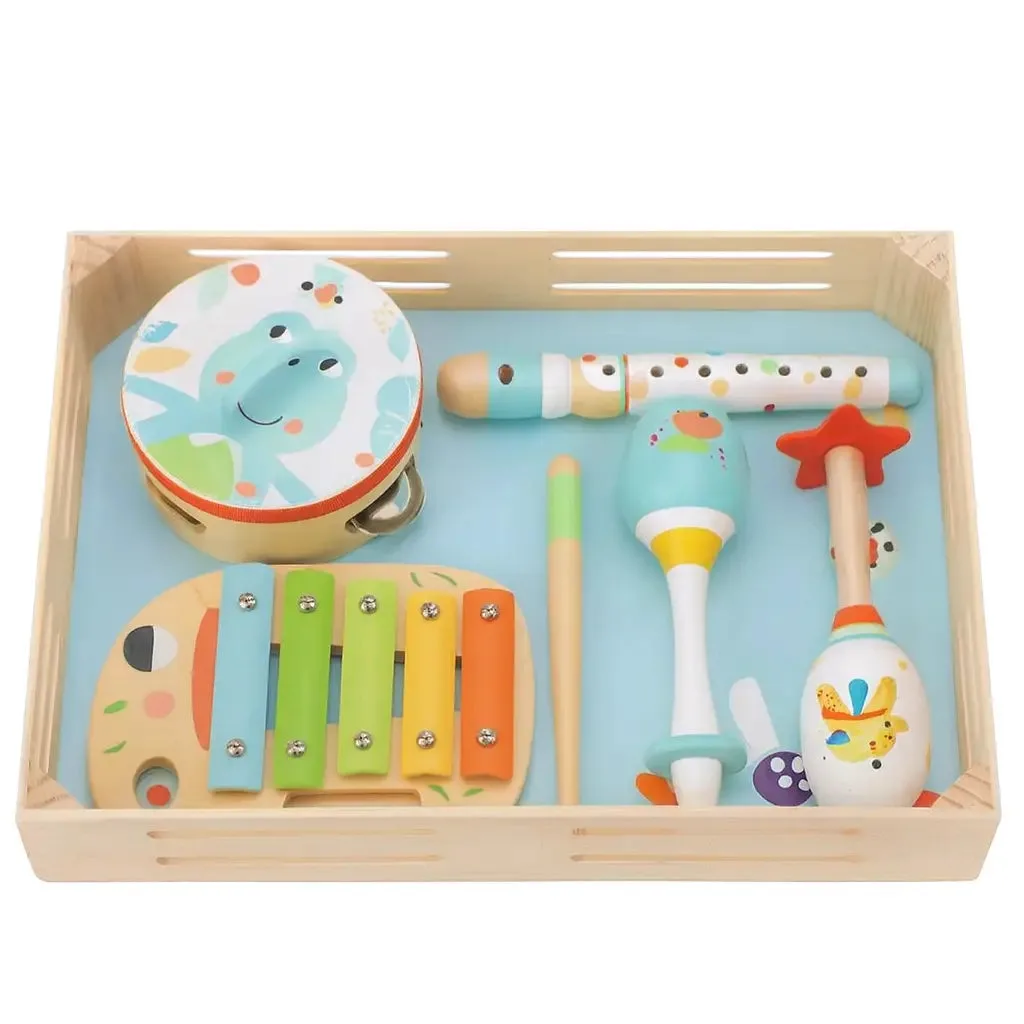
- 1. Introduce one instrument in a calm setting: Choose a quiet time when your baby is alert but not hungry or tired. Place a single instrument (e.g., the shaker egg) on the floor mat and let your baby reach for it. Model a gentle shake, then pause and wait for your baby to imitate. Common mistake: offering all instruments at once. Stick to one per session to avoid overstimulation.
- 2. Name the sound and the action: As your baby shakes or taps the instrument, say a simple word like 'shake' or 'tap'. Repeat it slowly a few times. This links the motor action with language, supporting early vocabulary development.
- 3. Play a call-and-response game: Sit facing your baby. Make a short sound pattern (two shakes, pause, one shake) and then smile expectantly. Wait at least 10 seconds for your baby to respond with any sound. Respond back with a similar pattern. This teaches turn-taking and listening. Common mistake: rushing to fill the silence. Give your baby time to process and respond.
- 4. Add a simple rhythm to a familiar song: Sing a nursery rhyme like 'Twinkle, Twinkle, Little Star' while gently tapping a drum or xylophone in time with the beat. Let your baby hold a shaker and move along. You are building rhythm awareness without forcing any specific motion.
- 5. End with a clean-up routine: After 5–10 minutes of play, sing a short 'all done' song and place the instrument back in its box or basket. Invite your baby to help by handing you the piece. This establishes a predictable transition and teaches respect for materials. Common mistake: leaving instruments scattered. A consistent clean-up ritual helps babies feel secure and ready for the next activity.
Product facts
-
Music Instrument Set: This wooden Music Instrument Set lets little ones explore sound and rhythm through play, featuring child-safe instruments that encourage creativity, coordination, and early music appreciation. The child-safe design means you can focus on the play activity without worrying about harmful materials, even when your baby mouths the instruments briefly.
Music Instrument Set