Quick answer
Use Whirly Squigz by attaching them to any smooth surface and guiding your child through simple spinning, pulling, and placement activities that build hand strength and coordination.
Why Whirly Squigz work for fine motor development
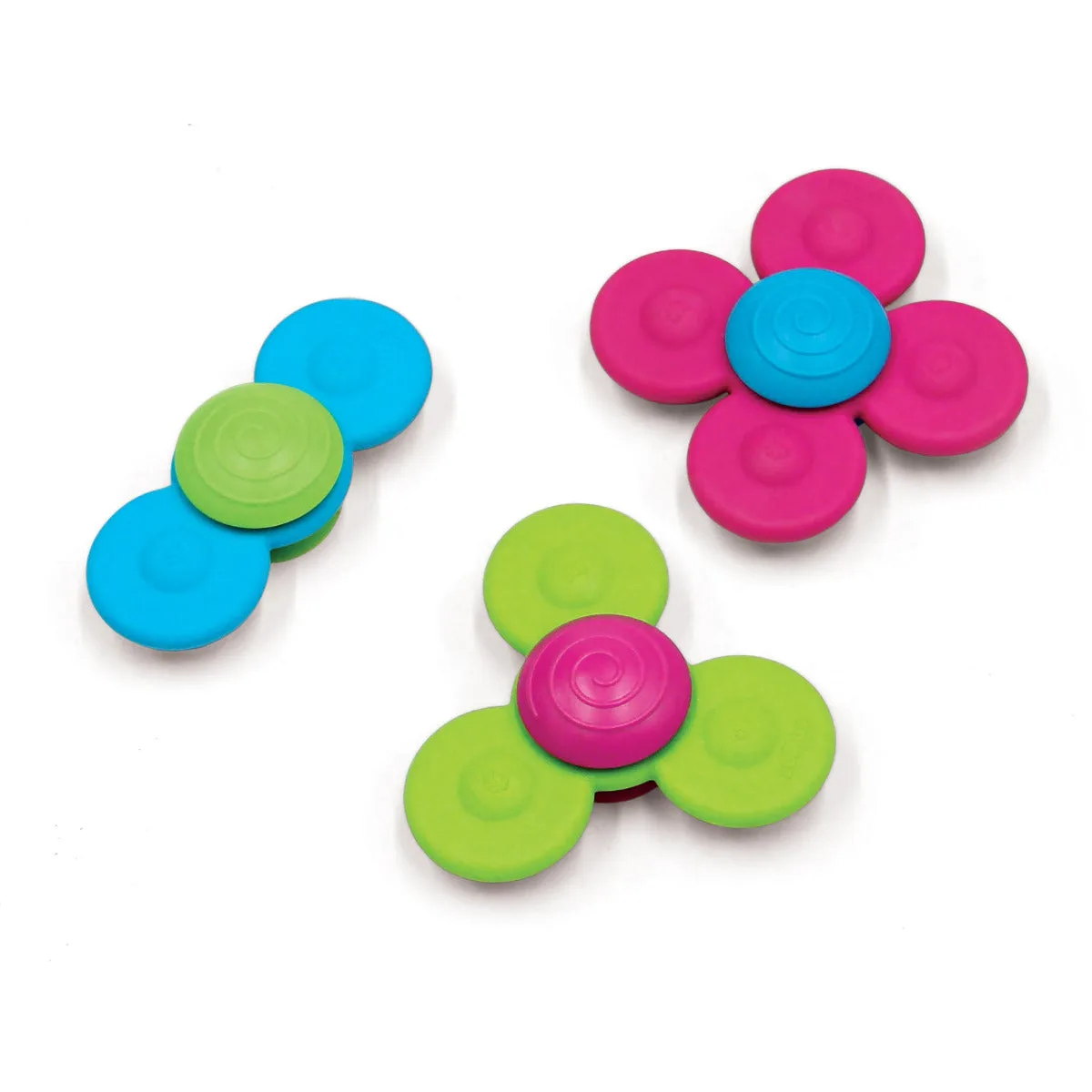
Whirly Squigz combine suction and spinning in a way that naturally challenges small hand muscles. The soft silicone body is easy to grip, even for children with low motor control, and the quiet spin provides calming sensory feedback. Because they stick to surfaces like tables, windows, or bathtubs, kids must use a pincer grasp or whole-hand squeeze to attach and remove them, which directly strengthens the same muscles needed for writing, buttoning, and using utensils.
Choosing the right surface and setting
Whirly Squigz work best on non-porous smooth surfaces: a high chair tray, a plastic placemat, a window, or the side of a bathtub. Avoid textured or painted surfaces where the suction may not hold. For on-the-go calm, try sticking one to a car window or restaurant table. The quiet spinning means they won't distract others, making them a practical choice for waiting rooms or shared spaces.
How to play with Whirly Squigz: step-by-step
- Step 1: Attach to a smooth surface: Press the suction cup end firmly onto a clean, smooth surface. Push down until you feel the seal lock. A common mistake is pressing too lightly; the toy will fall off if not fully sealed. Check that the suction cup is flat and free of dust or moisture for the strongest hold.
- Step 2: Demonstrate the spin: Give the top of the Whirly Squigz a gentle flick or twist with your fingers. Show your child how the spinner rotates quietly. Avoid over-spinning, which can cause the toy to detach. Start with slow spins so your child can see the motion and feel confident copying it.
- Step 3: Practice pulling off: Ask your child to grip the body of the Squigz and pull it away from the surface. This builds hand strength and coordination. A common mistake is pulling at an angle, which breaks the suction early and reduces the effort needed. Encourage a straight pull directly away from the surface to maximize the muscle work.
- Step 4: Create a pattern or sequence: Attach multiple Whirly Squigz in a row or circle. Have your child spin each one in order or remove them one by one. This adds a sequencing and attention component. Avoid making the pattern too complex at first; start with 2–3 toys. Use the pattern to practice left-to-right directionality, a pre-reading skill.
- Step 5: Incorporate into a calming routine: Use Whirly Squigz during transitions or before bed. The repetitive spin-and-pull motion can help regulate an overwhelmed child. A common mistake is treating it only as a high-energy game; the quiet spin is equally useful for winding down. Pair the activity with deep breathing or a soft timer to signal the end of play.
Product details
-
Whirly Squigz: Whirly Squigz are quiet spinners that are easy to grip and spin for those with low motor control. They suction to any smooth surface. This means a child with limited hand strength can still participate in fine motor play and get the calming sensory input they need without frustration.
Whirly Squigz