Quick answer
Digging almost always comes from tension, not size. Put the leg strap on first, set it so one finger slides under the elastic without lifting it off the skin, then attach and adjust your hosiery last. If it still bites, widen the elastic rather than loosening the strap, because a wide strap spreads pressure while a loose one slides and rubs.
Why a leg strap digs when the size is right
A suspender leg strap is a narrow band under load, so pressure concentrates along one line of your thigh. Two things make that line painful: over-tightening to stop slipping, and hosiery that pulls the strap upward into a crease. A correctly fitted strap sits flat, stays roughly parallel to the floor, and only tightens when you move.
Elastic relaxes with body heat and movement, so the tension you set standing still in a cool room will feel tighter ten minutes later. Set it slightly looser than feels secure at first, then check it after you have walked around.
Match the strap to what you are wearing underneath
Leg straps behave differently over bare skin, hosiery and a bodysuit. Over bare skin they grip best but can drag; over smooth hosiery they slide unless the elastic is wide or textured; over a bodysuit the fabric adds a layer that changes where the strap sits. Decide your base layer before you adjust anything, because changing it later means starting over.
If you are building a full look, a non-wired stretch lace body such as the Scantilly Opulence Multiway Stretch Lace Body in Black gives you a smooth, lightweight base with lace panels, so the leg strap has a consistent surface to sit on rather than shifting between skin and fabric edges.
Placement: where the strap should actually sit
The strap belongs on the fullest part of your upper thigh, not in the crease where thigh meets hip. Sitting it in the crease lets it roll and pinch every time you sit down. Sitting it too low on the thigh makes it slide toward the knee.
Walk a few steps, sit down and stand up before you finalize anything. If the strap has moved more than a finger's width, relocate it rather than tightening it.
Adjusting a fully adjustable strap correctly
Fully adjustable stretch elastic means you control the circumference, so adjust in small increments and check after each one. Loosen the strap, put it on, then tighten only until it stops sliding. Fasten hosiery to the suspender clips last, because attaching hosiery first pulls the strap out of position while you are still adjusting it.
Rose gold hardware accents and decorative straps are designed to be seen as well as worn, so there is no need to hide the strap under a tight hem. A visible strap that sits flat looks intentional; one that is overtightened to disappear under fabric usually leaves a mark.
When the strap still digs in
If you have followed the steps and it still bites, the problem is usually strap width or hosiery tension, not the leg strap itself. A wider elastic spreads the same load over more surface. Check that your hosiery is not too short in the leg, because a stretched stocking pulls upward on the clips all day.
Take the strap off at the end of the evening rather than sleeping in it, and give the elastic a rest between wears. Elastic that has been overstretched stays stretched, and a stretched strap no longer holds its position, which pushes you to tighten it further.
Step-by-step: fitting a leg strap so it stays comfortable
- 1. Choose your base layer first: Decide whether you are wearing the strap over bare skin, hosiery or a bodysuit before you adjust anything. Each surface changes how much grip the elastic has. Common mistake: adjusting over bare skin, then pulling hosiery on and wondering why the strap now slides or pinches.
- 2. Loosen the strap completely, then put it on: Open the adjustment to its widest point, step into it, and position it on the fullest part of your upper thigh, clear of the hip crease. Checkpoint: the strap should sit roughly parallel to the floor, not angled up toward the hip.
- 3. Tighten in small increments until it stops sliding: Tighten a little, walk a few steps, and repeat. Stop at the point where it holds position, not the point where it feels tight. Common mistake: overtightening straight away to prevent slipping. Elastic relaxes with body heat, so what feels snug now will feel tighter in ten minutes.
- 4. Test one finger of space: Slide one finger under the elastic. It should pass with light resistance and not lift the strap off your skin. If you cannot get a finger under it, loosen by one notch and retest.
- 5. Attach hosiery last: Fasten the suspender clips to your hosiery only after the leg strap is set. Attaching first pulls the strap out of place while you adjust. Checkpoint: hosiery should have a little slack at the clip, not pull upward on the strap.
- 6. Do a sit-stand-walk test: Sit down, stand up and walk across the room. If the strap has moved more than a finger's width, reposition it rather than tightening further. If it rolls in the hip crease, it is sitting too high. Move it down onto the thigh.
- 7. Take it off after wear and let the elastic rest: Remove the leg strap at the end of the evening and store it flat. Do not sleep in it. Overstretched elastic loses its hold, which pushes you to tighten it more next time and starts the digging cycle again.
Product facts that affect leg strap fit
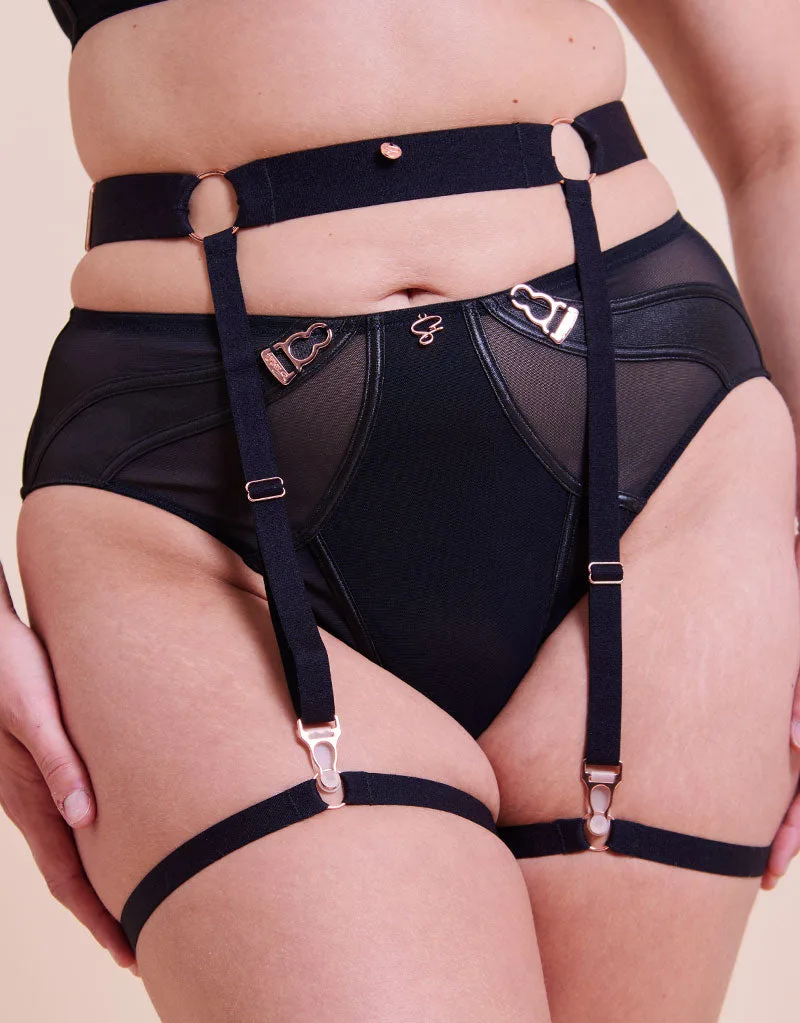
- Scantilly Rules of Distraction Leg Strap Suspender Black: Scantilly Rules of Distraction Leg Strap Suspender Black is a fully adjustable stretch elastic suspender with rose gold hardware accents, designed to wrap around the body. Full adjustability lets you fine-tune circumference in small steps, which is the main control you have over digging. The stretch elastic conforms as you move instead of holding one rigid tension.
- Scantilly Embrace Stretch Lace Teddy Black: Scantilly Embrace Stretch Lace Teddy Black has a stretch microfibre body with lace details, ultra-low cups, non-padded non-wired cups, and fully adjustable 10mm wide straps. A smooth stretch microfibre base gives a leg strap a consistent surface, so it is less likely to catch on seams or shift between skin and fabric. The teddy also works as underwear-as-outerwear, so a visible strap reads as part of the styling.