Quick Answer
To get front-to-back sharpness in a landscape, focus at the hyperfocal distance for your focal length, aperture, and sensor size—not on the farthest detail. Use a hyperfocal chart or app to find that distance, then focus there manually and recompose without changing focus. Pair this with a tripod and a narrow aperture like f/8 to f/11, and check sharpness on the rear LCD by zooming in.
Why Focusing at Infinity Fails
Many photographers focus on the farthest mountain or horizon, assuming everything closer will fall into place. But depth of field extends roughly one-third in front of the focus point and two-thirds behind it. When you focus at infinity, you waste the near half of your available depth of field, and foreground rocks, flowers, or waves turn soft. Hyperfocal focusing shifts the zone of acceptable sharpness forward so it covers from a defined near limit to infinity. That is why landscape photography focus technique matters more than lens sharpness alone.
What You Need Before You Start
You need a camera with manual focus or focus-by-wire override, a lens with a distance scale or an electronic readout, a sturdy tripod, and a way to reference hyperfocal distance—either a printed chart, a mobile app, or a depth-of-field scale on the lens barrel. Know your sensor size (full-frame, APS-C, Micro Four Thirds) and your chosen focal length and aperture. If your lens has no distance scale and your camera does not display focus distance, you can still use the steps below by estimating distance with a rangefinder or by focusing on a specific near object and checking the result.
Step-by-Step Hyperfocal Focusing
1. Set your composition and lock the tripod. 2. Choose an aperture that balances depth of field and diffraction—typically f/8 to f/11 for full-frame, f/5.6 to f/8 for smaller sensors. 3. Look up the hyperfocal distance for your focal length, aperture, and sensor size using a chart or app. 4. Switch to manual focus and turn the focus ring until the distance scale reads that hyperfocal distance. If your lens lacks a scale, focus on an object at that approximate distance, then switch to manual and do not touch the ring. 5. Recompose if needed without changing focus. 6. Use live view magnification to check sharpness at the nearest foreground element and at infinity. 7. Adjust aperture or focus distance slightly if either end is soft, then recheck.
Common Mistakes and How to Avoid Them
The most frequent error is focusing on the nearest foreground object and stopping down to f/16 or f/22, hoping diffraction will not matter. It will—especially on high-resolution sensors. Another mistake is using a hyperfocal distance calculated for a different sensor size or focal length. If you zoom after focusing, the hyperfocal distance changes. Also, do not trust the depth-of-field scale on older lenses; it was often calculated for a lower standard of sharpness than modern sensors reveal. Finally, remember that hyperfocal distance gives acceptable sharpness, not maximum sharpness at every plane. For critical work, focus stacking may be better.
When Hyperfocal Distance Is Not Enough
Hyperfocal focusing is fast and works well for scenes with a clear foreground and distant background. But if your foreground is extremely close—say, within a foot of the lens—or if you need maximum sharpness across all planes for large prints, focus stacking is more reliable. Focus stacking involves shooting multiple frames at different focus distances and blending them in software. It takes more time and requires a static scene, but it avoids the softness that diffraction can cause at very small apertures. For nature photography sharpness, knowing both techniques lets you choose the right tool for the scene.
Hyperfocal Focusing Steps at a Glance
- Set aperture and focal length: Choose f/8 to f/11 for full-frame or f/5.6 to f/8 for smaller sensors, and lock your composition before focusing. Checkpoint: changing focal length after this step invalidates your hyperfocal distance.
- Find the hyperfocal distance: Use a chart or app for your exact sensor size, focal length, and aperture. Write down the distance if needed. Mistake to avoid: using a value calculated for a different sensor size.
- Focus manually at that distance: Turn the focus ring until the distance scale reads the hyperfocal distance. If no scale exists, focus on an object at that distance, then switch to manual without moving the ring. Checkpoint: confirm the focus ring has not shifted after recomposing.
- Verify sharpness at both ends: Use live view magnification to inspect the nearest foreground element and the farthest detail. If either is soft, adjust aperture or focus distance slightly and recheck. Mistake to avoid: trusting the LCD without zooming in.
Recommended Resources
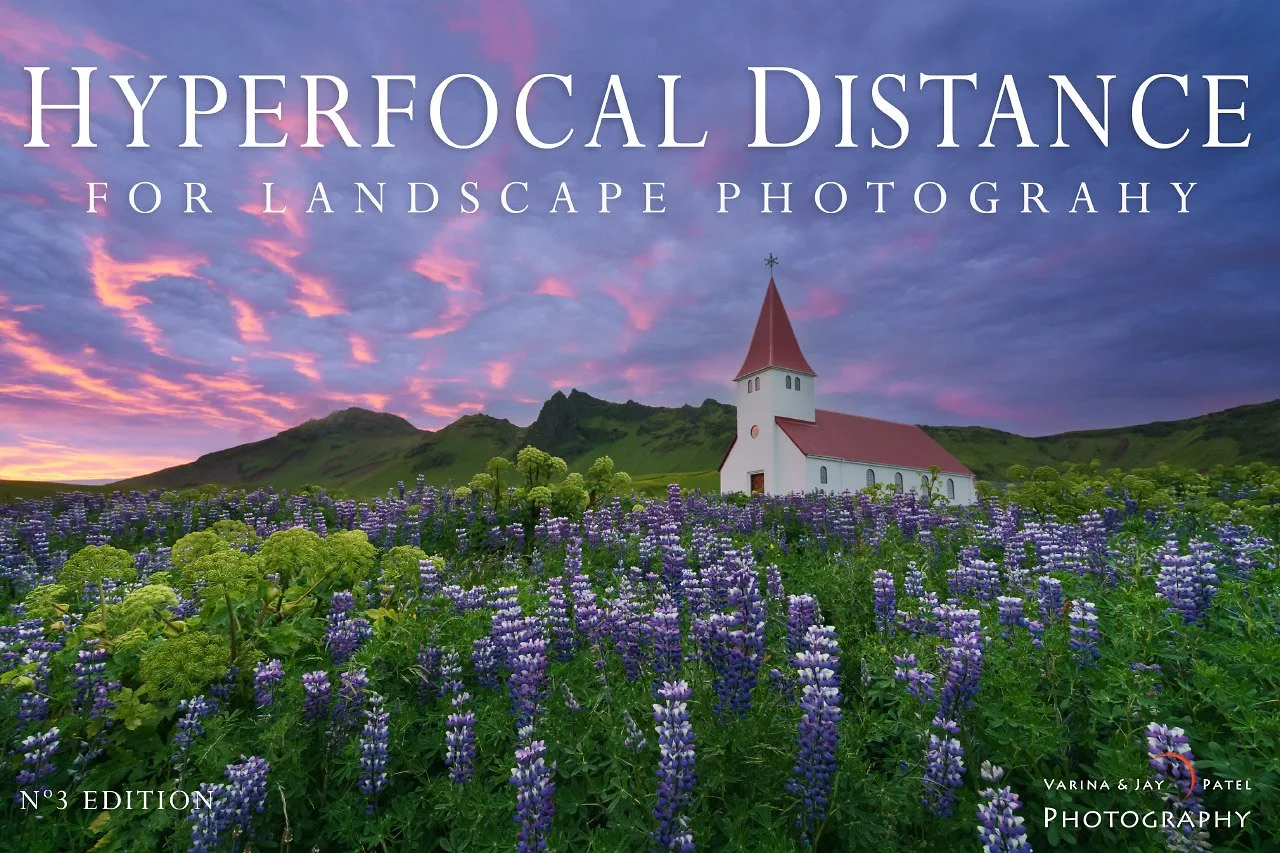
- Hyperfocal Distance for Landscape Photography: Feel confident using hyperfocal distance for landscape photography to get in close with a wide angle lens and get everything in sharp focus. Builds the exact skill this article teaches, with practical guidance for wide-angle compositions.
- Nature Photography In Sharp Focus: Video tutorial for nature photographers on mastering camera focus settings, focus stacking, and motion tracking for sharper, more precise images. Extends your focusing toolkit beyond hyperfocal distance, especially when focus stacking is the better choice.
- Getting it Right in Camera: Learn how to capture stunning nature photos in-camera with expert techniques on focus, composition, filters, and lighting—perfect for landscape and wildlife photographers! Connects sharpness decisions to the broader in-camera workflow that determines final image quality.