Quick answer
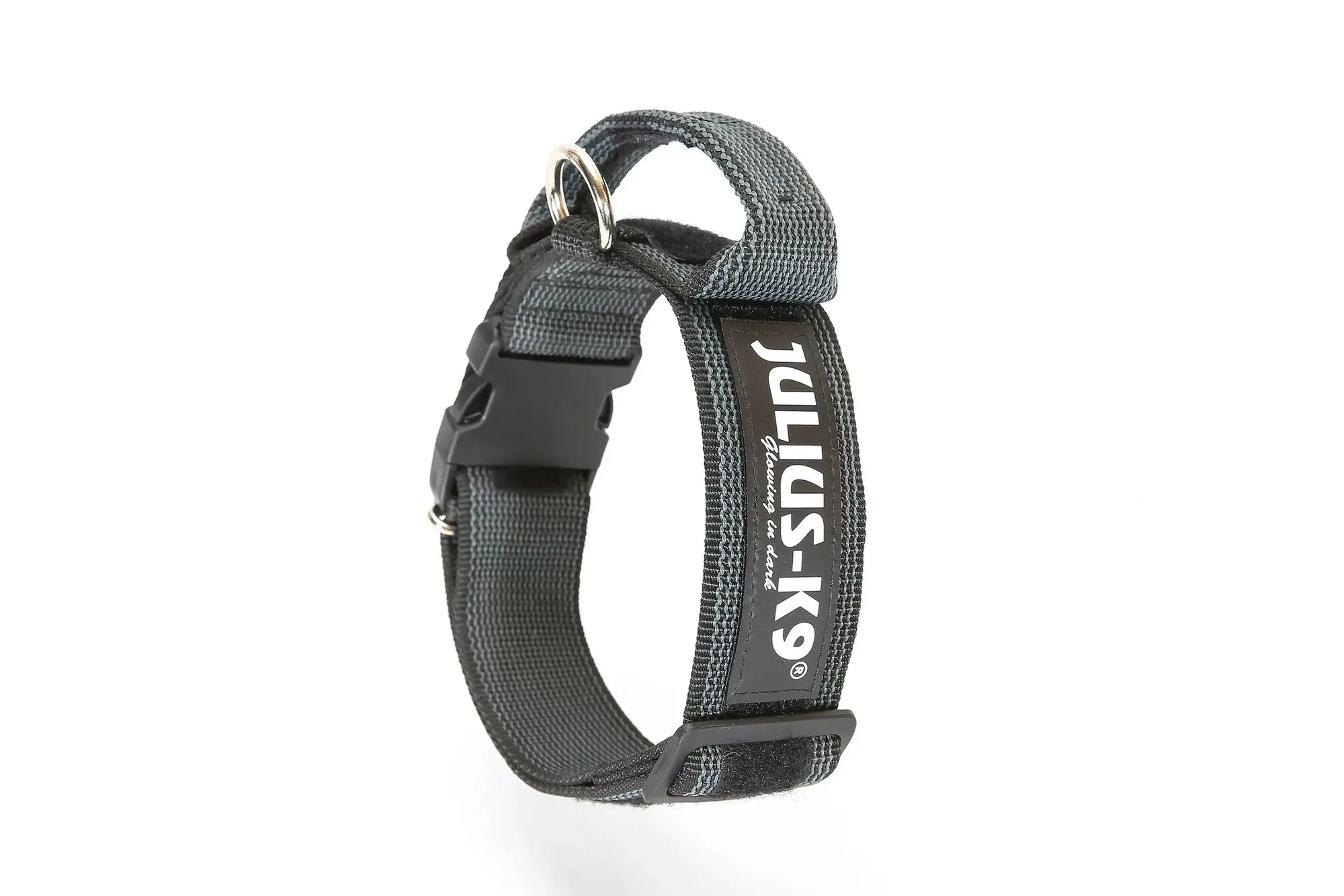
Put the Julius-K9 Color & Gray collar on so the handle sits on top of the neck, then adjust the strap until you can slide two fingers underneath. Close the double safety lock before every walk, and use the handle only for brief, steady control—not for lifting or tethering. Swap the patch whenever you want to update your dog's identification.
Why the handle and safety lock change your walking routine
A dog collar with handle gives you a second contact point without switching to a harness. The top handle on this collar is designed for quick grabs at curbs, in crowds, or when you need to hold your dog close for a moment. The double safety lock adds a backup closure so the buckle stays put during everyday walks. Together, these features make the collar more than a place to hang tags—it becomes a control tool you can use deliberately.
Fit checkpoints that prevent slipping and rubbing
A correct fit is snug enough that the collar does not slide over the head, but loose enough that it does not pinch. Check the fit after every adjustment and recheck it if your dog's coat changes with the seasons. Because the collar has a handle, a poor fit becomes more obvious: the handle should stay centered on top of the neck, not twist to the side. If the handle rotates, the collar is likely too loose or the strap is uneven.
Using the handle without turning it into a lifting strap
The handle is for momentary control, not for carrying your dog or tying them to a fixed object. Use it to guide your dog closer at a curb, to steady them during a vet check, or to keep them from lunging toward another dog. Keep the leash attached to the D-ring as your primary connection, and treat the handle as a supplement. For training sessions that need frequent hand contact, practice with the handle in a low-distraction area first so your dog gets used to the sensation.
Patch changes and everyday maintenance
The interchangeable patch lets you update the collar's look or carry a short identification message without buying a new collar. Swap patches when you want a different color or when the current patch becomes worn. Clean the collar with a damp cloth and mild soap, then let it air dry. Avoid harsh chemicals that could degrade the soft-touch textile. Check the safety lock and buckle for debris after muddy walks, since grit can make the closure harder to operate.
Step-by-step: fitting and using the collar
- Place the collar with the handle on top: Slip the collar over your dog's head so the handle sits centered on the back of the neck and the D-ring hangs at the front. Fasten the buckle. Checkpoint: the handle should not twist to the side; if it does, the collar is too loose or uneven.
- Adjust the strap for a two-finger fit: Tighten or loosen the strap until you can slide two fingers comfortably under the collar at the widest part of the neck. Recheck after a few minutes of wear. Mistake to avoid: leaving it loose enough to slip over the head—this defeats the safety lock and makes the handle unstable.
- Close the double safety lock: Press the safety lock closed until it clicks or seats fully. Tug gently on the collar to confirm the buckle is secure before every walk. Checkpoint: if the lock feels loose or gritty, clean it before use.
- Attach the leash to the D-ring, not the handle: Clip your leash to the metal D-ring as the primary connection. Reserve the handle for brief, steady control—never for tethering or lifting. Mistake to avoid: clipping the leash to the handle, which can put uneven stress on the stitching.
- Swap the patch when needed: Remove the current patch and insert a new one according to the collar's design. Make sure it sits flat and secure. Checkpoint: a loose patch can catch on branches or fences; press it firmly into place.
Product facts
- Julius-K9 Color & Gray® Collar with Handle, Safety Lock and Interchangeable Patch: Sturdy top handle for instant control and quick grabs. Gives you a reliable second contact point for curbs, crowds, and training moments without switching to a harness.
- Julius-K9 Color & Gray® Collar with Handle, Safety Lock and Interchangeable Patch: Double safety lock secures the buckle during walks. Reduces the chance of accidental opening, so you can focus on your dog instead of checking the buckle.
- Julius-K9 Color & Gray® Collar with Handle, Safety Lock and Interchangeable Patch: Soft-touch textile construction with interchangeable patch. Comfortable for daily wear and lets you update identification or color without replacing the collar.