Quick Answer
Choose jumbo nuts and bolts for toddlers who need twisting grip practice and early engineering play; choose a peg board for toddlers who are still building pincer grasp and stacking control. If your child is 2–3, start with the peg board; if they are 3–4 and already stack well, jumbo nuts and bolts add a new mechanical challenge. Both are occupational therapy toddler toys, but they train different hand skills.
The Hand Skills Each Toy Trains
Nuts and bolts ask the hand to rotate while gripping—a wrist and finger motion that peg boards do not require. Peg boards ask the thumb and index finger to pinch and place, which is the foundation for holding a crayon or spoon. A child who can stack pegs easily may still struggle to line up and turn a bolt, and a child who can twist a bolt may still need peg practice for precise placement.
- Peg board: pincer grasp, hand-eye coordination, stacking towers
- Nuts and bolts: twisting grip, wrist rotation, shape and color matching
- Both: focus, persistence, and turn-taking with a caregiver
How Many Pieces Fit Your Play Space
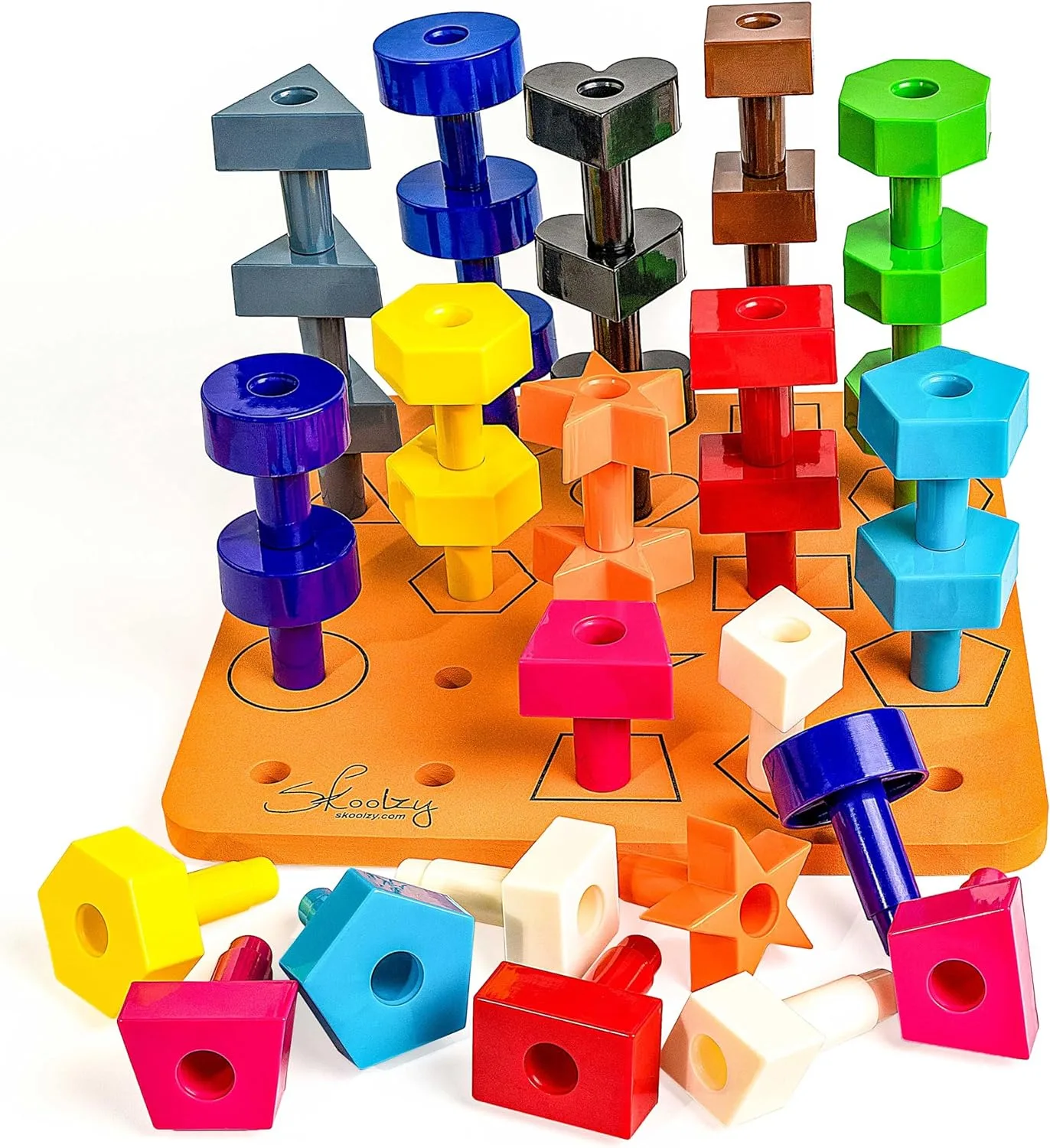
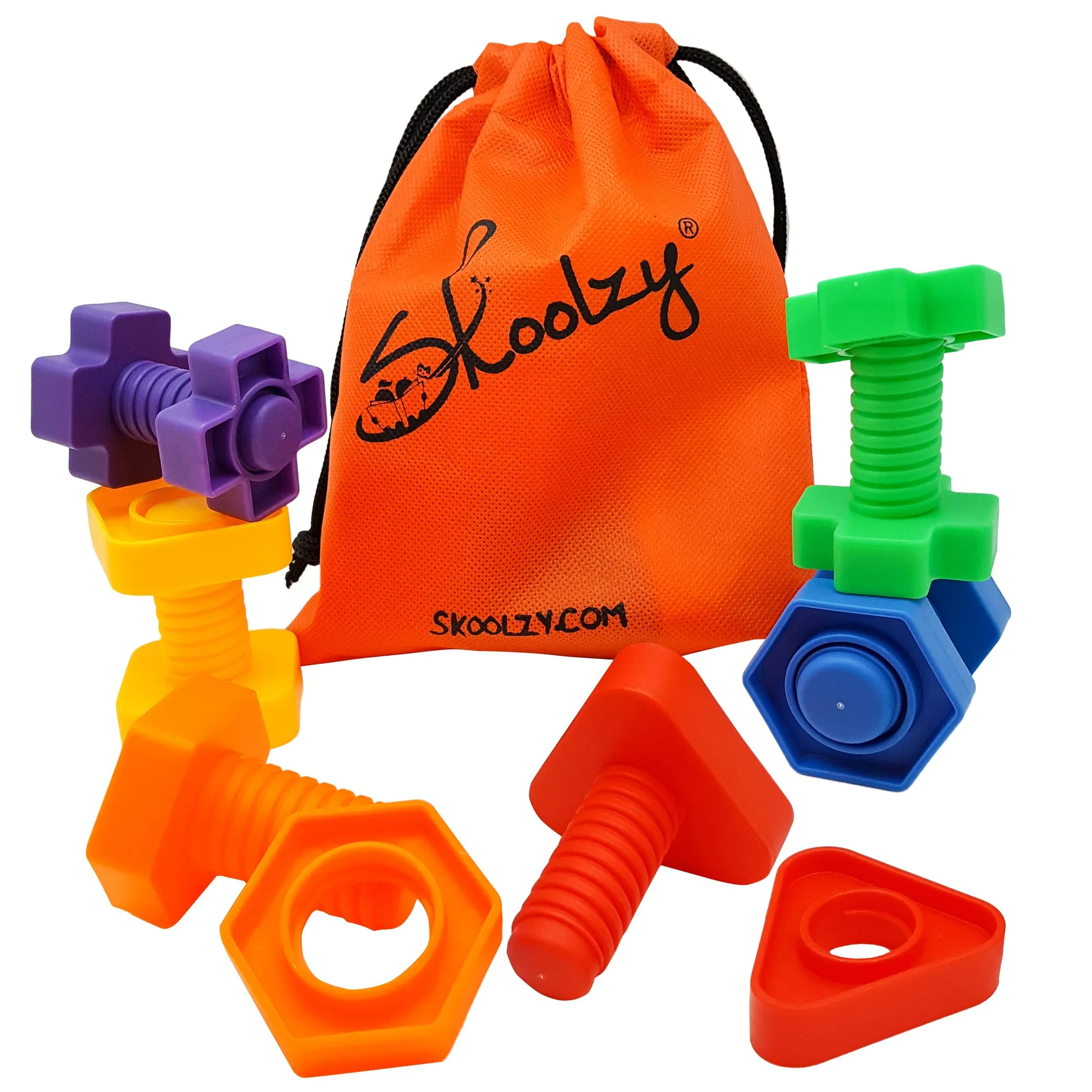
Skoolzy offers a 12-piece jumbo nuts and bolts set with tote and a 24-piece jumbo nuts and bolts set, plus a 33-piece sensory peg board set. More pieces mean longer play but more to store; fewer pieces mean faster setup and easier clean-up. The 12-piece set is enough for one child to complete every shape without hunting; the 24-piece set supports two children or extended sorting games. The 33-piece peg board gives more pegs than a toddler can place in one sitting, so you can rotate colors or shapes to keep it fresh.
Matching the Toy to Your Child's Stage
If your child is 2 and still learning to pinch, the 33-piece sensory peg board is the better first step because the oversize pegs are easy for small fingers to grasp and stack. If your child is 3–4 and already stacks blocks, the jumbo nuts and bolts set adds a new challenge: aligning the bolt and turning it. For a child who needs occupational therapy, both toys are used by therapists, but the twisting motion of nuts and bolts targets a different muscle group than peg placement.
Trade-Offs to Weigh
- Twisting vs. pinching: Nuts and bolts build wrist rotation and grip strength; peg boards build pincer grasp and precise placement. You cannot get both from one toy. Pick the skill your child needs most right now.
- Piece count vs. storage: A 24-piece or 33-piece set offers more play but more pieces to track; the 12-piece nuts and bolts set and the drawstring backpack on the 24-piece set make clean-up easier. If pieces go missing often, choose the set with a tote or backpack.
- Age fit: Oversize pegs suit 2-year-olds; jumbo nuts and bolts suit 3–4-year-olds who already stack and sort. Starting too early can lead to frustration. Match the toy to the hand skill, not just the birthday.
Product Facts
- Jumbo Nuts and Bolts for Toddlers 24 Piece | Kids Nuts and Bolts | Toddler Engineering Toys for 2-4: Jumbo Nuts and Bolts for Toddlers 24 Piece includes a Skoolzy drawstring backpack and is described as fine motor toys for screwing and unscrewing, first STEM toys, and montessori toys for babies. The backpack keeps 24 pieces together, and the 24-piece count supports two children or longer sorting sessions.
- Sensory Peg Board 33 Piece Set - Montessori Occupational Therapy Toys for Kids & Toddlers 2+: Sensory Peg Board 33 Piece Set has oversize pegs that are easy for small and tiny fingers to grasp and stack on the peg boards and stacking to build towers. Oversize pegs reduce frustration for 2-year-olds who are still developing a pincer grasp.
- 12 pc Jumbo Nuts and Bolts Set With Tote: 12 pc Jumbo Nuts and Bolts Set With Tote helps fine tune fine motor muscles, and both boys and girls screw and unscrew while shape matching and sorting. The 12-piece set is a lower-commitment way to try twisting play before buying a larger set.
- 24 pc Jumbo Nuts and Bolts Set: 24 pc Jumbo Nuts and Bolts Set includes 12 complete plastic nuts and bolts and is described as a starter STEM toy for toddlers that teaches colors, shapes, and basic mechanical engineering. 12 complete pairs mean every bolt has a matching nut, so shape-matching games work without missing pieces.
Which One Fits Your Child?
Best for
- Toddlers 2–3 who need pincer grasp and stacking practice
- Children who prefer open-ended building and tower play
- Families who want a single set with many pieces for rotation
Not for
- Children who already stack confidently and need a new challenge—choose jumbo nuts and bolts instead
- Toddlers who still mouth small parts—oversize pegs are safer, but always supervise
- Families who want a quiet, no-twist activity for travel