Start with one peg in hand
Jumbo Peggy is described as the first peg game for children from 2 years of age. The pieces are colourful, large and stackable, so the simplest way to begin is to hand your child one peg and let them explore it. That single piece is enough for a first session: they can hold it, turn it over and try to place it. From there, you can introduce a small handful of pegs and let the play grow.
The set supports two broad kinds of play: making colourful mosaics and building tall towers. You do not need to decide in advance which one your child will prefer. Offer the pegs and see whether they start lining them up side by side or stacking them on top of each other. Both are valid ways to play and both work the same large pieces.
What the Jumbo Peggy set gives you to work with
-
Jumbo Peggy: The first peg game for children from 2 years of age. This sets the starting age for the activities below, so you can match the play to a toddler rather than an older child.
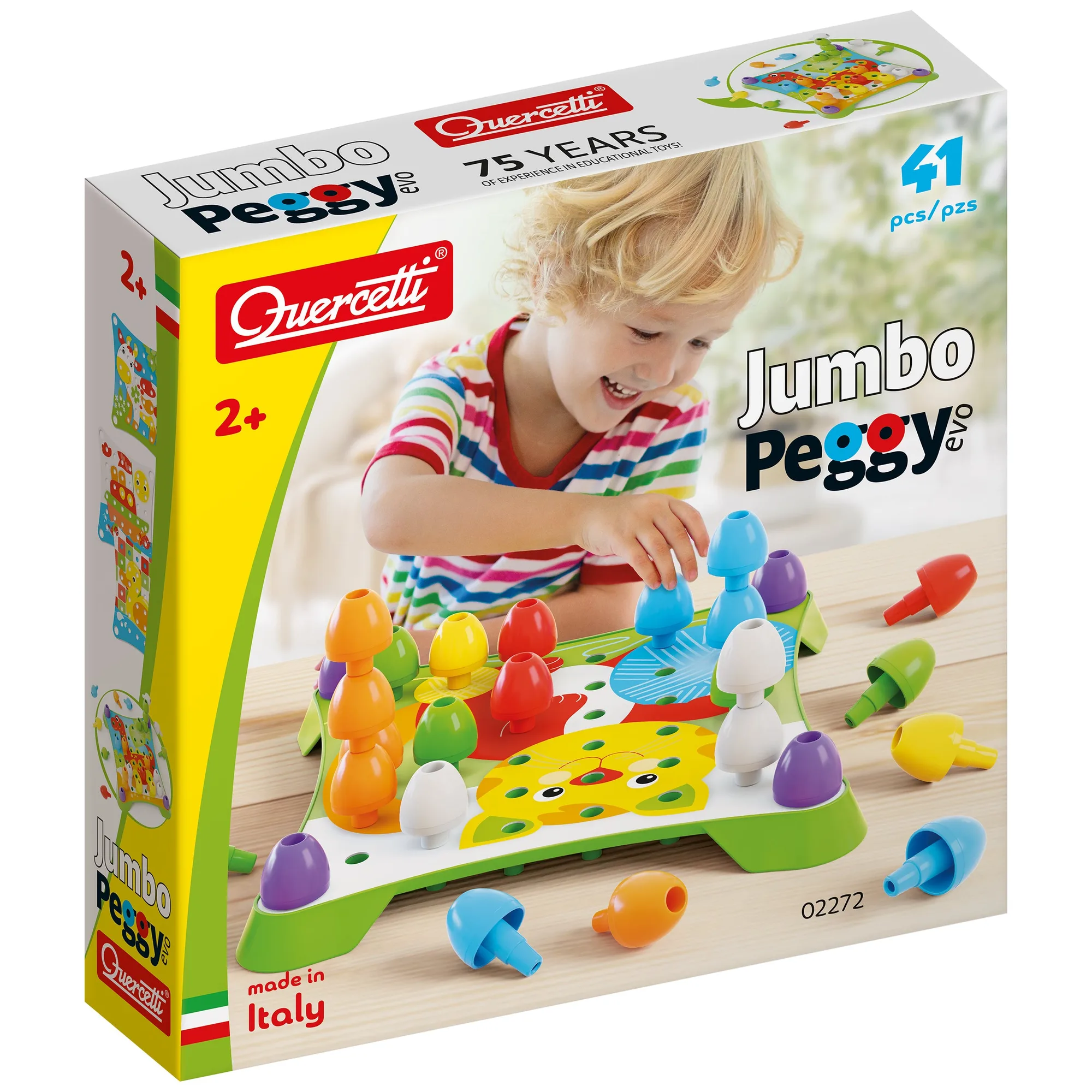
Jumbo Peggy
-
Jumbo Peggy: The many pieces are colourful, large and stackable for making colourful mosaics or building tall towers. Large, stackable pieces are what make both mosaic play and tower building possible with the same set.
-
Jumbo Peggy: A great game that stimulates creativity and manual skills. This explains why the play ideas here focus on open-ended making and hands-on handling rather than a fixed puzzle solution.
A first Jumbo Peggy session, step by step
This sequence keeps the first experience simple. It uses only the pegs and the play surface you have, and it lets your child set the pace.
- 1. Offer a few large pegs: Put three or four colourful pegs within reach. Large pieces are easier for small hands to grasp, so your child can pick one up without help.
- 2. Let your child choose: mosaic or tower: Watch what they do first. If they press pegs down side by side, follow that into mosaic play. If they pile one on top of another, follow that into tower building.
- 3. Copy what your child starts: Add a peg next to theirs in the same colour or stack one more on their tower. Copying keeps the game going without turning it into a lesson.
- 4. Name colours as you play: The pieces are colourful, so you can say the colour of a peg as you pick it up. This adds a language layer to the same manual activity.
- 5. Stop while it is still fun: Peg play uses manual skills, so a short first session is enough. You can bring the set out again another day and repeat the same simple start.
Large peg activities for toddlers
These ideas stay close to what the set is described as doing: large, colourful, stackable pieces for mosaics and towers. Each one can be done with a small number of pegs, so you do not need to tip out the whole set at once.
- Colour hunt: Pick one colour and ask your child to find all the pegs of that colour. Because the pieces are large and colourful, they are easy to spot and pick up.
- One-colour mosaic: Place a few pegs of the same colour side by side to make a small patch. This is a gentle first mosaic that does not require a picture or a plan.
- Tall tower challenge: Stack pegs one on top of another and see how tall the tower gets before it falls. The stackable pieces are made for this, and a fall is part of the game rather than a failure.
- Peg parade: Line pegs up in a row and move them along like a train. This uses the same large pieces in a different way and keeps hands busy.
Preschool peg play that adds a little more thinking
Older children can use the same Jumbo Peggy pieces for activities that ask for more planning. These still rely on the supplied description of mosaics and towers rather than on any additional rules.
- Simple pattern mosaics: Start a short repeating pattern, such as two colours alternating, and ask your child to continue it. This turns mosaic making into a thinking game with the same large pegs.
- Plan a tower first: Ask your child to choose the order of colours before stacking. Then build the tower to match the plan. This adds a planning step to tower building.
- Copy my mosaic: Make a small mosaic of a few pegs and invite your child to copy it. Keep it short so the copying stays manageable and the focus stays on handling the pieces.
- Sort and store: At the end, sort the pegs by colour into piles or containers. This is a practical way to finish play and gives children another hands-on task with the large pieces.
Fine motor peg games that need no extra rules
The manual skills in the product description come from handling the pegs themselves. You do not need a separate game to work on them. Picking up a large peg, turning it and placing it down is the fine motor activity. Stacking adds control because the peg has to land on another piece. Making a mosaic adds placement because the peg has to go beside the others.
For a toddler, the simplest fine motor game is to move pegs from one pile to another, one at a time. For a preschooler, the same idea can become a relay: carry one peg at a time to a growing tower. Both use the large, stackable pieces and neither requires instructions beyond what the set already supports.
What to keep in mind before you start
The supplied information describes Jumbo Peggy as suitable from 2 years of age, with large, colourful, stackable pieces. It does not include a piece count, a play surface description, or care and safety instructions. That means you should check the packaging or the full product listing for those details before you buy or set up play.
There is also no supplied guidance on how many pegs to offer at once or how long a session should last. The step-by-step above uses a small number of pegs as a sensible starting point, but you can adjust it to your child. If your child loses interest, put the set away and try again another day. The open-ended nature of the pieces means the same set can support both a quick toddler activity and a longer preschool mosaic project.