Quick answer
Kitchen tower and learning tower are two names for the same idea: a raised wooden platform that lets a toddler stand safely at counter height. The real choice is not tower versus tower, but which version fits your kitchen, your child's age, and how long you want to use it. Pick a toddler kitchen tower with an adjustable platform and a wide base if you mainly need counter help, and choose a convertible design if you want the piece to stay useful after the toddler years.
Why the two names describe one product
The label changed as the product moved from Montessori classrooms into home kitchens. A learning tower for toddlers is built so a child can join in at the counter instead of being held or perched on an unstable chair. A toddler kitchen tower does the same job, and most wooden kitchen tower designs on the market are functionally identical: a frame with a platform, a step, and a safety rail.
That means comparison shopping should focus on structure, not naming. Look at the platform height range, the footprint, the weight limit, and whether the tower folds or converts. Two towers with the same name can differ more than a tower and a learning tower from the same maker.
What a fixed tower gives you
A fixed tower is the simplest version: one platform height, one footprint, no moving parts. It is usually cheaper and lighter than a convertible model, and there is nothing to adjust, so it is ready the moment you unpack it. For a family with one toddler and a standard-height counter, a fixed tower often does everything needed.
The trade-off is growth. Once your child outgrows the platform height or wants to sit at the counter instead of stand, a fixed tower has no second job. If you have a small kitchen, it also occupies the same floor space whether it is in use or not.
What a convertible tower gives you
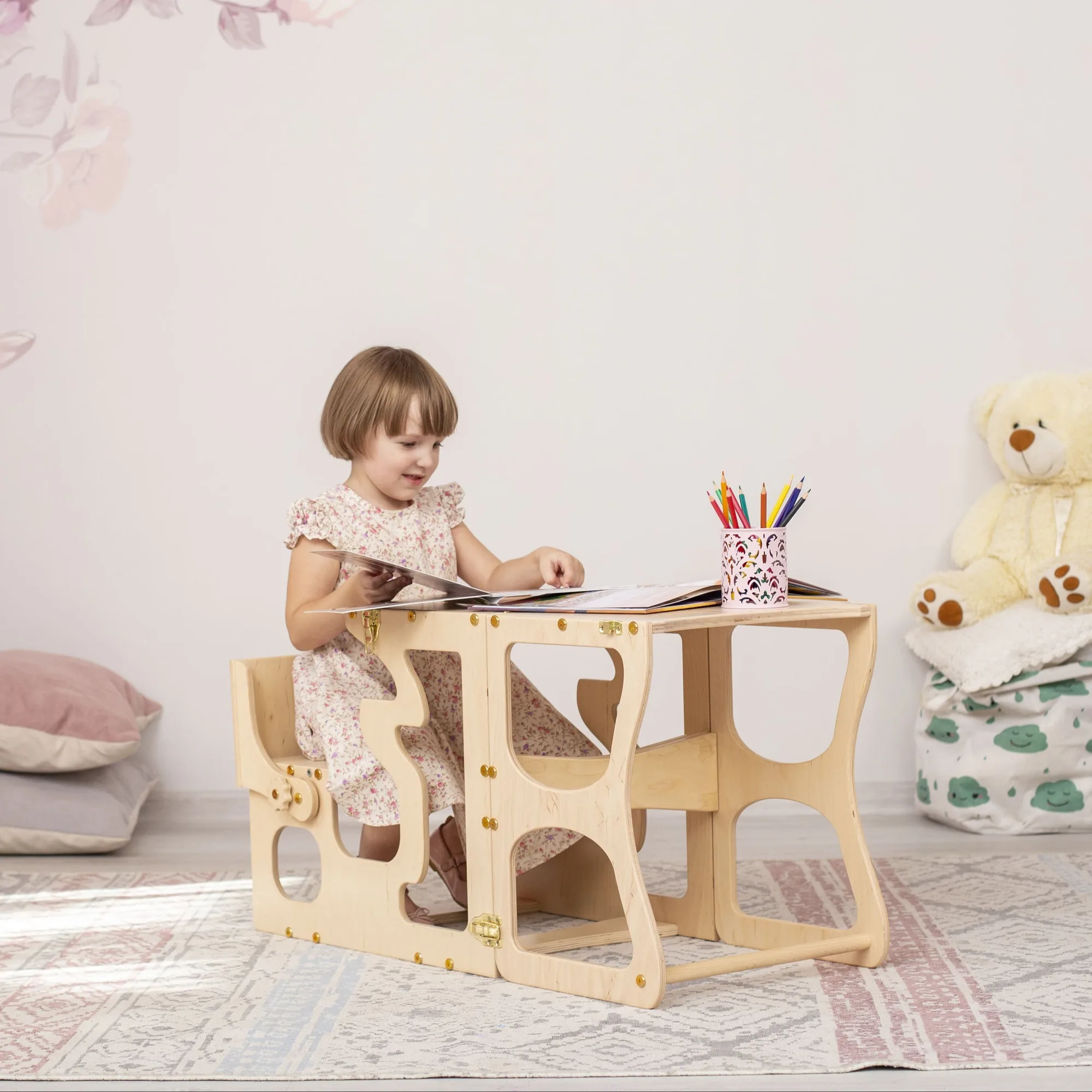
A convertible tower adds a second function. The Convertible Kitchen Tower is built for kids from 8 months to 6 years old and transforms into a sturdy table for reading and playing. That matters if you want one piece of furniture to cover both the standing-at-the-counter stage and the sit-down stage that follows.
The trade-off is weight and cost. Convertible designs have more parts and usually cost more than a basic fixed tower, and you need to learn the conversion steps before you buy. If you only ever need counter access, you may be paying for a feature you never use.
How to measure before you buy
Stand at your counter and measure the distance from the floor to the countertop. Then check the tower's stated platform height against your child's height, not just their age. A tower that puts the platform too low turns into a step stool; too high and your child cannot climb in safely.
Next, measure the floor space where the tower will live. A tower needs clearance on all sides so a child can climb in and out without tipping. If your kitchen is tight, a folding or compact design is worth prioritizing over extra features.
Safety details that separate good towers
Look for a wide base relative to the platform height, a rail that surrounds the standing child, and a step that is easy for a toddler to reach. Wooden kitchen tower frames should feel solid when you push them sideways with one hand; if they wobble on a flat floor, that is a sign the joints or feet need attention.
Never leave a child unattended in a tower, and keep the tower away from stove burners, hot pans, and knife edges even when the child is standing safely. The tower solves reach, not supervision.
Where a tower fits into a playroom setup
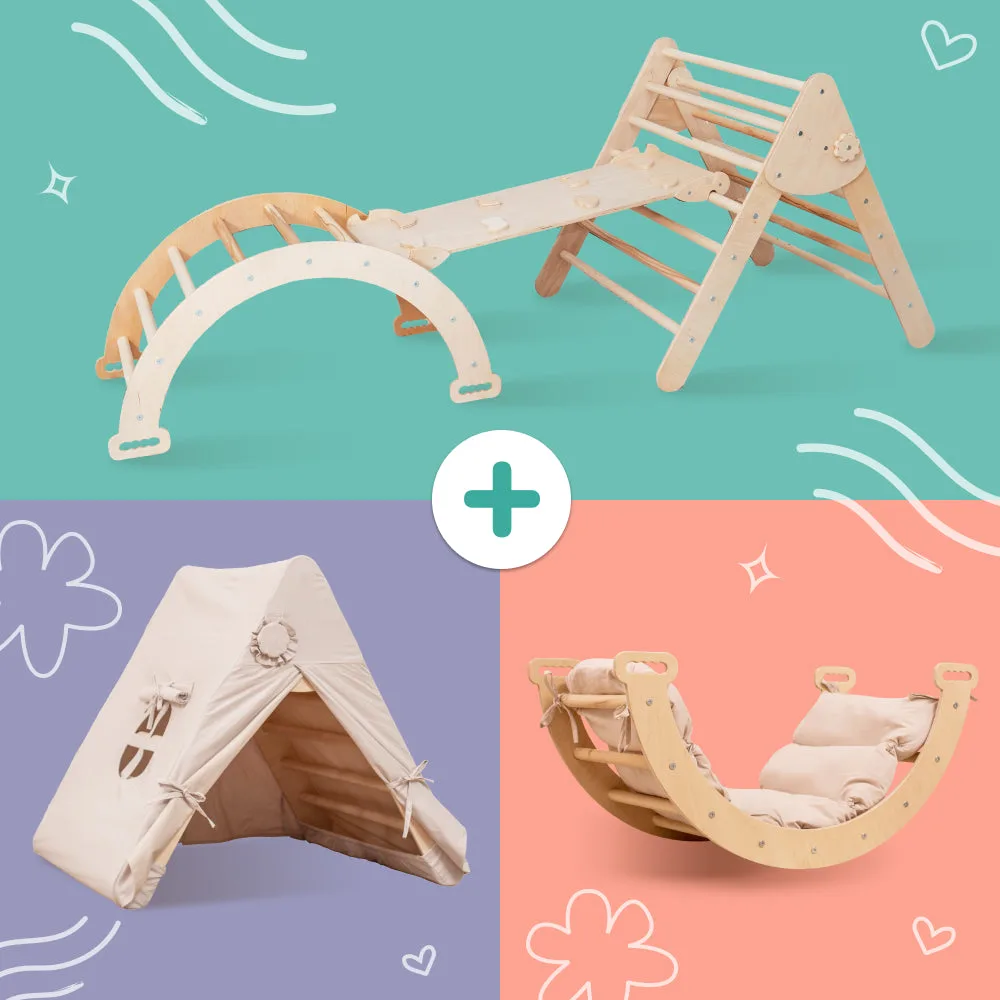
Some families buy a tower for the kitchen and a separate climbing set for the playroom. If you already have a climbing structure, check whether the tower duplicates it. A Montessori Climber with Accessories, for example, is built around a triangle, arch, and ramp for movement play, while a tower is built for standing at a fixed height. They solve different problems, so owning both is reasonable if you have the space.
If space is limited, decide which need comes first: counter participation or active indoor play. Buy for the need you have this month, not the one you might have in two years.
Trade-offs to weigh before you choose
- Fixed vs convertible: A fixed tower is simpler and usually cheaper, but stops being useful when your child outgrows the platform height. A convertible tower like the Convertible Kitchen Tower costs more and has more parts, but changes into a table so it stays in use from 8 months to 6 years. Choose convertible if you want one piece to last; choose fixed if counter access is the only job.
- Counter helper vs climbing structure: A tower raises a child to counter height for cooking and washing up. A climbing set such as the Montessori Climber with Accessories or the Wooden Climbing Set builds movement, balance, and coordination instead. These are different purchases. Buy the one that matches your child's daily routine first.
- Floor space vs features: Every tower occupies floor space even when unused. Convertible and multi-part designs take up more room than a basic frame, and a playroom bundle takes more still. Measure your kitchen before buying, and let available space rule out options early.
- Price vs longevity: The Convertible Kitchen Tower is listed at USD 161.83, while the Montessori Climber with Accessories is USD 406.40 and the Wooden Climbing Set is USD 284.86. A tower is the lower-cost entry into independent toddler participation. If budget is tight, start with the tower and add climbing equipment later.
Products that match these needs
- Convertible Kitchen Tower: Convertible Kitchen Tower is for kids from 8 months to 6 years old, is based on Montessori pedagogy, and transforms into a sturdy table for reading and playing. It covers both the standing-at-the-counter stage and a later sit-down stage, so it earns its floor space for longer than a single-purpose tower.
- Montessori Climber with Accessories: Montessori Climber with Accessories is built around three elements: the Montessori triangle, the arch, and the ramp with wooden pebbles, which can be combined in different ways. It is a movement-play structure rather than a counter-height helper, so it complements a tower instead of replacing it.
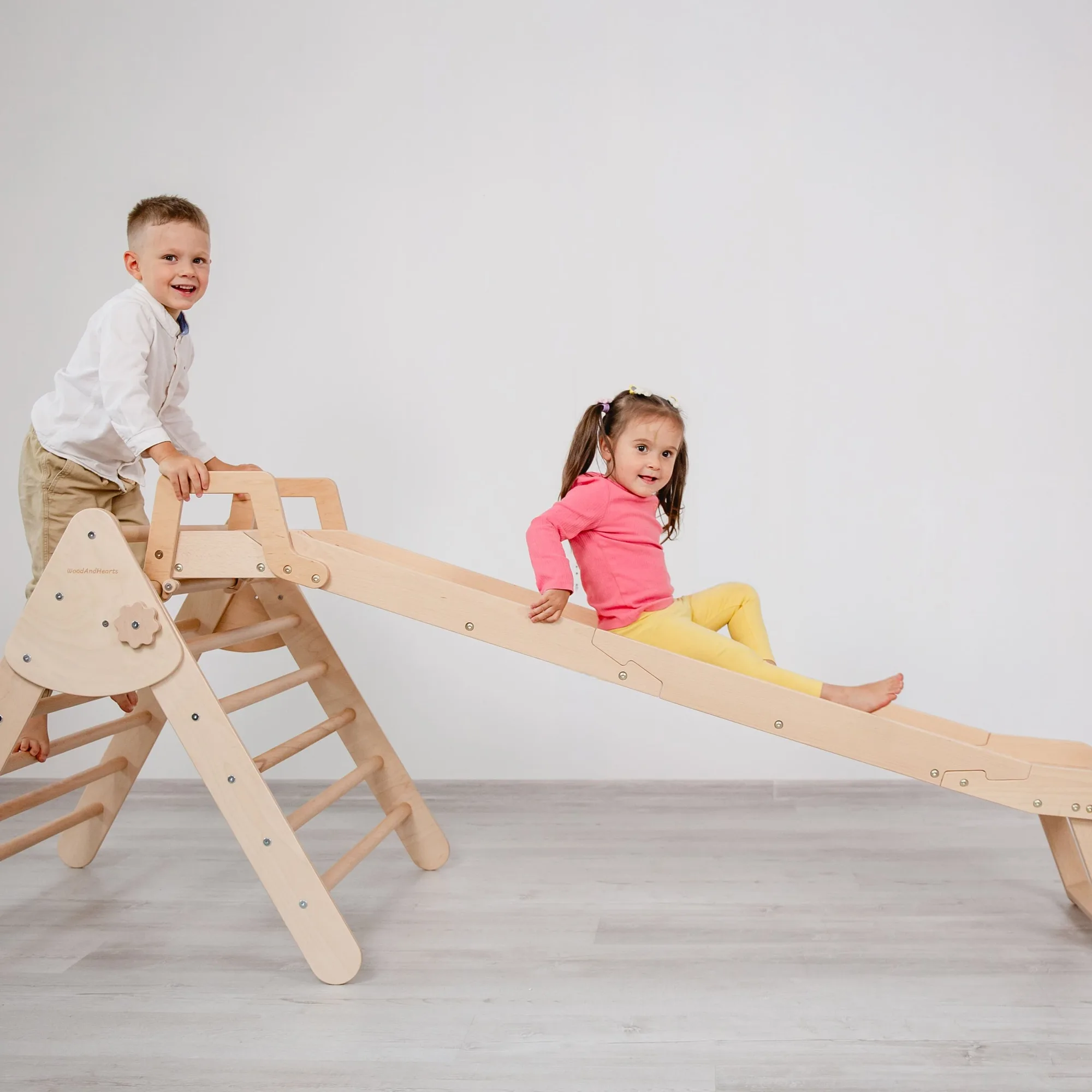
- Wooden Climbing Set: Wooden Climbing Set is a 2-in-1 set that includes a large Montessori triangle and a slide for active play at home. If your child mainly needs climbing and sliding rather than kitchen access, this covers that need at a lower entry point than a full playroom bundle.
Which should you buy?
Best for
- Families who want a toddler to join in at the counter safely
- Parents who want one piece that works from 8 months to 6 years, such as the Convertible Kitchen Tower
- Small kitchens where a single multi-use item beats several single-purpose ones
Not for
- Families whose main goal is climbing, sliding, and active indoor play — a climbing set suits that better
- Homes with no safe, supervised counter space to place a tower
- Buyers who want the absolute lowest-cost option and will not use the convertible feature