Quick Answer
Kodak Indicator Stop Bath gives you precise, consistent development control with a built-in exhaustion signal, while a water stop is cheaper and simpler but risks uneven results and shorter fixer life. For most home darkroom work, an acid stop bath like Kodak Indicator Stop Bath is the more reliable choice.
How a Stop Bath Works in Film Processing
After development, the stop bath halts the developer action by quickly changing the pH. An acid stop bath like Kodak Indicator Stop Bath drops the pH to around 4.0–5.0, instantly neutralizing the alkaline developer. This prevents overdevelopment and extends the life of your fixer by reducing carryover of developer residue.
A plain water stop (a rinse or multiple water changes) also dilutes and slows developer action, but it does not neutralize it as quickly or completely. This can lead to slightly uneven development, especially with dense negatives or when processing multiple rolls in a session.
Kodak Indicator Stop Bath: Control and Convenience
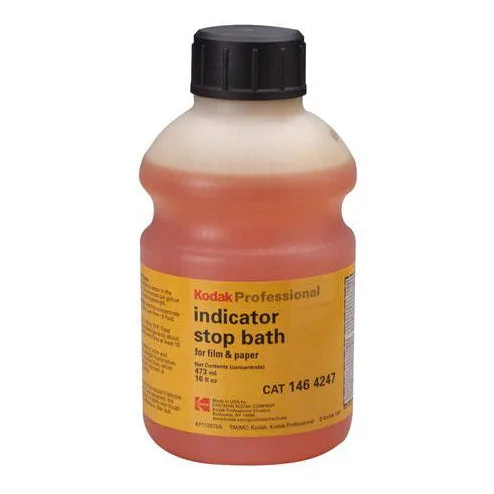
Kodak Indicator Stop Bath is a non-hardening, general-purpose stop bath concentrate for films and papers. It contains a color indicator that changes from yellow to purple when the bath is exhausted, so you know exactly when to replace it. The concentrate is diluted 1 part with 63 parts water, making each bottle go a long way. At a catalog price of USD 6.70 (compared to USD 10.99), it is an affordable upgrade for consistent results.
The main trade-off: you need to buy and mix the chemical, and it is only available for store pickup since photographic chemicals cannot be shipped. If you live near Austin Camera, this is a minor inconvenience. If you don't, you may need to plan ahead.
Water Stop: Simple and Free, but Less Precise
Using plain water as a stop is the cheapest and most accessible option. You simply rinse the film in running water or use a series of water changes. There is no chemical cost, no mixing, and no disposal concerns. It works well for casual or single-roll development where consistency is less critical.
The downside: water does not stop development instantly. Developer can continue to work in the emulsion for a few seconds, potentially causing slight density variations. It also does not condition the film for the fixer as effectively, which can shorten fixer life. For critical work or when processing multiple rolls, the lack of control becomes a real drawback.
Trade-Offs at a Glance
- Development Precision: Acid stop bath halts development instantly and uniformly. Water stop is slower and less consistent. Choose acid stop for critical work; water is fine for casual or single-roll sessions.
- Cost and Convenience: Kodak Indicator Stop Bath costs USD 6.70 and requires mixing. Water is free and always available. If you process frequently, the small cost of a stop bath is worth the control.
- Fixer Life: Acid stop neutralizes developer carryover, extending fixer life. Water stop does not, so fixer may exhaust faster. Using an acid stop bath saves money on fixer in the long run.
- Availability: Kodak Indicator Stop Bath is store pickup only (chemicals cannot be shipped). Water is always at your tap. Plan ahead if you don't live near Austin Camera.
Product Facts
- Kodak Indicator Stop Bath - 16 Fluid oz.: Kodak Indicator Stop Bath is a non-hardening, general-purpose stop bath for use with films and papers. It contains an indicator to signal exhaustion. Dilute 1 part concentrate with 63 parts water. Liquid concentrate. The built-in indicator takes the guesswork out of bath life, so you never accidentally use an exhausted stop bath that could ruin your negatives or waste fixer.
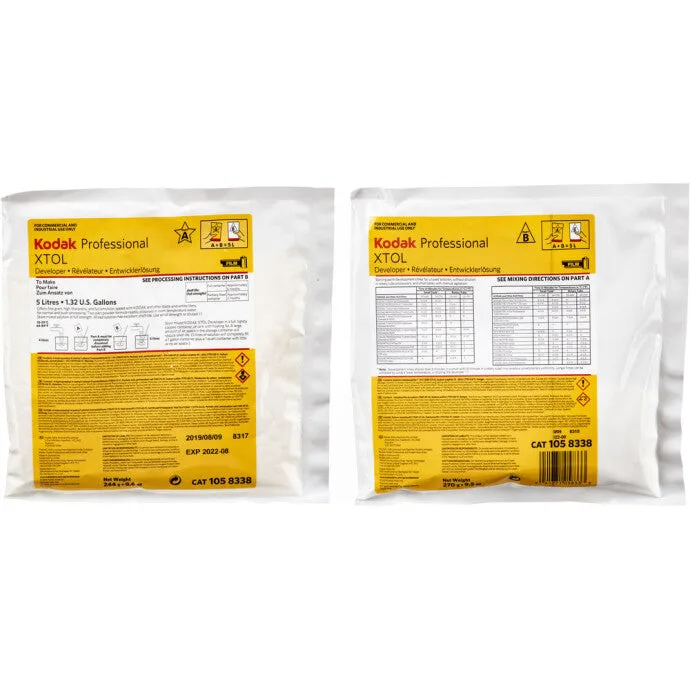
- Kodak Xtol Professional Film Developer - Makes 5 Liters: Kodak Xtol Professional Film Developer makes 5 liters of working solution. It is a fine-grain developer suitable for a wide range of films. Pairing a consistent stop bath with a reliable developer like Xtol helps you achieve repeatable, high-quality negatives roll after roll.
Which Should You Choose?
Best For
- Home darkroom users who process film regularly and want consistent, repeatable results
- Photographers developing multiple rolls in one session who need to protect fixer life
Not For
- Occasional developers who only process a roll or two and want the simplest, cheapest workflow
- Anyone who cannot pick up chemicals in person and needs a fully shippable solution