Quick answer
Bulk loading Kodak T-Max 400 from a 30.5m roll saves money and lets you customize roll lengths. You need a bulk loader, reusable cassettes, a dark changing bag, and careful handling to avoid light leaks or scratches. Follow the steps below for consistent, waste-free results.
What you need before starting
A 30.5m roll of Kodak T-Max 400 35mm black and white film gives you about 18 standard 36-exposure rolls. To bulk load, you need a bulk film loader (like a Lloyd or Watson style), empty reusable 35mm cassettes, a dark changing bag or completely dark room, scissors, and a film retriever or leader puller for the cassette.
Make sure your reusable cassettes are clean and have a light-trap felt in good condition. Worn felt lets in light and ruins the film. If you are using recycled single-use cassettes, tape the spool end securely to prevent the film from unspooling inside the camera.
Setting up the bulk loader
Place the bulk loader, the Kodak T-Max 400 roll, and the empty cassettes inside the changing bag. Seal the bag completely. Reach in and load the film roll into the loader following the loader’s instructions — typically you feed the film leader through a light-trap slot and onto the take-up spool. Close the loader before taking it out of the bag.
Common mistake: forgetting to advance the film a few turns after loading to remove slack. Slack can cause uneven winding and jams. Always test the advance knob feels smooth before removing from the bag.
Step-by-step bulk loading process
- Set the frame counter: Dial in the desired number of exposures on the bulk loader (e.g., 36 for standard rolls). Most loaders have a knob or dial that stops advancing at the set count. Checkpoint: Make sure the counter resets to zero before each new cassette. A miscount wastes film.
- Insert the cassette: Open the loader’s cassette chamber, slide the empty cassette onto the spool hub, and close the light trap. Ensure the cassette’s felt light trap is aligned with the loader’s exit slot. Common mistake: forcing the cassette in crooked can damage the felt, causing light leaks later.
- Wind the film: Turn the advance knob steadily until the counter stops. Avoid fast or jerky winding — it can create static marks on T-Max 400’s thin emulsion. Checkpoint: Listen for the click when the counter locks. If you hear grinding, stop and check for a jam.
- Cut and seal the film: Use the built-in cutter or scissors to cut the film from the bulk roll. Leave a 3-4 inch leader sticking out of the cassette. Tape the film end to the cassette spool with a small piece of light-proof tape. Common mistake: using regular tape that doesn’t block light. Always use black photo tape or electrical tape to prevent fogging on the first few frames.
- Remove and label the cassette: Open the loader’s cassette chamber and take out the loaded cassette. Immediately stick a label with the film type and exposure count (e.g., “T-Max 400, 36 exp”). Store in a light-tight canister until use. Checkpoint: If you are not using the cassette right away, keep it in a cool, dry place to preserve the film’s latent image quality.
Featured product
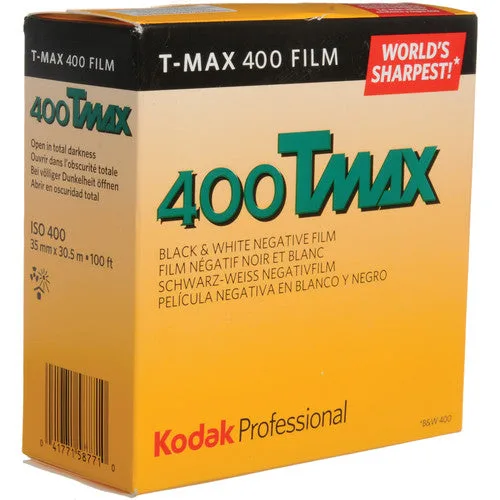
- Kodak T-Max 400 35mm Black & White 135 Film 30.5m Roll: Kodak T-Max 400 is an excellent professional black and white 35mm film. Kodak's patented T-grain emulsion delivers impressive levels of detail in different - and difficult - lighting situations. It has also been optimised for high quality scanning and enlarging post-development. The T-grain emulsion and ISO 400 speed make it ideal for bulk loading because you get consistent, high-quality results across many rolls, even in varying light conditions. It scans well, so you can digitize your bulk-loaded frames without losing detail.