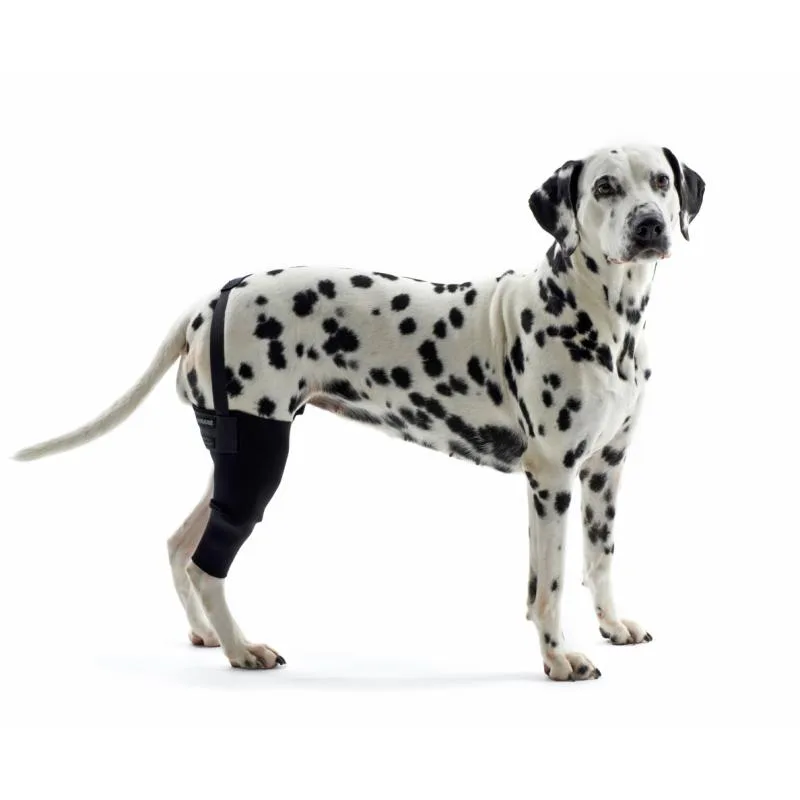
Start With the Measurements, Not the Breed Label
The KRUUSE Rehab Hock Protector XL is listed for large Rottweilers, large German Shepherds, large Golden Retrievers and Great Danes, but breed names alone won't tell you whether it sits correctly on your dog. The supplied record gives three measurements you can check against your dog's leg before you commit: a total height of 20.5 cm / 8.1", an upper width of 16 cm / 6.3" taken 1 cm from the edge, and a lower width of 13.5 cm / 5.3" taken 1 cm from the edge.
Measure around the leg above and below the hock and compare those circumferences with the upper and lower widths. The protector needs to stretch around the leg in both places, so the closer your dog's leg is to those widths, the more likely the XL is the right starting point. If your dog sits well outside them, the supplied information does not confirm an alternative size, so treat this as a reason to check with your vet or the store before ordering.
What the XL Record Confirms
-
KRUUSE Rehab Hock Protector XL: Total height, edge to edge: 20.5 cm / 8.1"; upper width 1 cm from edge: 16 cm / 6.3"; lower width 1 cm from edge: 13.5 cm / 5.3". These are the only dimensions supplied, so they are the basis for deciding whether the XL wraps your dog's hock without gaping or over-stretching.
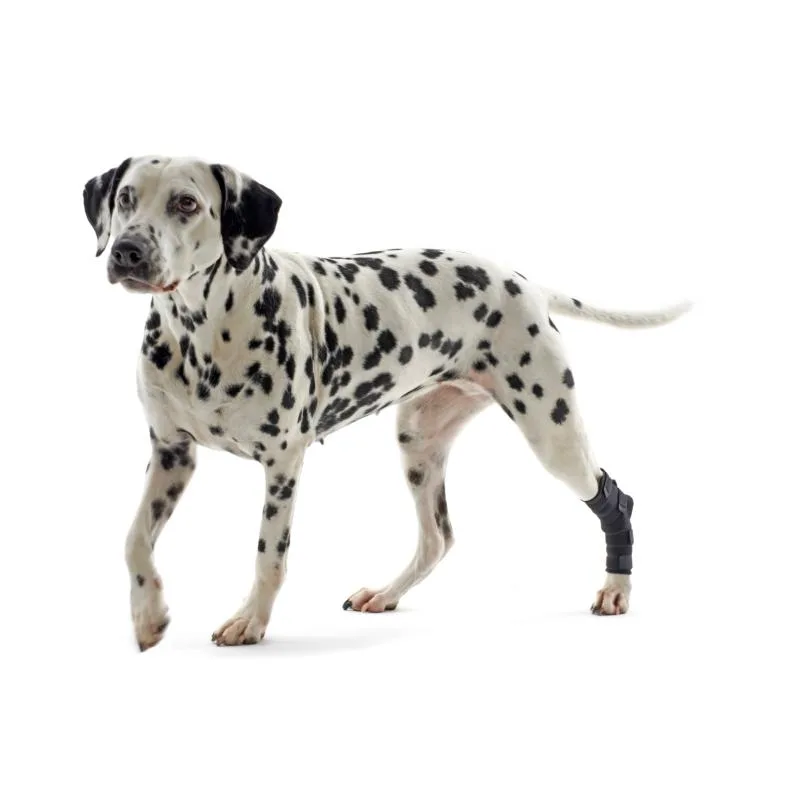
KRUUSE Rehab Hock Protector XL
-
KRUUSE Rehab Hock Protector XL: Made of 80% neoprene, 11% nylon and 9% polyester, and described as waterproof. Neoprene gives the stretch needed to pull the guard around the joint, and the waterproof construction matters because the protector sits near the ground.
-
KRUUSE Rehab Hock Protector XL: Suitable for large Rottweiler, large German Shepherd, large Golden Retriever and Great Dane; supplied as 1/pk. This confirms the XL is intended for large-breed legs, and that one protector arrives per pack.
How to Put the Hock Protector On
The supplied instructions describe one placement method. Work calmly and have your dog standing squarely so the leg is in a natural position.
- Guide the hock through the opening: Place the protector so the tip of the hock passes through the opening in the protector. This opening is what keeps the guard aligned over the point of the joint rather than sliding up or down the leg.
- Stretch it around the leg above and below the joint: Once the hock tip is through, stretch the neoprene around the leg both above and under the joint. Check that the upper and lower edges sit where you measured, with no bunching behind the leg.
- Check the inside stays dry: The supplied preparation note states that everything on the inside of the joint protector remains dry even in extremely poor weather. After fitting, confirm the inside surface is dry against the leg and that the outer neoprene is doing the weather-facing work.
Why Dryness Matters More Than You Might Think
The catalog explanation is specific: a wet joint protector cools down the joint and impairs the healing process, and because the hock sits close to the ground it easily becomes wet. That is the reasoning behind the waterproof neoprene and the note that the inside stays dry.
In practice, that means checking the inside of the guard after walks in wet grass, rain or snow, and drying it before the next wear. The supplied care instruction is to wash by hand and air-dry, so skip the washing machine and the tumble dryer; heat and agitation are not part of the confirmed routine.
Fit Checkpoints Before You Head Out
Run through these checks each time you fit the XL, especially in the first days of use.
- The hock tip sits in the opening: If the point of the hock is not through the opening, the guard is sitting on the wrong part of the leg and the upper and lower widths no longer line up with your measurements.
- Upper and lower edges follow the leg: The 16 cm upper width and 13.5 cm lower width should wrap the leg above and below the joint. Watch for the lower edge rolling or the upper edge gaping when your dog walks.
- The inside is dry: The supplied note says the inside remains dry even in extremely poor weather. If you feel dampness inside after a wet walk, dry the protector before putting it back on.
- Your dog moves without obvious rubbing: The record does not specify wear time or a walking schedule, so introduce the protector gradually and watch how your dog moves. If it slips or rubs, re-check the placement against the measurements rather than tightening it arbitrarily.
Where the XL Fits Into a Recovery Plan
The hock protector is listed for use before and after surgery, and for chronic arthritis including osteoarthritis, OCD, ligament injuries and arthritis, as well as other assessments. The catalog reasoning is that the healing period is long and the dog needs support around the joint so the injury does not worsen during healing. It was designed by ReDog of Sweden.
What the supplied information does not do is set a treatment plan. It gives no wear schedule, no exercise limits and no guidance on when to remove the protector, so those decisions belong with your veterinarian. Use the measurements and the fitting steps here to get the physical fit right, and let your vet direct how long and how often the guard is worn.