What makes this recipe suited to large breed puppies
Large breed puppies grow quickly, and their joints carry more weight during that growth than small breed puppies do. Super Premium Large Breed Puppy Food - Salmon & Potato is formulated with that in mind. The recipe includes a Joint Care Pack with glucosamine (355 mg/kg), methylsulfonylmethane (355 mg/kg) and chondroitin sulphate (250 mg/kg) to help support cartilage for healthy joints in large breed puppies.
Salmon makes up 36% of the recipe, including freshly prepared salmon, dried salmon and salmon gravy. Salmon is naturally rich in omega 3 essential fatty acids, which the product describes as having anti-inflammatory properties and providing support for skin and coat condition and joint health. The recipe also contains potato as an easily digestible carbohydrate source, which the product notes is ideal for dogs with sensitive digestion.
Key label facts for this large breed puppy food
-
Super Premium Large Breed Puppy Food - Salmon & Potato: Analytical constituents: Crude Protein 27%, Crude Fat 15%, Crude Fibre 2.5%, Omega 3 0.9%, Calcium 1.1%, Phosphorus 0.7%. These figures give you the nutritional profile to compare against other puppy foods or to discuss with your vet.
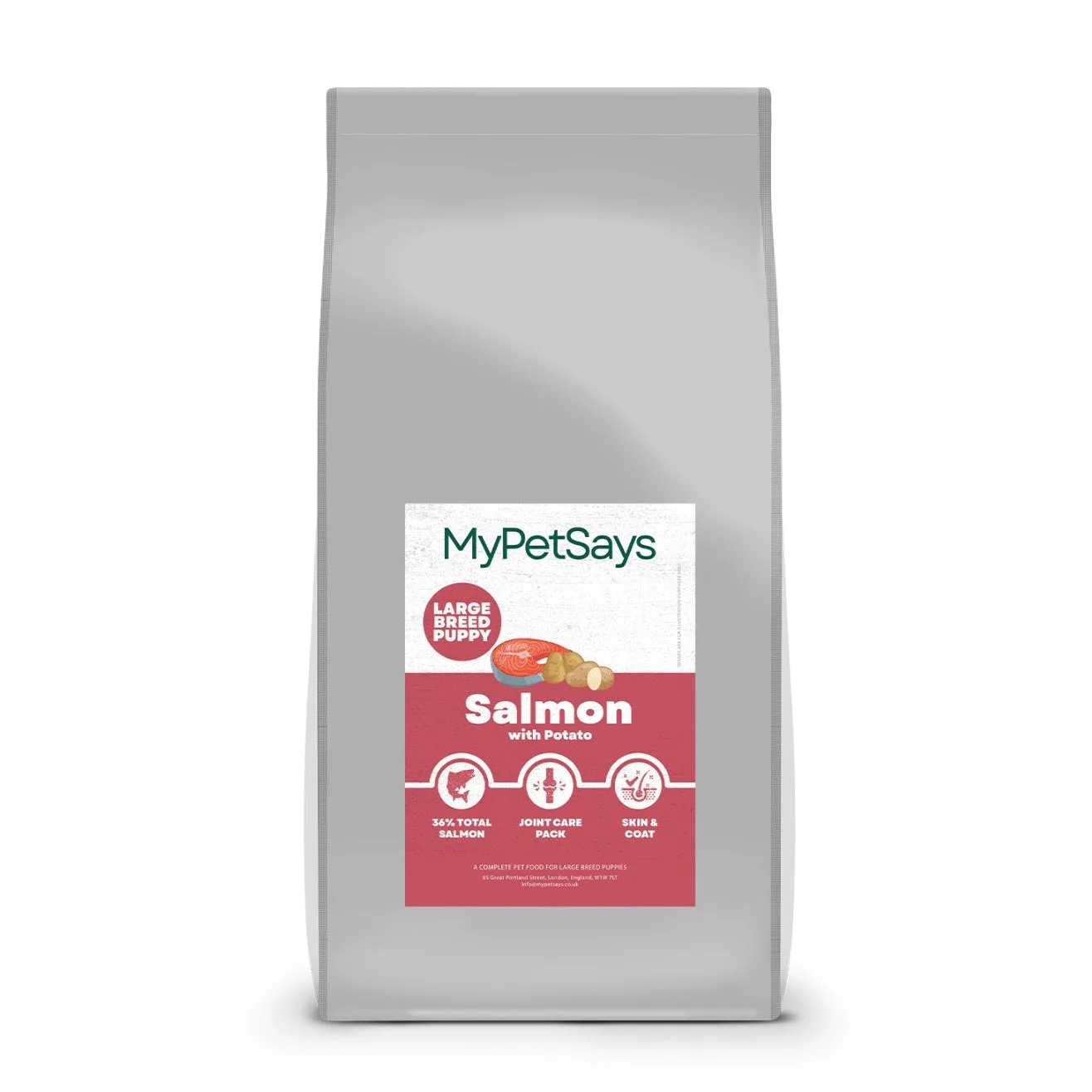
Super Premium Large Breed Puppy Food - Salmon & Potato
-
Super Premium Large Breed Puppy Food - Salmon & Potato: Metabolisable Energy 388 kcal/100g. Energy density matters when you are estimating how long a bag will last, though the label does not state a daily feeding amount.
-
Super Premium Large Breed Puppy Food - Salmon & Potato: Hypoallergenic recipe formulated without common food allergens for dogs: beef, pork, wheat, wheat gluten, dairy and soya. Useful if your puppy has shown sensitivity to those ingredients, but always confirm with your vet before changing diet.
How to use the bag size options in your routine
This food comes in 12kg, 15kg and 24kg bags. The 15kg bag is labelled "Working Dog" and has a different colour, but the composition and kibble size are exactly the same as the other bag sizes. That means you can choose based on convenience and storage space rather than any difference in the food itself.
For a single large breed puppy, a 12kg bag is a manageable starting point while you establish a routine. The 24kg bag suits multi-dog households or owners who prefer fewer reorders. Keep the bag sealed and stored somewhere cool and dry, and check the best-before date before decanting.
Feeding amounts: what the label does and does not tell you
The supplied product information does not include a feeding guide or daily portion recommendation. That is not unusual for a product page, but it means you should not guess a amount from the bag size or the energy figure alone. The metabolisable energy of 388 kcal/100g is a reference point, not a portion instruction.
Your puppy's daily intake depends on age, expected adult weight, activity level and body condition. Ask your vet or breeder for a starting amount, then adjust based on your puppy's body condition score at regular weigh-ins. The label gives you the nutritional profile to support that conversation, but it does not replace it.
A practical way to introduce this food
The supplied information does not include a transition schedule, so the steps below are general good practice rather than a manufacturer instruction. Always check with your vet if your puppy has a sensitive stomach or a known allergy.
- Start with a small proportion: Begin by mixing a small amount of the new food with your puppy's current food. The exact ratio is not specified in the supplied information, so use your judgement and your vet's advice.
- Increase gradually over several days: Slowly increase the new food while decreasing the old food. The product does not supply a fixed timeline, so watch your puppy's digestion and slow down if you see loose stools.
- Keep portions consistent: Once fully transitioned, stick to a consistent daily amount based on veterinary guidance rather than free-feeding, so you can monitor growth and body condition.
- Store the bag properly: Reseal the bag after each use and keep it in a cool, dry place. The 15kg Working Dog bag is the same food as the other sizes, so the same storage advice applies.
When to switch your large breed puppy food
The supplied product information does not state an age or weight at which to switch from puppy food to adult food. Large breed puppies are often fed a puppy formula until they reach a significant proportion of their adult size, but the exact timing depends on breed and growth rate. Your vet can assess your puppy's growth curve and advise when to transition.
If you are considering this food for a puppy that is already on another large breed formula, the transition steps above apply. If your puppy is approaching adulthood, ask your vet whether a large breed adult formula would be more appropriate before you buy another large bag.
What the ingredient list adds to your decision
The full ingredient list includes salmon 36% (freshly prepared salmon 22%, dried salmon 13%, salmon gravy 1%), potato 22%, barley, oats, chicken fat, potato protein, peas, beet pulp 2%, omega 3 supplement, minerals, vitamins, glucosamine, methylsulfonylmethane and chondroitin sulphate. The recipe is naturally preserved using rosemary extract and contains no added artificial colours or preservatives.
Barley and oats are included alongside potato, so this is not a grain-free recipe. If your puppy needs a grain-free diet for a diagnosed reason, this food is not the right choice. For puppies without grain sensitivity, the combination of salmon protein and digestible carbohydrates is designed to support growth and skin and coat condition.