Why a medallion quilt needs a quilting plan
A medallion quilt starts with one central block and builds outward through multiple borders. That structure is beautiful, but it can make machine quilting feel like a series of unrelated decisions. Each border is a new shape, a new scale, and a new chance for the quilting to look disconnected from the center.
The practical answer is to choose designs that work together before you start stitching. In the Machine Quilting a Medallion Quilt course, Natalia Bonner demonstrates a variety of designs that complement each other across the quilt, including free-motion quilting, ruler work, and feathers.
What the course covers
-
Machine Quilting a Medallion Quilt: Medallion-type quilts can often present a challenge because you start with one block and have multiple borders. This is the core problem the course addresses: coordinating quilting across a center block and several borders.
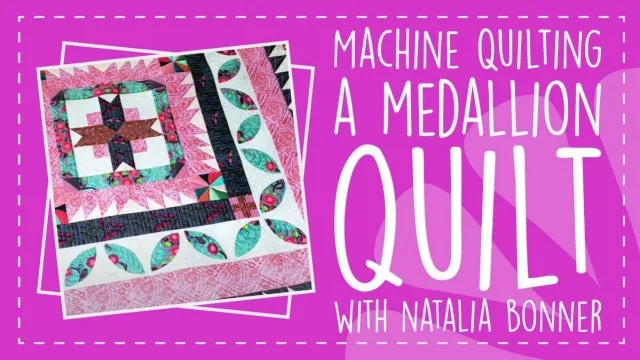
Machine Quilting a Medallion Quilt
-
Machine Quilting a Medallion Quilt: In this video Natalia will show a variety of designs that work well together, including FMQ, ruler work, feathers and more. You see how different techniques can be combined into one cohesive plan rather than treated as separate skills.
A simple way to build your medallion quilting plan
Use these steps as a planning framework, not a rigid sequence. The course shows the designs; you decide how they fit your quilt.
- Start with the center block: Treat the center as the anchor. Choose a design that feels right for its size and shape, and keep in mind that the borders will need to relate to it.
- Choose designs that repeat or echo: Natalia demonstrates designs that work well together. Look for shapes, curves, or motifs you can repeat or vary as you move outward.
- Assign techniques to borders: FMQ, ruler work, and feathers each bring a different texture. Decide which borders suit which technique based on the border width and the effect you want.
- Check the transition between center and first border: The first border sets the tone for the rest. Make sure the scale and style of quilting there connects visually to the center block.
- Keep the outer borders in mind: As you plan, think about how the outer borders will finish the quilt. A design that works in the center may need to be simplified or enlarged at the edge.
How to use the course while you quilt
Watch the video once before you start stitching to get the overall approach. Then, as you work on each section, revisit the relevant part. The course is a video, so you can pause and rewatch the designs that apply to your current border.
If you want more in-depth videos, the course mentions that you can become a member of the Piece N Quilt Academy and gain unlimited access to all membership videos. Note that unlimited access ends at termination of membership, and some restrictions may apply.
What this course does and does not decide for you
The course gives you a set of designs and shows how they can work together. It does not prescribe a single quilting plan for every medallion quilt.
- What it provides: Demonstrations of FMQ, ruler work, feathers, and other designs that complement each other across a medallion quilt.
- What you decide: Which designs to use in your center and borders, how to scale them, and how to adapt them to your quilt's dimensions and style.
- What is not confirmed: The supplied information does not list specific machine settings, thread requirements, or step-by-step instructions for each design. Treat the course as a visual guide and use your own machine and materials knowledge.
Course access details
- Machine Quilting a Medallion Quilt: To see more in-depth videos, become a member of the Piece N Quilt Academy and gain unlimited access to all membership videos. *Unlimited access ends at termination of membership. Some restrictions may apply. This explains the membership option for quilters who want more than the single course.
Who this course suits
This course is a good fit if you have a medallion quilt top waiting to be quilted and you want ideas for coordinating the center and borders. It is also useful if you are comfortable with basic machine quilting and want to see how FMQ, ruler work, and feathers can be combined in one project.
If you are looking for a single, rigid pattern to follow stitch by stitch, this course is not that. It is a demonstration of designs and how they can work together, leaving the final plan in your hands.