Why reverse a lens instead of buying a macro lens
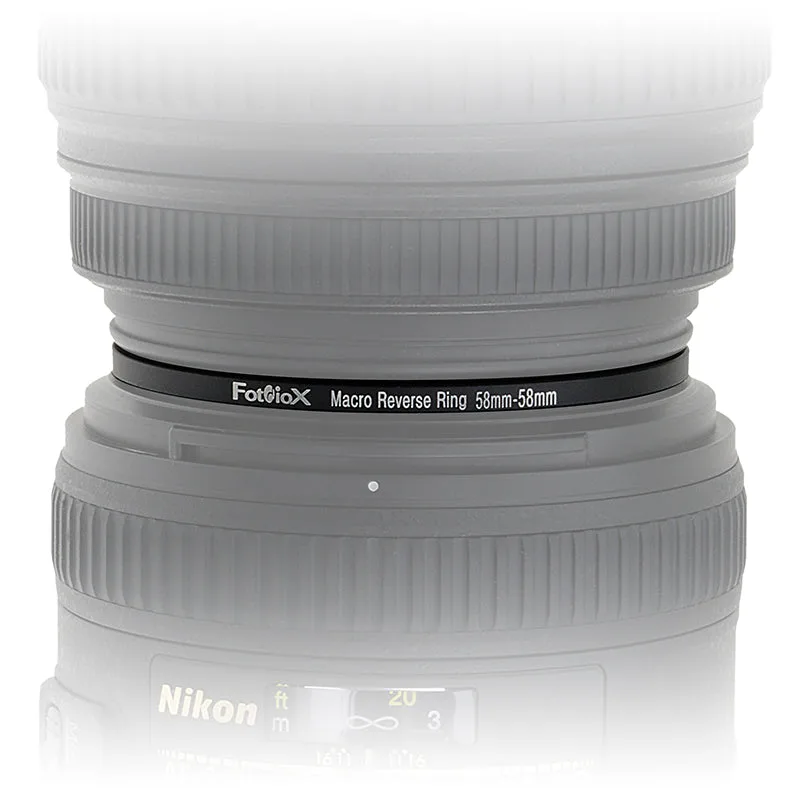
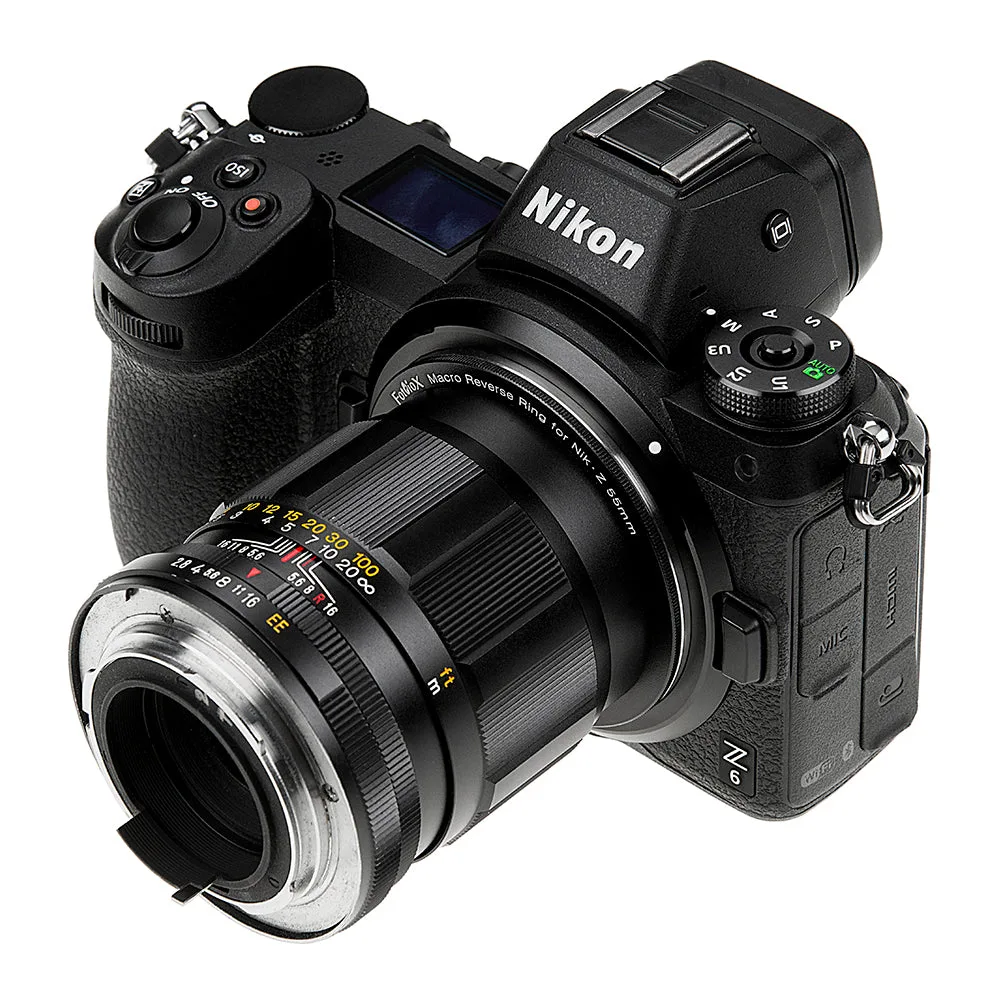
A reverse ring is a simple metal adapter that lets you mount a lens backward on your Nikon Z camera. The front filter thread of the lens screws into the ring, and the ring's camera mount attaches to the Z body. Because no glass is added, the lens keeps its original optical quality while you gain close-focusing capability. The Fotodiox Macro Reverse Ring for Nikon Z is made of hardened anodized aluminum and weighs only 0.5–0.8 oz, so it adds almost nothing to your bag.
The tradeoff is that all electronic communication stops. Autofocus, AE metering, and image stabilization are disrupted, and you will need to focus manually and set exposure manually or use aperture-priority mode. That makes a reverse ring best for static subjects and controlled lighting, not fast-moving handheld work.
Before you mount: three checks that save frustration
- Match the filter thread size: The ring is available in 49mm, 52mm, 55mm, 58mm, 62mm, 67mm, 72mm, and 77mm. Check the filter thread diameter printed on your lens or its cap. If your lens size falls outside these, step-up or step-down rings can bridge the gap, but the supplied information does not confirm specific step-ring combinations, so test the fit before relying on it.
- Confirm the lens has a manual aperture ring: Without a manual aperture control ring, the lens aperture will revert to its default position—either stopped down to its largest f-stop or opened to its smallest, depending on the lens. That may leave you with an unusable exposure. Lenses with a physical aperture ring give you control.
- Avoid focus-by-wire lenses: Focus-by-wire lenses such as Canon STM or Nikon AF-P require power to engage the manual focus ring. Since the reverse ring has no electrical contacts, those lenses will not be able to focus when reversed. Use a lens with a mechanically coupled focus ring instead.
Fotodiox Macro Reverse Ring for Nikon Z at a glance
-
Macro Reverse Ring for Nikon Z - Camera Mount to Filter Thread Adapter for Nikon Z-Mount Mirrorless Camera Mounts: Camera mount: Nikon Z-Mount Mirrorless Cameras; thread side accepts any lens with a filter thread, not just Nikon Z lenses. You can reverse legacy or third-party lenses on a Z body, turning almost any lens into a macro lens at low cost.
Macro Reverse Ring for Nikon Z - Camera Mount to Filter Thread Adapter for Nikon Z-Mount Mirrorless Camera Mounts
-
Macro Reverse Ring for Nikon Z - Camera Mount to Filter Thread Adapter for Nikon Z-Mount Mirrorless Camera Mounts: No optical insert; hardened anodized aluminum; weight 0.5–0.8 oz. The ring preserves the lens's original optical properties and adds negligible weight, which matters for handheld close-up work.
-
Macro Reverse Ring for Nikon Z - Camera Mount to Filter Thread Adapter for Nikon Z-Mount Mirrorless Camera Mounts: No electrical contacts; manual focusing and manual or aperture-priority exposure required. Plan for a fully manual workflow—autofocus, AE metering, and stabilization are disrupted.
-
Macro Reverse Ring for Nikon Z - Camera Mount to Filter Thread Adapter for Nikon Z-Mount Mirrorless Camera Mounts: Limited 2-year manufacturer warranty. The adapter is backed for two years, though the warranty does not cover lens compatibility issues.
Mounting and first exposure
Screw the ring onto the front filter thread of your lens, then attach the ring's Nikon Z mount to the camera body. The all-metal design and smooth surface are intended for an effortless mount. Once attached, the lens will be reversed, so the rear element faces your subject and the front element faces the camera.
Set your camera to manual focus and either manual exposure or aperture-priority mode. Some Nikon Z bodies may display an 'Error Lens Not Attached – Check lens' message; the supplied notes indicate that certain camera settings may be needed to work with the adapter. Check the Fotodiox Knowledge Base for possible solutions by camera brand. Expect to experiment with different lens focal lengths to find a magnification and working distance you like—the supplied information does not prescribe specific focal lengths or magnification ratios.
What to expect in use
- Working distance becomes very short: Reversing a lens typically brings the front element close to the subject. The supplied information does not state minimum focus distances, so test carefully to avoid bumping the lens into your subject or lighting.
- Aperture control depends on the lens: If your lens has a manual aperture ring, you can stop down for more depth of field. Without one, the aperture defaults to an extreme position, which may limit usable exposures.
- Stabilization and metering are unavailable: Because the connection is fully manual, in-camera metering and stabilization are disrupted. Use a tripod and manual exposure for consistent results.
When a reverse ring makes sense—and when it doesn't
This adapter is a good fit if you already own a lens with a manual aperture ring and a filter thread in one of the supported sizes, and you want to try extreme close-up photography without buying a dedicated macro lens. It is also useful for repurposing older lenses on a Nikon Z body. The low weight and all-metal build suit occasional use in a lightweight kit.
It is not the right choice if your only lenses are focus-by-wire or lack a manual aperture ring, or if you need autofocus and automatic exposure for moving subjects. In those cases, the manual workflow will be frustrating. Also note that the supplied information does not confirm compatibility with specific lens models beyond the filter-thread and manual-control requirements, so verify your lens before ordering.