Quick answer
For travel, magnetic puzzles are the better pick for most families because pieces stay put and the case doubles as a work surface. Choose a traditional jigsaw only when you have a flat table and a child who can handle loose pieces without losing them.
Why piece security matters on the road
On a plane, train, or in a hotel room, the biggest enemy of a jigsaw is a sudden jolt. Traditional jigsaw pieces scatter and slide, and you can spend more time hunting for lost pieces than actually puzzling. Magnetic puzzles solve this by using pieces that stick to a magnetized board, so they stay in place even when the tray is tilted or bumped.
That built-in stickiness also means fewer pieces end up on the floor, under seats, or in the bottom of a bag. For parents, that translates to less stress and fewer tears mid-trip.
Portability: case design and storage
Traditional jigsaws usually come in a flimsy box that doesn't seal well once opened. You need a separate tray or board to build on, and storing unfinished work is tricky. Magnetic puzzles often come in a tri-fold portfolio that closes securely, so you can pack up mid-puzzle without losing progress.
That fold-and-go design is a real advantage when your child wants to switch activities or when it's time to get off the train. You don't need to find a flat surface to keep the puzzle safe—just close the case and tuck it away.
Age and skill considerations
Traditional jigsaws offer a wider range of piece counts and complexity, which is great for older kids who enjoy a challenge. Magnetic puzzles, like the 20-piece sets in the Mudpuppy to Go series, are simpler and more suitable for younger children who are still developing fine motor skills.
If your child is under five, magnetic puzzles are often easier to handle because the pieces don't slide around. Older kids who can manage a tray and have the patience to sort pieces may enjoy the extra challenge of a traditional jigsaw.
Trade-offs at a glance
- Piece security: Magnetic puzzles hold pieces in place; traditional jigsaws scatter with movement. Choose magnetic for planes, trains, or car rides. If you'll be in bumpy or cramped spaces, magnetic is the safer bet.
- Setup and workspace: Magnetic puzzles need no extra tray and work on your lap; traditional jigsaws require a flat, stable surface. Pick magnetic when a table isn't guaranteed. Pack a magnetic puzzle for picnics or waiting rooms where tables are scarce.
- Complexity and longevity: Traditional jigsaws offer more piece counts and challenge; magnetic sets are simpler and better for younger kids. Choose traditional for older children who want a longer activity. Match the puzzle difficulty to your child's age and attention span.
Product spotlight
-
Bugs & Birds Magnetic Puzzles: The Bugs & Birds Magnetic Puzzles come in a portable tri-fold portfolio with 2 puzzles, each with 20 magnetic pieces, and an extra magnetic surface for packing up. This design keeps pieces secure and lets you pause and resume the puzzle anywhere, making it ideal for travel without a flat table.
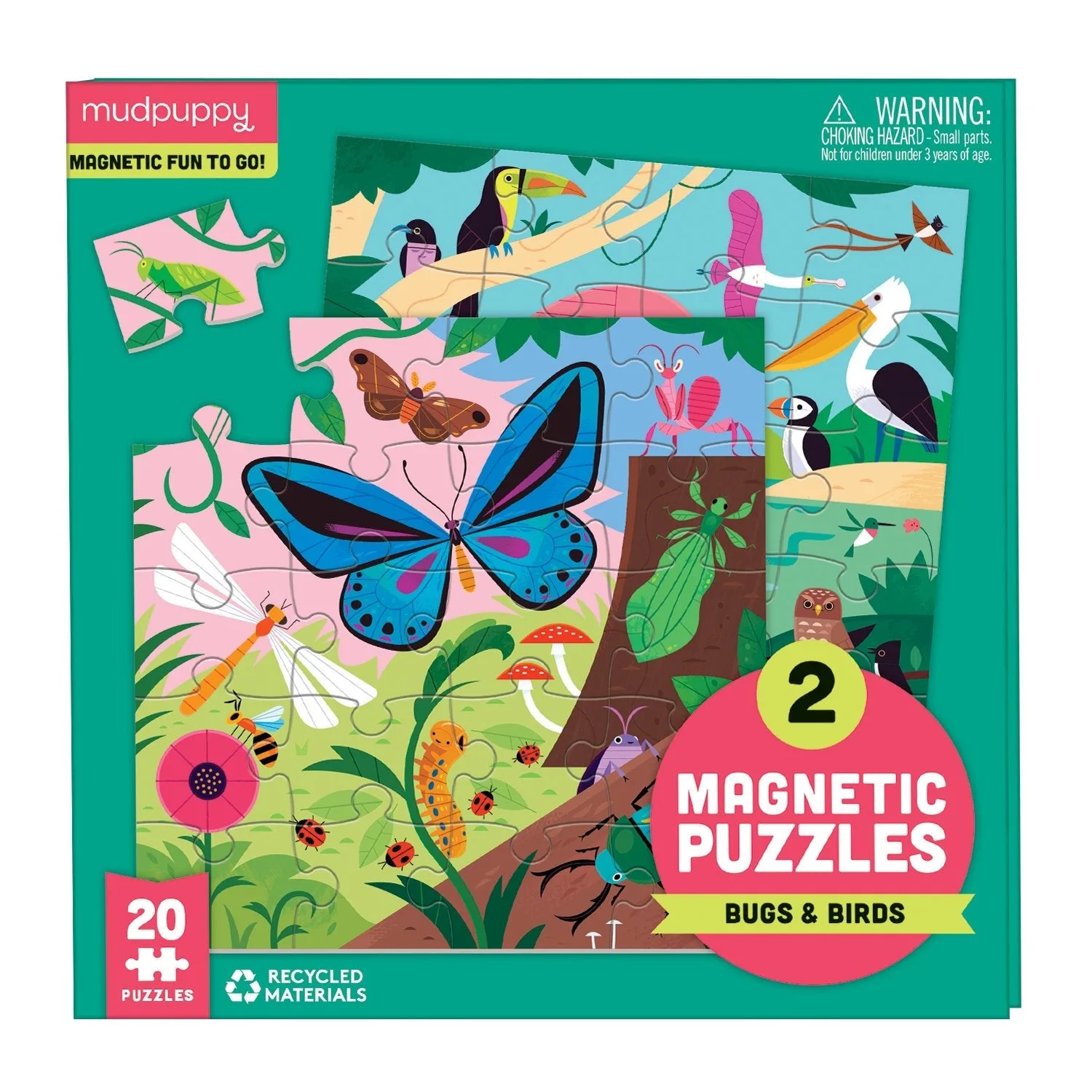
Bugs & Birds Magnetic Puzzles
Which should you choose?
Best for
- Families traveling by plane, train, or car where space is tight and movement is constant
- Young children (ages 3-6) who need pieces to stay put and enjoy simple, themed puzzles
Not for
- Older kids who crave a bigger challenge and have a stable table to build on—they may prefer a traditional jigsaw