Quick answer
Magnetic tiles and building blocks develop different skills. Blocks build patience, precision, and gravity-based problem-solving. Magnetic tiles build spatial reasoning, quick iteration, and confidence through instant connections. For most families, magnetic tiles win for toddlers and early STEM play because they are forgiving and fast. Blocks win for older kids who want realistic structures and fine-motor precision. The best choice depends on your child's age and frustration tolerance.
How magnetic tiles and blocks differ in play
Magnetic tiles snap together with magnets, so pieces self-align and hold their shape. That means a toddler can build a tower or a house without perfect hand control. Blocks require stacking and balancing; one wrong move and the tower falls. This difference shapes the entire play experience: tiles encourage rapid experimentation, while blocks teach careful planning and patience.
Because tiles stay connected, kids can pick up and move their creations. Blocks are usually stationary once built. That portability changes how children play—tiles become cars, castles, or houses that travel. Blocks become cities or towers that stay put.
Fine motor skills: which toy develops what
Blocks develop precise hand-eye coordination and a steady grip. Placing a small block on top of another without knocking it over takes control. That is excellent practice for handwriting and other fine-motor tasks. Magnetic tiles also build fine motor skills, but differently: children practice pinching, pulling apart, and aligning edges. The magnetic pull gives feedback, so the task is less frustrating for beginners.
For toddlers, tiles offer earlier success. For preschoolers and older kids, blocks add a challenge that tiles may not provide once the child masters the magnetic connection.
STEM learning: spatial reasoning vs. engineering
Magnetic tiles shine for spatial reasoning and geometry. Kids see how triangles and squares combine into 3D shapes. They learn about symmetry, area, and structure without formal instruction. Tiles also make it easy to test ideas quickly—if a design fails, you can adjust one piece instead of rebuilding from scratch.
Blocks teach engineering and physics more directly: balance, center of gravity, and load-bearing. A block tower that falls teaches a clear lesson about stability. Both are valuable STEM toys, but they emphasize different concepts. Tiles lean toward math and design; blocks lean toward physics and construction.
Age and frustration tolerance
For under-3s, large magnetic tiles are often easier to handle than small blocks, which can be a choking hazard. Tiles also reduce frustration because they stay together. For ages 4–7, both work well. Blocks become more appealing as fine motor control improves. For ages 8+, blocks and more advanced building sets (like those with motors or gears) may hold attention longer, while magnetic tiles can still be used for rapid prototyping or decoration.
If your child gets upset when a tower falls, tiles may be a better starting point. If your child enjoys a challenge and has the patience to rebuild, blocks are a great choice.
Storage, durability, and cleanup
Magnetic tiles are typically plastic and easy to wipe clean. They stack flat, so storage is simple. Blocks are often wood or plastic; wooden blocks can dent or chip over time, and they are heavier. Both require cleanup, but tiles’ magnetic attraction can make them easier to gather—they stick together in a bin.
Durability: high-quality magnetic tiles last for years, but the magnets can weaken if dropped repeatedly. Blocks are simple and rarely break, but painted blocks may show wear. Consider your storage space and tolerance for noise—blocks make more clatter when they fall.
Trade-offs: magnetic tiles vs. blocks
- Ease of building: Magnetic tiles self-align and hold together, so toddlers can build successfully with less frustration. Blocks require steady hands and balance, which can be harder for young children. Choose tiles for beginners; choose blocks for kids who enjoy a physical challenge.
- Skill development: Tiles emphasize spatial reasoning, geometry, and rapid iteration. Blocks emphasize patience, precision, and gravity-based engineering. Both are valuable; pick based on whether you want to foster design thinking or construction persistence.
- Portability and play patterns: Tile creations can be moved and played with as toys (e.g., a house that travels). Block creations are typically stationary and become dioramas. If your child likes to carry and animate their builds, tiles have an edge.
- Longevity and expansion: Magnetic tile sets can combine across sets and scales (standard, micro, rails). Blocks are often limited to one scale and may become less interesting as kids age. Tiles offer more room to grow with add-on sets and themes.
MAGNA-TILES sets that show the trade-offs
- House 28 Piece Set: House 28 Piece Set includes unique door and staircase pieces plus a sheet of reusable stickers with 20 home-related images. These special pieces let kids build a recognizable house, bridging the gap between abstract tiles and realistic block play. The stickers add storytelling, which blocks alone don't offer.
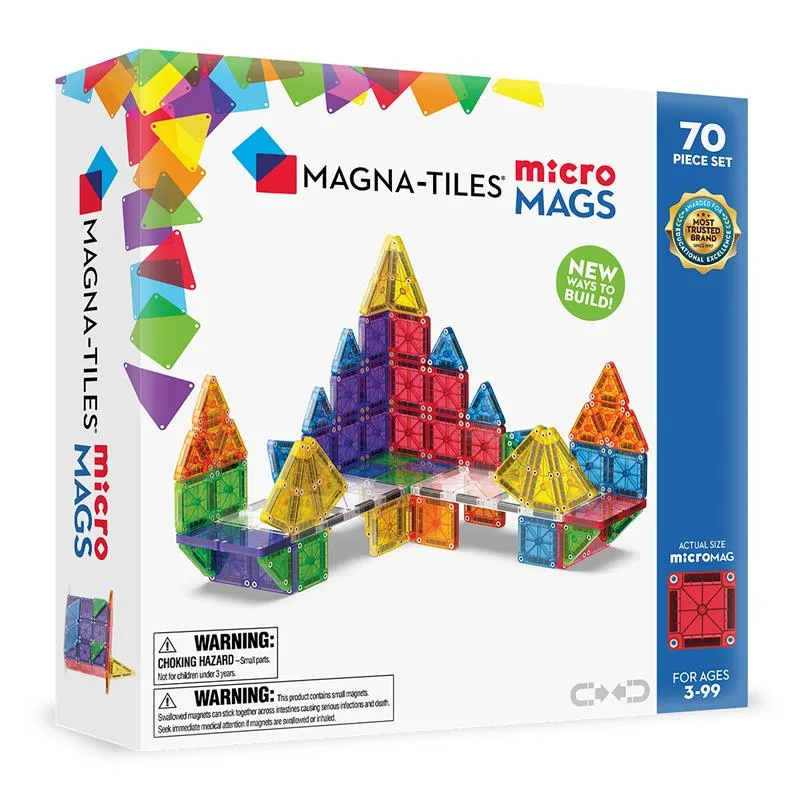
- microMAGS™ 70 Piece Set: microMAGS 70 Piece Set is 75% smaller than traditional MAGNA-TILES pieces and can combine with every MAGNA-TILES set. Smaller pieces require more precise fine motor control, similar to blocks, but still offer magnetic forgiveness. This set grows with a child who has mastered standard tiles.
- Rail Racers Max 80 Piece Set: Rail Racers Max 80 Piece Set includes trapdoor tiles, curved and short track pieces, quarter arcs, and classic tiles for multi-level raceways and ball runs. This set introduces motion and engineering challenges—height, drops, and ball runs—that rival block-based marble runs, but with magnetic ease.
Which building toy is better for your child?
Magnetic tiles are best for
- Toddlers and preschoolers who get frustrated when towers fall
- Families who want a portable building toy that can be played with on the go
- Kids who enjoy open-ended, themed play (houses, castles, vehicles)
- Parents looking for a STEM toy that grows with add-on sets
Blocks are better for
- Children who want to build realistic, load-bearing structures like bridges or skyscrapers
- Older kids (8+) who crave a precise, challenging building experience
- Families with limited storage who prefer a single, simple toy
- Kids who enjoy the satisfying clack of wooden blocks and don't mind rebuilding