Quick answer
Use a Makroschlitten to shift your camera in millimeter increments between shots, then combine the sharpest areas in post-processing for a fully focused macro image.
Why a Makroschlitten matters for focus stacking
In macro photography, depth of field is extremely shallow—often just a few millimeters. Even at small apertures, you cannot get the entire subject sharp in one shot. A Makroschlitten lets you move the camera forward or backward in precise, repeatable steps, keeping the focus plane consistent while capturing different slices of the subject. This is far more accurate than adjusting the focus ring manually, which can introduce slight shifts in composition.
The Rollei Makroschlitten, for example, offers 14 mm of travel per revolution, giving you the fine control needed for stacking small subjects like insects, coins, or flower stamens. Its two-directional movement also helps you reposition the camera without touching the tripod head, saving time and reducing vibration.
How to do focus stacking with a Makroschlitten
- Set up your camera and subject: Mount your camera on the Makroschlitten, which sits on a sturdy tripod. Position the subject so the closest point of interest is just in focus. Use a remote shutter or self-timer to avoid camera shake. A common mistake is using a flimsy tripod; vibrations ruin the alignment between shots.
- Determine the number of steps: Estimate the total depth of your subject and divide by the depth of field at your chosen aperture. For a 10 mm deep flower at f/11 (approx. 2 mm DOF), you need about 5 steps. Use the Makroschlitten's scale to mark each position. Overlapping steps by 30-50% gives you more leeway in post-processing and reduces artifacts.
- Take the sequence: Start at the nearest focus point, take a shot, then turn the Makroschlitten knob by the calculated amount. Repeat until you reach the farthest point. Keep lighting and exposure constant. Check the first and last frame on your LCD to ensure you covered the entire subject—missing a slice means redoing the stack.
- Merge the images in software: Import the series into a focus stacking program like Helicon Focus, Zerene Stacker, or Photoshop. Align and blend the sharpest areas. Fine-tune the result by masking out any halos or ghosting. Save your source files; you may want to re-stack with different settings later.
Product facts
-
Makroschlitten: 14 mm hub per revolution for millimeter-precise adjustment This fine control lets you take the exact number of steps needed for a smooth focus stack, even on tiny subjects.
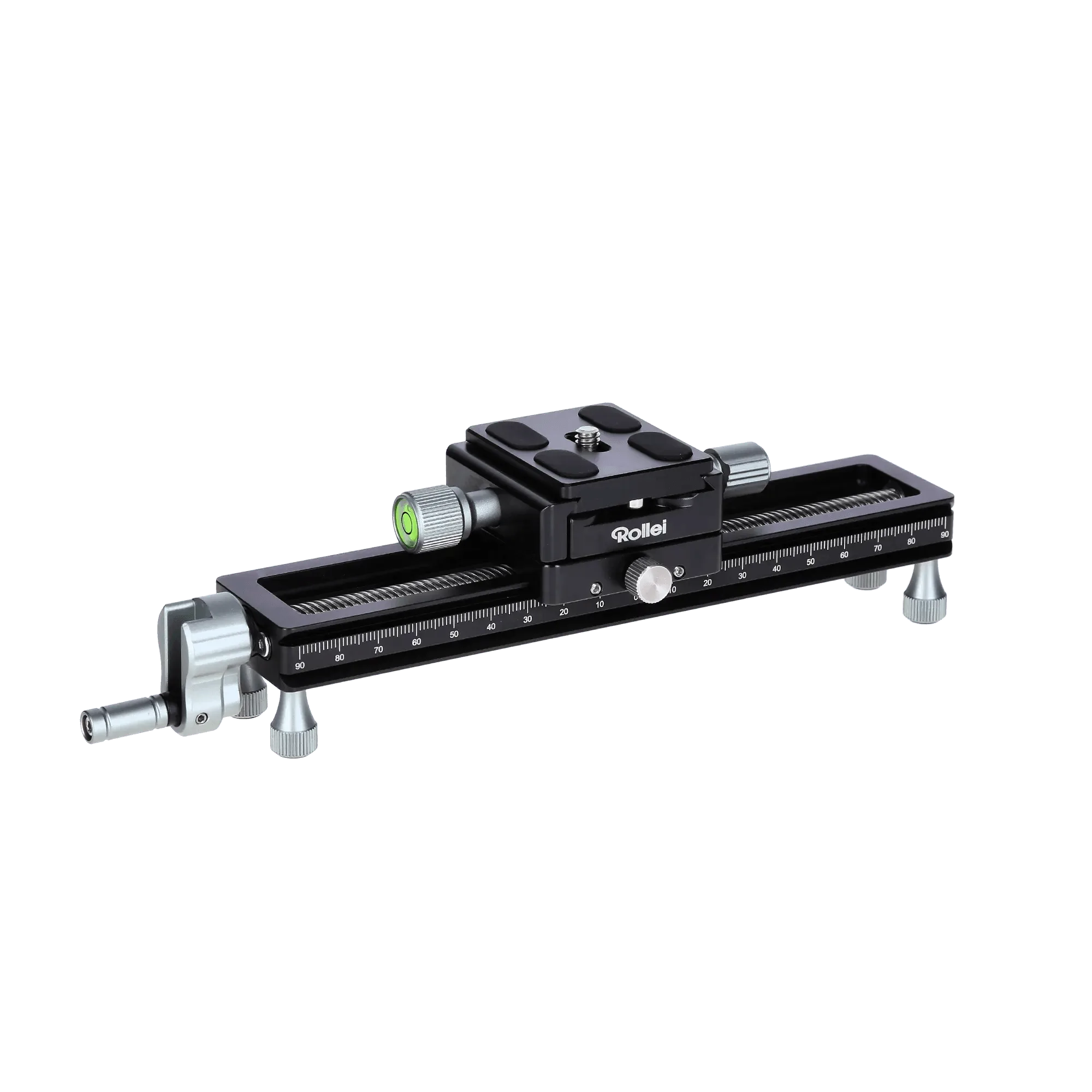
Makroschlitten