Quick answer
The Manfrotto 1051BAC Stacker Stand 3-Pack gives you three matching stands for a small studio, and the fastest way to set them up is to assign each stand a permanent job: key light, fill light, and background or accent light. Add the Manfrotto 110G Wheel Set if you need to roll the setup, and use the Manfrotto 045-6 Background Paper Hooks when you want to hang multiple paper rolls from one stand pair. Plan the positions before you tighten anything, and label each stand so your next setup is faster.
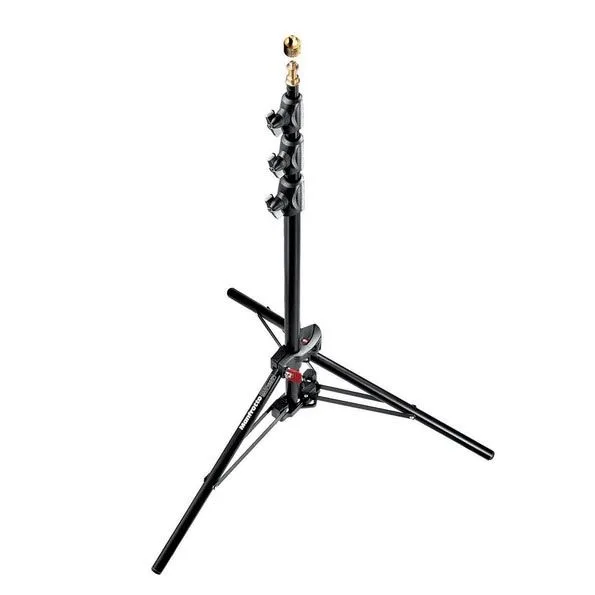
Manfrotto 1051BAC Stacker Stand
Why a matched three-stand kit changes small-studio workflow
A compact studio usually fails for one of two reasons: too many mismatched stands, or too few stands for the lighting plan. The 1051BAC Stacker Stand 3-Pack solves both by giving you three identical stands that stack for storage and share the same footprint. Identical stands mean you can swap positions without re-learning height markings, and they pack into less floor space between shoots. If you are searching for the best stacker stand for studio use, the value here is consistency rather than a single standout specification.
The tradeoff is that a three-pack locks you into one stand model. If your work needs a boom arm or a very tall overhead position, check whether the 1051BAC meets that need before buying, because the catalog does not list a maximum height or load rating for this pack. Treat it as a compact-to-mid studio stand until you confirm those numbers.
Step 1: Map your light positions before you unpack
Sketch the room and mark where the subject, camera, and background will sit. Then place three stand positions: key light at roughly 45 degrees to the subject, fill light opposite and slightly lower, and a third stand for background, hair, or accent light. Walk the path a photographer or assistant would take between the camera and the background. If that path crosses a stand, move the stand now rather than after you have mounted a light.
- Common mistake: placing stands by eye and discovering the tripod or subject chair collides with a leg.
- Checkpoint: every stand should have at least one clear walking side.
Step 2: Deploy the three stands and lock the leg spread
Unstack the three stands and open each leg set fully before raising the column. Set the leg spread first because it determines the base footprint and stability; raising the column first makes the stand top-heavy while you adjust. Tighten every leg lock by hand, then do a light push test on the top of each stand to confirm no leg slides. Work from the background stand forward so you are not stepping over open legs.
- Common mistake: leaving one leg lock finger-tight, which shows up as a slow sink once a modifier is mounted.
- Checkpoint: with the column down, each stand should sit flat with no rocking.
Step 3: Set heights in a repeatable order
Raise the background or accent stand first, then the key light, then the fill. Setting the background height first gives you a reference line for the top of the frame. Record the height of each stand in a notebook or phone note, using the same reference point each time, such as the top of the column. Because the catalog does not supply a maximum height for the 1051BAC pack, stop raising a section if you feel resistance and never force a lock.
- Common mistake: raising the key light to full height and then trying to match the fill by eye, which wastes time on every shoot.
- Checkpoint: write down the three heights so the next setup is a repeat, not a rebuild.
Step 4: Add mobility only where it helps
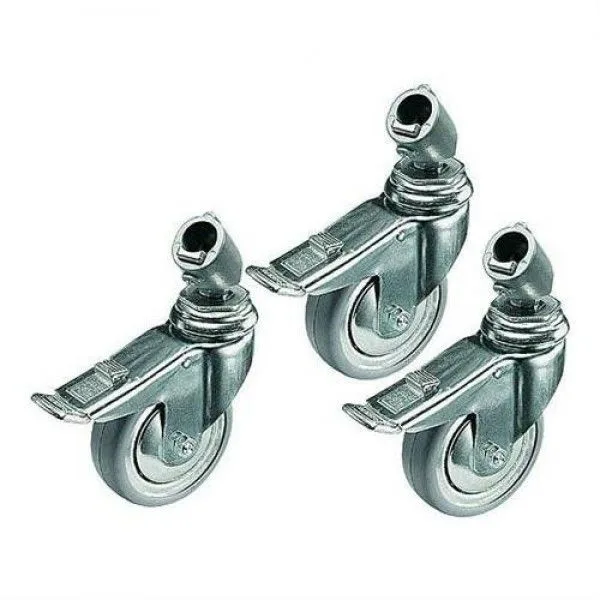
If you share the room or move between setups, the Manfrotto 110G Wheel Set 100mm w/ Brakes fits any light stand leg with a 22mm round leg ending. That compatibility note matters: measure your stand leg ends before ordering, because a non-round or different-diameter leg will not accept the adapter. Braked casters are the right choice for a studio floor because you can lock a stand in place, adjust a light, then unlock and roll. Do not put wheels on a stand that will hold a heavy boom unless you lock the brakes and keep the load centered.
- Common mistake: buying casters for every stand when only the two front stands actually need to move.
- Checkpoint: after fitting wheels, confirm each brake holds the stand still when you nudge the top.
Step 5: Set up backgrounds with the right hooks
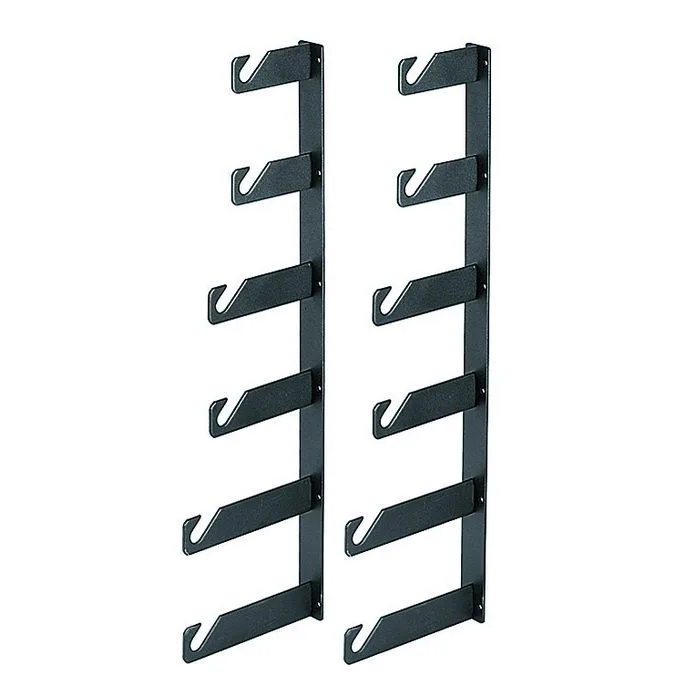
For paper backgrounds, the Manfrotto 045-6 Background Paper Hooks support up to six backgrounds and are designed for use with the Manfrotto 046M or Kupo KPDS01 background support systems. That means the hooks are not a standalone background stand; they are the part that lets one support frame hold several rolls. Use them when you want to switch paper colors quickly instead of swapping a single roll. Keep the rolls balanced left and right so the crossbar does not twist, and check that the hooks are seated before you pull paper down.
- Common mistake: hanging six rolls and then trying to move the support without checking the hooks are fully engaged.
- Checkpoint: pull a short length of paper from the roll you plan to use first to confirm it feeds smoothly.
Step 6: Cable, sandbag, and label the setup
Run power and sync cables down the back of each stand, leaving a small service loop at the top so a raised light does not pull on the connector. Sandbag the base of any stand that holds a modifier or sits in a walkway, and place the bag on the leg that points toward the subject for the most stable counterweight. Label each stand with a number or color tape that matches your lighting diagram. Labeling is the step most people skip, and it is the one that saves the most time on the next shoot.
- Common mistake: taping cables to the column above a leg lock, which prevents the stand from collapsing for storage.
- Checkpoint: collapse one stand fully as a test to confirm cables and tape do not block the sections.
Studio setup steps at a glance
- Map positions first: Sketch subject, camera, and three stand positions before unpacking. Leave one clear walking side per stand. Checkpoint: no stand leg blocks the camera-to-subject path.
- Open legs, then raise columns: Set the leg spread and tighten every leg lock by hand before raising any column. Push-test each stand top. Checkpoint: no leg slides and no rocking with the column down.
- Set heights in order: Background stand first, then key, then fill. Record each height using the same reference point. Checkpoint: three heights written down for a repeatable setup.
- Add wheels only where needed: Use the Manfrotto 110G Wheel Set on round 22mm leg ends. Lock brakes before adjusting a mounted light. Checkpoint: each brake holds the stand still when nudged.
- Hang backgrounds with the right hooks: Use the Manfrotto 045-6 hooks with a Manfrotto 046M or Kupo KPDS01 support. Balance rolls left and right. Checkpoint: hooks fully seated before pulling paper.
- Cable, sandbag, and label: Leave a service loop at the top, sandbag stands with modifiers, and label each stand to match your diagram. Checkpoint: one stand collapses fully without cable interference.
Product facts
- Manfrotto 1051BAC Stacker Stand (3 Pack): Manfrotto 1051BAC Stacker Stand (3 Pack) Three matching stands give you a consistent base footprint and let you assign key, fill, and background roles without mixing stand types. The catalog does not list a maximum height or load rating for this pack, so confirm those numbers if you plan to use heavy modifiers or a boom.
- Manfrotto 110G Wheel Set 100mm w/ Brakes: The Manfrotto 110G Braked Caster Set features 3 wheels, each with a diameter of 100mm, with an adapter for any light stand legs that have a diameter of 22mm. They are compatible with almost any light stand that has a round leg ending of 22mm. Measure your stand leg ends before ordering. If the legs are round and 22mm, these braked casters let you roll a stand into position and lock it, which is useful in a shared or multi-setup studio.
- Manfrotto 045-6 Background Paper Hooks For Six Expan 046 sets: Set of 2 background holder Hooks support up to 6 backgrounds Made of steel To be used with Manfrotto 046M or Kupo KPDS01 These hooks are for a background support system, not a standalone stand. They let one support frame hold several paper rolls so you can change background color without swapping a single roll.