Quick answer
If your child is 8+ and ready for a fast-paced cooperative challenge that mixes multiplication with exponents, Math Rush 2 is the stronger pick. If you want a more straightforward multiplication drill without exponents, Math Rush 3 may fit better.
Math Rush 2: Speed and Exponents
Math Rush 2 is a real-time cooperative card game designed for 1 to 5 players aged 8 and up. Each round lasts about 15 minutes, and the game pushes players to balance strategy and speed while solving multiplication and exponent problems.
The inclusion of exponents adds a layer of complexity that rewards players who already feel confident with basic multiplication facts. It’s not just about knowing the answer—it’s about thinking fast under pressure.
Math Rush 3: A Different Focus
Math Rush 3 shifts the focus away from exponents, emphasizing pure multiplication fluency. This makes it a better fit for younger players or those who are still building their times-table recall.
Because the math is more straightforward, Math Rush 3 can be played with less supervision and may feel less intimidating for kids who are new to cooperative games.
The Trade-Off: Depth vs. Accessibility
Choosing between the two games is a trade-off between depth and accessibility. Math Rush 2 offers a richer mental workout with exponents but demands a higher baseline skill. Math Rush 3 is easier to jump into but won’t stretch advanced players as much.
Consider your child’s current math confidence and whether you want a game that grows with them or one that delivers immediate fun.
How to decide: Math Rush 2 vs Math Rush 3
- Skill level: If your child has mastered basic multiplication facts (up to 12x12) and is comfortable with powers, Math Rush 2 will engage them. If they still hesitate on times tables, Math Rush 3 is the safer starting point.
- Play style: Both games are cooperative and real-time, but Math Rush 2 adds exponent calculations that can slow down a group not yet fluent. For a smoother first cooperative experience, choose Math Rush 3.
- Long-term value: Math Rush 2 offers more room to grow as your child’s math skills advance, making it a better investment if you want a game that stays challenging. Math Rush 3 may be outgrown faster. If you're unsure, consider your child's current math level and how quickly they pick up new concepts.
Product facts
-
Math Rush 2: Multiplication & Exponents | A Cooperative Time-Based Educational Math Flash Card |STEM Game to Master Mental Math Skills: Math Rush 2 is a real-time cooperative game for ages 8+, 1-5 players, with 15-minute rounds and math concepts covering multiplication and exponents. This tells you it’s a fast, team-based challenge that suits older kids who can handle exponent notation under time pressure.
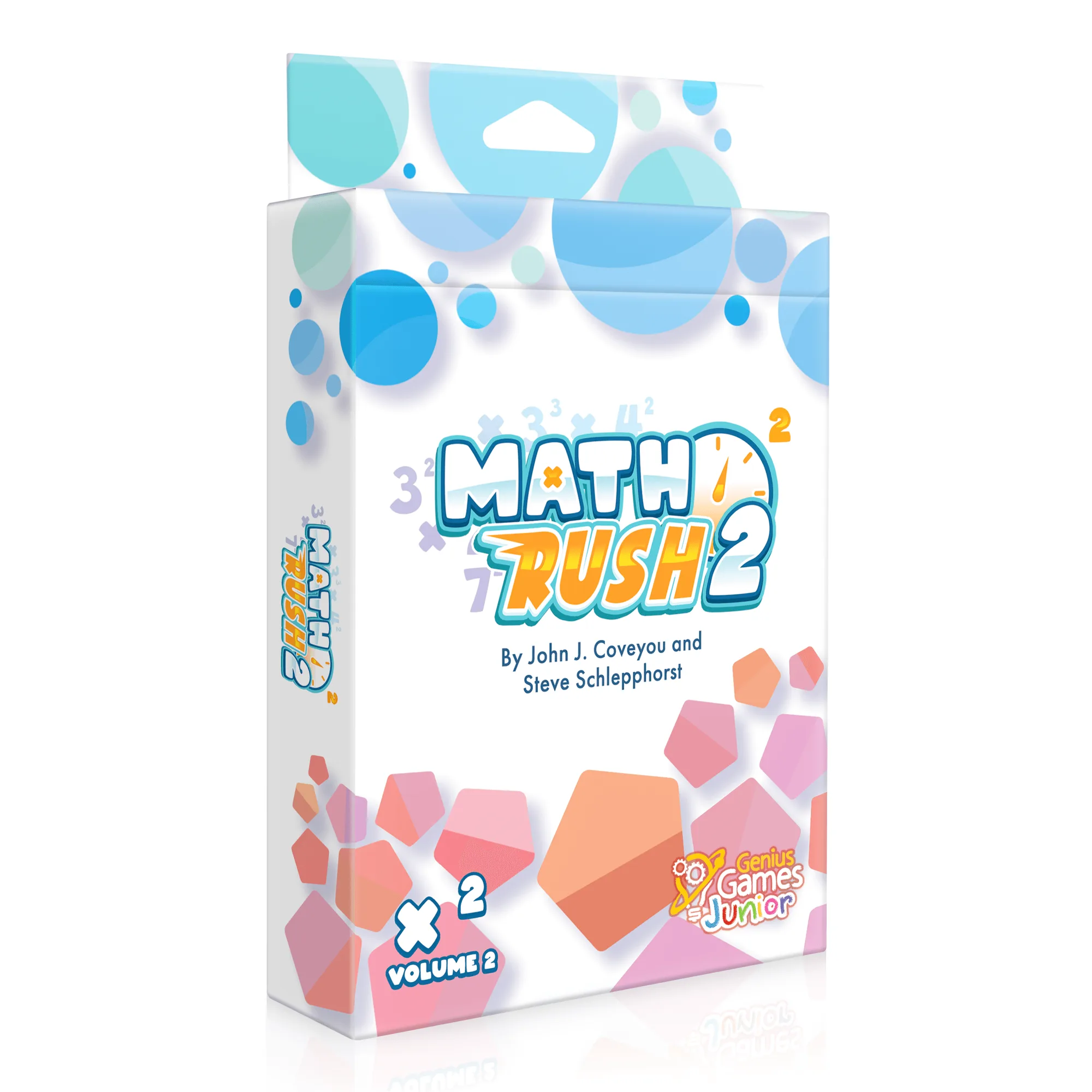
Math Rush 2: Multiplication & Exponents | A Cooperative Time-Based Educational Math Flash Card |STEM Game to Master Mental Math Skills
Which game fits your family?
Best for
- Kids aged 10+ who enjoy a mental challenge and already know their multiplication facts
- Families that want a cooperative game with a bit more strategic depth
Not for
- Younger kids (under 8) who are still mastering basic multiplication
- Players who prefer a calmer, turn-based math practice without time pressure