Quick answer
Use the mBot2 Rover outdoors by building its three forms, programming custom emojis on the display, and testing it on grass, gravel, or dirt tracks.
Why outdoor play matters for coding robots
Most coding robots stay indoors on smooth floors, limiting real-world testing. The mBot2 Rover's shock-resistant tracks and multi-terrain design let you explore outside, where bumps and slopes add authentic engineering challenges.
Choosing the right build for your terrain
The kit offers three forms: mBot2 (basic coding robot), mBot2 Rover (tank with DIY emojis), and mBot2 Ranger (tank with robotic arm). For outdoor activities, the Rover or Ranger builds provide better stability on uneven ground.
Step-by-step outdoor coding activities
- Assemble the Rover or Ranger form: Follow the instructions to build the track-based version instead of the basic mBot2. The tracks provide better grip on grass and gravel. Common mistake: using the standard mBot2 wheels outdoors—they slip on loose surfaces.
- Program a simple drive sequence: Use mBlock software (Scratch-based) to code forward, backward, and turn commands. Test on flat ground first, then add a slight slope. Checkpoint: if the robot veers, adjust the motor power values equally on both sides.
- Customize the emoji display: In mBlock, use the AI-generate or free-doodle tool to create an emoji. Upload it to the Rover's full-color screen. Program it to change when the robot hits an obstacle. Common mistake: forgetting to save the emoji file before uploading—always confirm it's in the correct format.
- Create an outdoor obstacle course: Mark a 10-foot path with cones or sticks. Code the Rover to navigate around them. Add a timer to challenge reaction times. Checkpoint: test each segment separately before combining the full course.
- Experiment with terrain types: Run the same code on grass, gravel, and dirt. Note any changes in speed or turning radius. Adjust the code to compensate for slippage. Common mistake: expecting same performance on all terrains—tracks reduce but do not eliminate slippage on loose gravel.
Product facts
-
Makeblock mBot2 Rover Robotics Kit: Kid's Interactive Emo Robot for Coding Learning and Outdoor Play: 3 Forms to Build: mBot2 (coding robot), mBot2 Rover (robot tank with DIY emojis), mBot2 Ranger (robot tank with robotic arm) You can switch between a basic coding robot and two outdoor tank builds, giving flexibility for different activities.
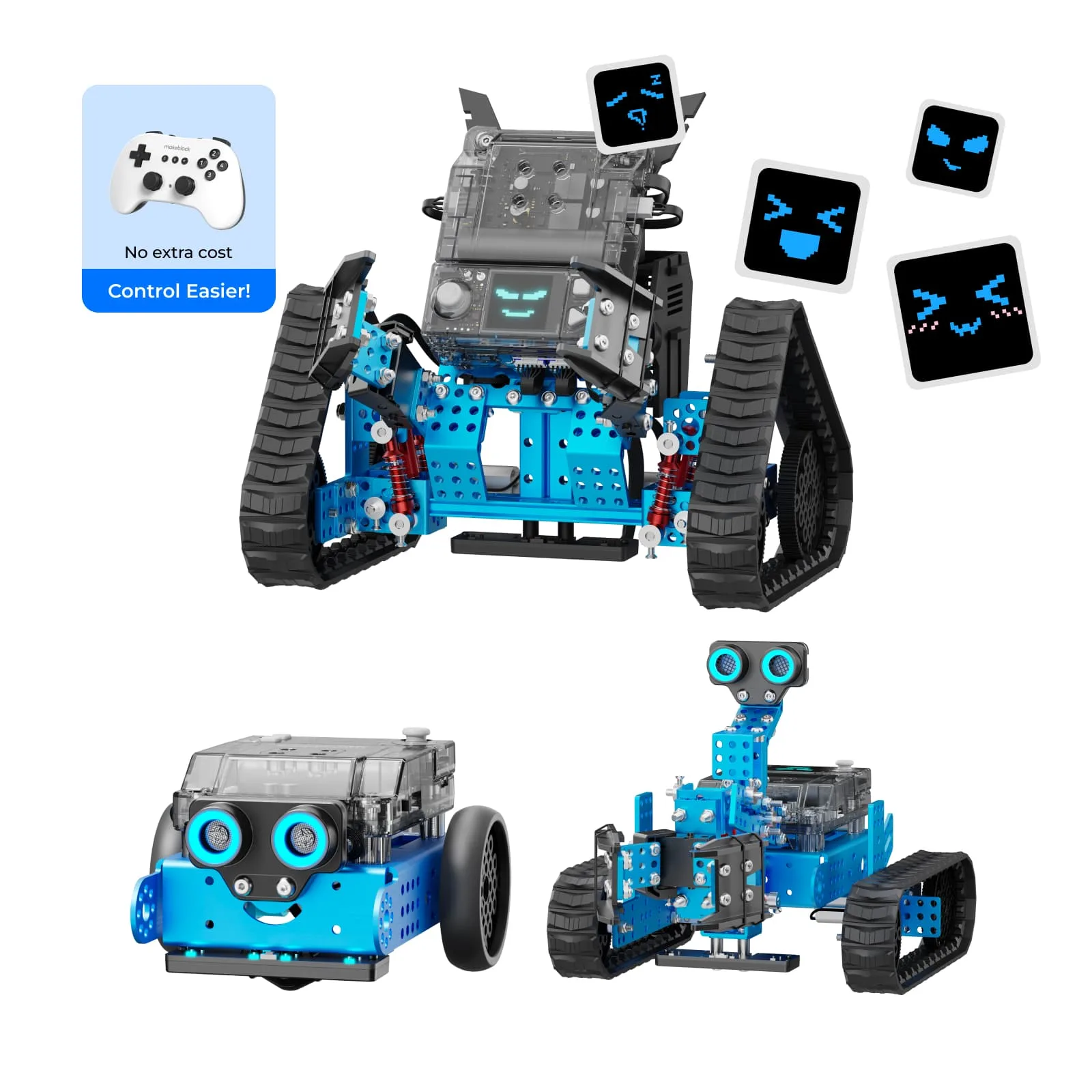
Makeblock mBot2 Rover Robotics Kit: Kid's Interactive Emo Robot for Coding Learning and Outdoor Play
-
Makeblock mBot2 Rover Robotics Kit: Kid's Interactive Emo Robot for Coding Learning and Outdoor Play: Innovative Robot Track: 2 types of design to fully unleash outdoor exploration in multi-terrains with shock-resistant The tracks handle grass, gravel, and dirt, so kids can test code in real-world conditions instead of just on a desk.
-
Makeblock mBot2 Rover Robotics Kit: Kid's Interactive Emo Robot for Coding Learning and Outdoor Play: Full-color Display Screen: Supporting customize Rover's emojis through AI-generated or free doodling in mBlock software Kids can create and upload their own emojis, making coding more personal and fun during outdoor play.