Quick answer
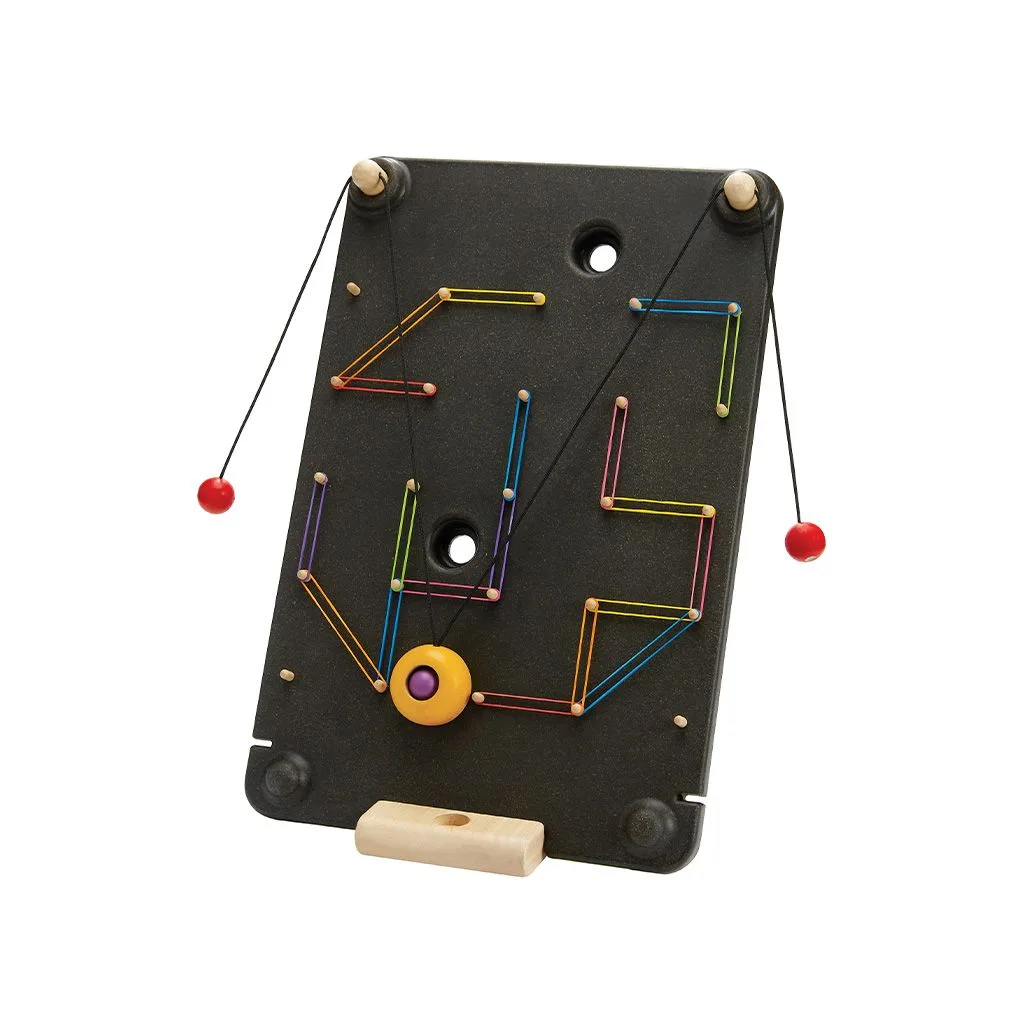
Mount the PlanToys Wall Ball Game securely on a wall at child height, then use the rubber bands and chalk to create a course that challenges coordination and control.
Why choose a wooden wall ball game for indoor play
The PlanToys Wall Ball Game turns a vertical surface into an interactive puzzle. Unlike electronic toys, it relies on the child's own pulling and releasing to move the ball upward, building patience and fine motor control. The rubber bands and chalk let you redesign the course endlessly, so the game grows with your child's skill level.
Safety and space considerations
This game requires a clear wall area about 3 feet wide and 4 feet tall. Make sure the mounting hardware is appropriate for your wall type (drywall anchors recommended). Supervise young children to prevent pulling the cord too hard or stepping on loose rubber bands. The toy is designed for ages 3 and up, but the small chalk pieces may pose a choking hazard for younger siblings.
Step-by-step setup guide
- Mount the board securely: Choose a flat wall area at a height where your child can comfortably reach the top pulleys. Use the included screws and wall anchors (or equivalent for your wall type). Level the board before tightening. A wobbly board makes the ball harder to control and can frustrate younger players. Check stability before play.
- Set up the rubber band course: Stretch the rubber bands across the board in a zigzag or ladder pattern. You can also crisscross them to create narrow passages. Start with a simple vertical path for beginners, then add horizontal bands to force the ball to weave side to side. Avoid stretching bands too tight – they can snap or make the ball bounce unpredictably. Replace damaged bands promptly.
- Draw obstacle lines with chalk: Use the chalk to mark a starting point at the bottom and a goal at the top. Draw arrows or “no-go” zones to guide the ball's path. Erase and redraw as your child masters each course. Chalk dust can be messy on carpets. Place a drop cloth underneath or play on a hard floor for easy cleanup.
- Teach the pulley technique: Show your child how to pull one cord at a time to lift the ball, then release slowly to let it drop onto the next rubber band. Practice moving the ball left and right before attempting an upward climb. Pulling both cords at once will stall the ball. Encourage single-hand pulls and watch for frustration – take breaks if needed.
- Supervise and adjust difficulty: Stay nearby during the first few rounds. If the ball keeps falling off, simplify the course by removing some rubber bands. As skill improves, add more bands or tighter turns to increase the challenge. The goal is concentration, not speed. Let your child experiment with different pulling rhythms to find what works.
Product details
-
Wall Ball Game: The PlanToys Wall Ball Game is a game of concentration and skill. Children can set the course difficulty using rubber bands and chalk to create obstacles. This means you can adjust the challenge as your child improves, keeping the game engaging for a long time without buying new toys.
Wall Ball Game