Start with the job, not the number of cups
A measuring cup set earns its place when its sizes match what you actually measure. The Westmark set pairs three capacities — 50 ml, 100 ml and 250 ml — so the useful question is not how many cups you get but whether those three cover your small and medium measuring tasks. If most of your cooking happens in spoons and cups rather than litres, this range does a lot of work. If you regularly measure large volumes for stock, dough or batch cooking, you will likely need a larger vessel alongside it.
What the three-piece set gives you
-
Measuring cup set, 3 pieces, 50, 100, 250 ml: Set of 3 measuring cups: 50 ml, 100 ml, and 250 ml These three capacities cover small, medium and larger measuring jobs without a crowded drawer.
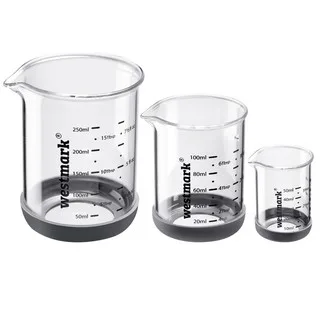
Measuring cup set, 3 pieces, 50, 100, 250 ml
-
Measuring cup set, 3 pieces, 50, 100, 250 ml: Ideal for liquid and dry ingredients One set can move between wet and dry measuring rather than forcing you to buy separate tools.
-
Measuring cup set, 3 pieces, 50, 100, 250 ml: Easy to read markings for accurate measurements Clear markings matter most at small volumes, where a few millilitres changes the result.
-
Measuring cup set, 3 pieces, 50, 100, 250 ml: Compact design for easy storage The set is easier to keep on hand if it does not demand much drawer or shelf space.
When to reach for the 50 ml cup
The 50 ml cup is the one you will use for small, precise additions: a splash of oil, a spoonful of syrup, a small amount of liquid for a sauce or dressing. Because the set is marked for accurate measurement, this is the cup that saves you from eyeballing a small quantity in a larger jug. It is also the size that makes the set worth owning if you cook in small portions or follow recipes that call for modest amounts of liquid or dry ingredients.
When the 100 ml cup is the middle ground
The 100 ml cup sits between the two extremes and often becomes the default for everyday measuring. It is large enough to hold a useful amount of liquid or dry ingredient, yet small enough to read the markings without straining. If you are measuring for a single serving, a small sauce or a modest baking batch, this is frequently the cup you will pick first. It is also a sensible choice when a recipe gives a range and you want to stay near the lower end.
When the 250 ml cup does the heavy lifting
The 250 ml cup is the largest in the set and handles the volumes that would otherwise need several smaller measures. It is the size to reach for when a recipe calls for a cup of liquid, a larger quantity of dry ingredients or a batch of dressing. Because it is the top capacity in this set, it also defines the set's limit: anything above 250 ml needs a larger measuring tool. That is not a flaw, but it is the practical boundary to know before you buy.
Which cup for which task
- Small precision additions: Use the 50 ml cup for oils, syrups, dressings and other small liquid or dry measures where accuracy matters.
- Everyday single-portion measuring: The 100 ml cup is the practical middle size for sauces, small baking batches and recipes that call for modest amounts.
- Larger liquid and dry measures: The 250 ml cup covers the biggest volume in the set, but anything beyond 250 ml needs a separate larger vessel.
Nesting and storage: what compact design means in practice
A three-piece set in a compact design is easier to store than three unrelated cups, and nesting is the usual reason small sets stay in the drawer rather than at the back of a cupboard. The catalog describes the set as compact for easy storage, so it is reasonable to expect the cups to take up less room than their combined capacities suggest. Check your own drawer or shelf space before buying if storage is tight; the set is small, but it still needs a home.
The honest tradeoff: three sizes, one ceiling
The main limitation of a 50, 100 and 250 ml set is the 250 ml ceiling. If your cooking regularly involves litres — stock, large batches of batter, big pots of sauce — this set will be a companion rather than a complete measuring solution. The upside is that three well-chosen sizes cover most small and medium tasks without clutter, and the compact design keeps them accessible. Buy this set if your measuring needs are modest and precise; pair it with a larger jug if your recipes regularly exceed 250 ml.
What the catalog does not confirm
The supplied product information does not include care instructions, material details beyond the general description, or guidance on dishwasher and microwave use. It also does not state specific assembly or compatibility requirements. If those points matter to you, check the product page or packaging before relying on the set for a particular use. The absence of that information here is not evidence that the set lacks a feature — only that it is not confirmed in the catalog details available.