Quick answer
For a successful Metro Twist quilt, focus on fabric contrast and accurate cutting with the Quick Curve Ruler. This guide walks you through the key steps and common pitfalls.
Why fabric contrast matters in Metro Twist
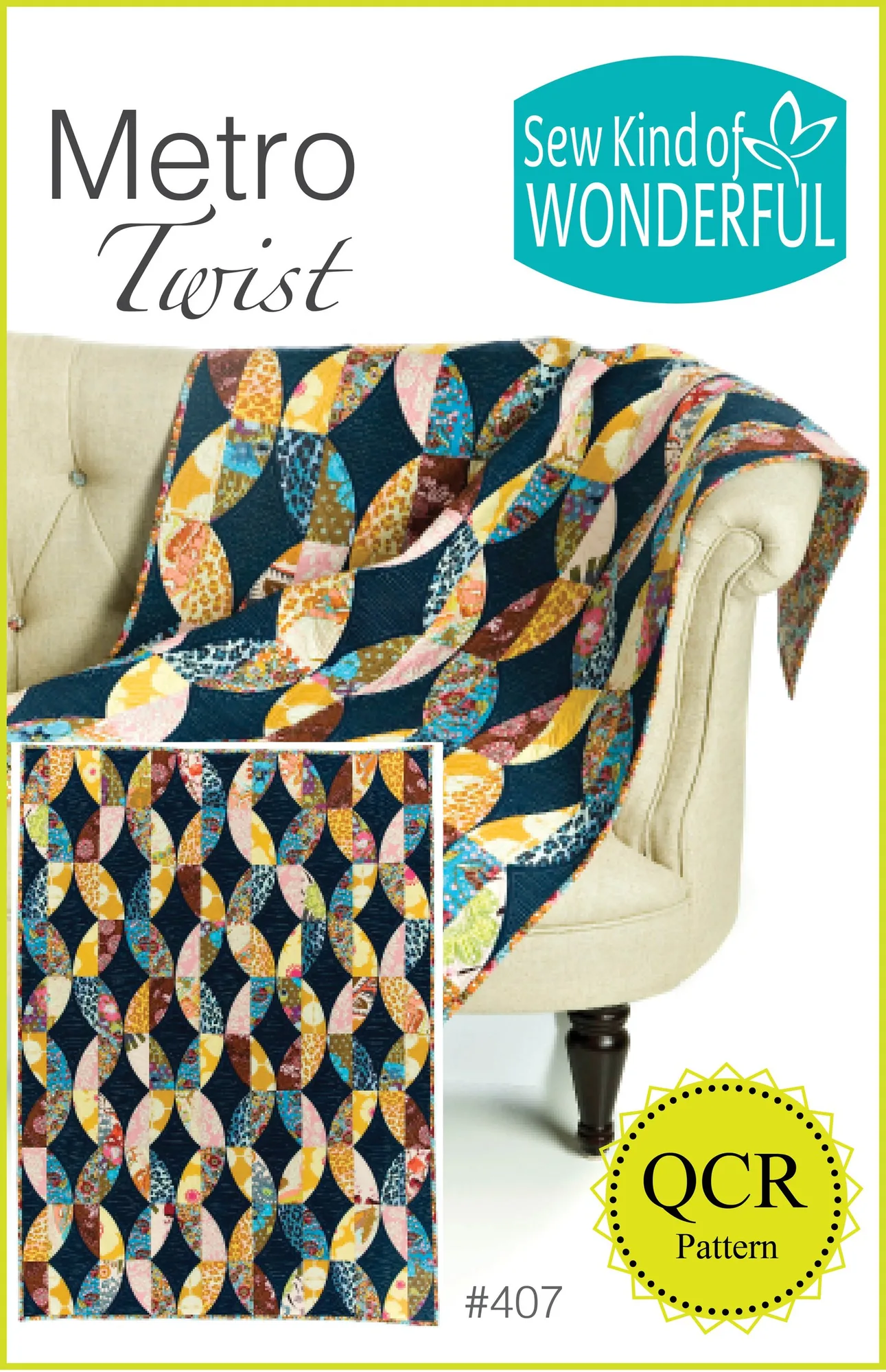
The Metro Twist pattern uses curved piecing to create interlocking shapes. High contrast between your print fabrics and the background fabric makes the curves pop. A navy background, as specified in the pattern, provides a strong visual anchor for lighter or brighter prints.
Choosing your prints: fat quarters vs. 10-inch squares
The pattern calls for either 40 assorted 10-inch squares or 8 fat quarters. Fat quarters give you larger pieces, which can be easier to cut into the required shapes. Ten-inch precuts save time but offer less flexibility in fabric placement. Both work well; choose based on your stash and preference.
Step-by-step sewing guide for Metro Twist
- Prepare your fabrics and tools: Gather your print fabrics, navy background, binding, backing, and the Quick Curve Ruler. Prewash your fabrics if desired to avoid shrinkage later. Check that your Quick Curve Ruler is clean and your rotary blade is sharp before you start cutting.
- Cut the fabric pieces accurately: Follow the pattern instructions to cut the print squares and background pieces. Use the Quick Curve Ruler to cut the curved segments precisely. Take your time on this step—accuracy here prevents gaps later. A common mistake is cutting the curves too quickly, leading to uneven seams. Slow down and use a steady hand.
- Sew the curved seams: Sew the curved pieces together using a scant 1/4-inch seam allowance. Pivot at the curve's apex and ease the fabric gently. Press seams toward the darker fabric to reduce bulk. Don't stretch the fabric as you sew. Let the feed dogs do the work to keep the curve smooth.
- Assemble the quilt top: Arrange your completed blocks in a layout you like. Sew blocks into rows, then join the rows. Press all seams open or to one side as you prefer. Check that your seams nest well before sewing—this prevents mismatched points.
- Add borders, backing, and quilt: Attach borders if desired, layer with batting and backing, then quilt as you wish. Bind the edges with the 1/2 yard of binding fabric. A walking foot helps feed multiple layers evenly during quilting.
Product details
-
Metro Twist (Paper): Materials: 40 x 10-inch squares or 8 fat quarters of assorted print fabric, plus 2.5 yards background fabric (navy), 1/2 yard binding, 3 yards backing, and Quick Curve Ruler (QCR). Knowing the exact fabric requirements helps you plan your purchase or shop your stash without buying too much or too little.
Metro Twist (Paper)