Quick answer
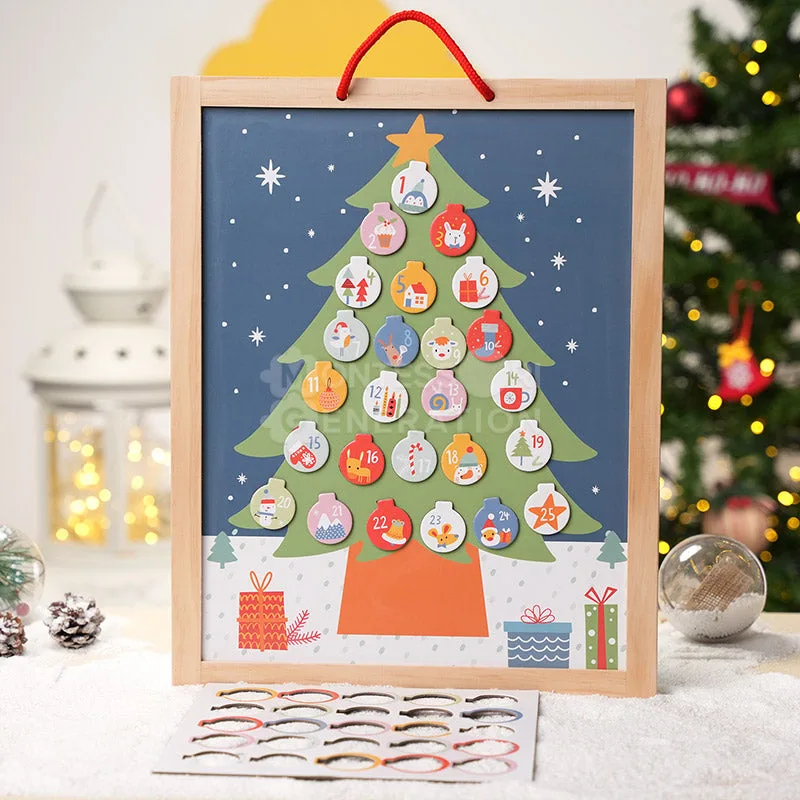
Hang the Montessori Advent Calendar at your child's eye level on December 1, then let your toddler place one wooden ornament each morning until all 25 are up. That single daily action becomes the countdown, and the calendar doubles as a counting and matching activity instead of a one-time paper treat.

Montessori
Why a reusable calendar changes the December routine
A paper advent calendar gives your child one small surprise and then disappears. A wooden calendar with 25 reusable ornaments gives the same daily moment but keeps working as a toy after December 25. For a toddler, that means the routine is the reward: choosing an ornament, finding its spot, and hanging it. You can also reuse the same calendar next year, which makes it a family object rather than a disposable one.
Set up the calendar so a toddler can use it alone
Place the calendar where your child can reach it without help, ideally at shoulder or eye level. Keep the ornaments in one shallow bowl or basket nearby so the daily choice stays simple. If you hang it high on a wall, you will end up lifting your child every morning, and the routine quickly becomes yours instead of theirs.
Choose a daily moment and keep it short
Attach the calendar to something that already happens every day: after breakfast, after nap, or before bedtime. A two-minute ritual is easier to keep than a long one, and toddlers handle repetition better than novelty. If you miss a day, hang two ornaments the next morning rather than skipping the count.
Add counting and matching without turning it into a lesson
Count the ornaments already hanging before your child adds a new one. Ask them to find an ornament that looks like the one they chose yesterday, or to pick the smallest piece in the bowl. These small prompts build one-to-one counting and visual matching, and they work because your child is already interested in the calendar.
Your daily advent calendar routine, step by step
- 1. Hang the calendar at child height before December 1: Use the wooden calendar's hanging point and place it where your toddler can reach the board without a stool. Put the 25 ornaments in a bowl within arm's reach. Checkpoint: your child can touch the top row of the calendar while standing on the floor.
- 2. Let your child pick one ornament each morning: Offer the bowl and let them choose freely. Do not direct which ornament they take; the choice is part of the routine. Common mistake: choosing for your child to keep the pattern neat. A mixed-up calendar is still a working calendar.
- 3. Count the hanging ornaments together before adding the new one: Point to each ornament already on the board and count aloud, then ask your child to hang the new one and count the total again. Checkpoint: by mid-December your child may start saying the next number before you do.
- 4. Name the ornament your child chose: Use simple words for shape, color, or size, such as round, red, or small. Repeat the same words on later days so the vocabulary sticks. Common mistake: quizzing your child. Say the word yourself and let them repeat it only if they want to.
- 5. Let your child hang it, even if it lands crooked: Resist straightening the ornament while your child is watching. Hanging is the fine motor work, and the result does not need to look tidy. Checkpoint: your child can place an ornament on the board with little or no help by the second week.
- 6. On December 25, count all 25 ornaments one last time: Take the ornaments down together or leave them up through the holidays, then store the set in a dry place for next December. Next step: wipe the wooden board with a dry cloth before storing, and keep the ornaments in a closed container so none go missing.
What the Montessori Advent Calendar includes
- Montessori Advent Calendar: Contains one hangable wooden calendar and 25 ornaments; size 12.6" x 15.9" x 0.5"; age 3+; high-quality, eco-friendly wood; clean with a dry cloth only and avoid prolonged contact with liquids. The 25 ornaments match the December countdown exactly, and the flat wooden board hangs easily. Keep it away from wet windowsills or damp walls, and wipe it dry rather than washing it.