Quick answer
For a baby who is crawling and mouthing everything, the montessori-baby-comfort-toy-b0b3ed33f4c6e88aaf0e4376-1541690">Montessori Baby Comfort Toy is the stronger first pick: it combines a plushie dog, a rattle, and a wooden teether in one lightweight set. Choose the Montessori Baby Bite Set instead if your priority is mealtime independence rather than floor play, since it is a full silicone feeding kit for self-feeding practice.
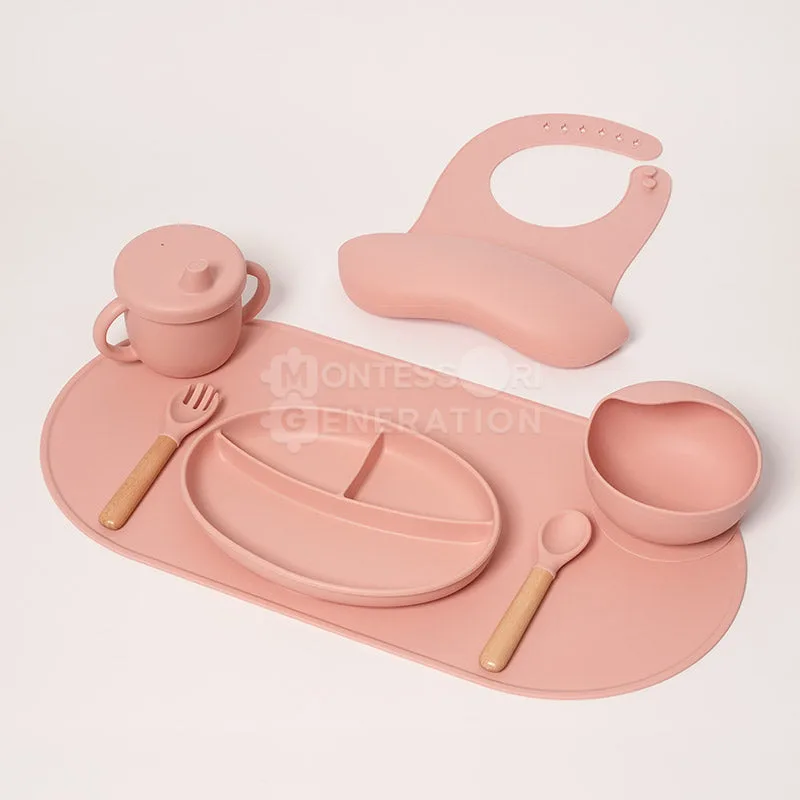
Montessori Baby Bite Set
Babies between roughly 9 and 12 months are usually doing two things at once: moving across the floor and grabbing at whatever they can reach. That makes the crawling stage a tricky time to buy toys, because a single object has to survive being dragged, chewed, and dropped. The two products compared here solve different halves of that problem.
The Montessori Baby Comfort Toy is a floor-play set built around a plushie, a rattle, and a wooden teether. The Montessori Baby Bite Set is a silicone feeding kit with a plate, utensils, bib, cup, bowl, and non-slip mat. They are both rated for 6+ months, but they are not interchangeable, and knowing which one your baby actually needs comes down to whether you are buying for movement or for meals.
What each toy is actually designed to do
The Montessori Baby Comfort Toy is a three-piece set: one plushie dog, one rattle, and one wooden teether, sized at 10.6 by 11.0 by 2.8 inches and weighing 5.8 ounces. The low weight matters for a crawler, because a baby who is still building upper-body strength can drag or lift it without frustration. The wooden teether gives a firm surface for sore gums, while the plushie offers a soft, familiar texture for comfort.
The Montessori Baby Bite Set is a mealtime system rather than a play object. It contains a plate, fork and spoon, bib, cup, bowl, and a non-slip mat, all made from food-grade silicone that is free of BPA and phthalates. At 1 pound 9.6 ounces and 19.7 by 9.8 inches across, it is meant to sit on a table or highchair tray, not on the floor. It is dishwasher safe, which is the practical detail most parents care about after a messy meal.
- If your baby is chewing on furniture and toys, the wooden teether in the Comfort Toy addresses that directly.
- If your baby is grabbing the spoon during meals, the Bite Set gives them a safe version to hold.
Where the trade-off really sits
The Comfort Toy wins on portability and versatility. At 5.8 ounces, it goes in a diaper bag, works in a stroller, and can be handed over during a diaper change or a restaurant wait. Its care routine is simple: wipe the wooden parts with a dry or damp cloth, keep them away from prolonged liquid contact, and hand-wash the plushie. That is slightly more hands-on than tossing something in a dishwasher, but it is a reasonable trade for a toy that travels.
The Bite Set wins on independence and cleanup. Every piece except the mat is designed to be washed like normal dishes or in a dishwasher, and the non-slip mat keeps the bowl and plate from sliding while a baby learns to scoop. The trade-off is that it does nothing for floor play. A crawler who is not yet sitting steadily at a table will get more developmental value from the Comfort Toy in the short term, and the Bite Set becomes more useful once self-feeding starts in earnest.
- Neither product is a substitute for the other; they target different daily routines.
- Buying both is reasonable if your baby is crawling and starting solids around the same time.
Materials, care, and what that means day to day
The Comfort Toy uses high-quality, eco-friendly wood alongside a hand-washable plushie. Wood gives the teether a firm, cool surface that many babies prefer over soft silicone, but it also means you should not soak it or leave it in a wet bag. A quick wipe after drooling is enough. The plushie is the part that will need the most attention, especially if your baby is a heavy chewer.
The Bite Set is entirely food-grade silicone, so it tolerates warm water, mild detergent, and the dishwasher without special handling. That difference in care routines is often the deciding factor for parents who are already washing bottles and pump parts. If you want the lowest-maintenance option, the Bite Set asks less of you per use; if you want a toy that can be wiped down and thrown in a bag, the Comfort Toy is easier to live with.
- Keep wooden parts away from prolonged liquid contact to avoid swelling or finish damage.
- Hand-wash the plushie rather than machine washing it with the rest of the laundry.
Which one fits your baby right now
If your baby is 9 to 12 months, crawling, pulling up, and putting everything in their mouth, the Comfort Toy is the more developmentally aligned purchase. It supports grasping, transferring objects between hands, and mouthing, all of which are core to this stage. The rattle adds a cause-and-effect element that encourages a baby to shake and listen, which is exactly the kind of repetition crawlers enjoy.
If your baby is already sitting in a highchair and reaching for your spoon, the Bite Set is the better buy. It is not a floor toy, and it will not help with crawling, but it will help your baby practice scooping, holding a cup, and tolerating a bib. Many families end up with both, using the Comfort Toy during floor time and the Bite Set at meals, which is a sensible split rather than a redundancy.
- Match the purchase to the routine you want to support, not to the age on the box alone.
- If you can only buy one now, pick the routine that happens most often in your day.
Trade-offs to weigh before you buy
- Floor play vs mealtime practice: The Comfort Toy supports crawling, grasping, and mouthing on the floor. The Bite Set supports scooping, holding utensils, and sitting at a table. Choose based on which routine you want to improve first.
- Portability vs cleanup convenience: At 5.8 ounces, the Comfort Toy travels easily but needs hand-washing for the plushie. The Bite Set stays home but goes in the dishwasher. Frequent outings favor the Comfort Toy; heavy meal routines favor the Bite Set.
- Wood vs silicone care: Wood should be wiped and kept away from prolonged liquid contact. Silicone tolerates warm water, mild detergent, and dishwashing. If low-maintenance cleaning is your priority, the Bite Set is the easier option.
- Buying both: The two products do not overlap in function, so owning both is a split by routine rather than a duplicate purchase. Buy the Comfort Toy first if your baby is still mostly on the floor.
Product facts at a glance
- Montessori Baby Comfort Toy: Age 6+ months; contains one plushie dog, one rattle, and one wooden teether; 10.6 x 11.0 x 2.8 inches; 5.8 ounces; eco-friendly wood; wipe wood with a dry or damp cloth and hand-wash the plushie. The low weight and three-piece format make it easy for a crawler to drag, lift, and mouth, while the care instructions are simple enough for daily use.
- Montessori Baby Bite Set: Age 6+ months; contains one plate, fork and spoon, bib, cup, bowl, and non-slip mat; 19.7 x 9.8 x 0.2 inches; 1 pound 9.6 ounces; 100% food-grade silicone free of BPA and phthalates; dishwasher safe. This is a self-feeding kit rather than a floor toy, and the dishwasher-safe silicone keeps cleanup manageable during the messy early months of solids.
Which one should you choose?
Best for
- Babies 9 to 12 months who are crawling, pulling up, and mouthing objects
- Parents who want one lightweight toy that works in a stroller, diaper bag, or play corner
- Families looking for a teething option that combines wood and soft fabric
Not for
- Babies who are already self-feeding and need utensils and a plate
- Parents who want a dishwasher-safe product with minimal hand-washing
- Toddlers past the mouthing stage who need a more advanced challenge
If your baby is crawling and chewing on everything, start with the Montessori Baby Comfort Toy. If meals are the bigger daily battle, the Montessori Baby Bite Set earns its place on the highchair tray. Buy for the routine you are in right now, and the other one can wait until the next stage.