What to Expect from This Guide
If you are looking for a wooden building toy that supports your toddler's development without screens, Montessori Building Blocks are a solid choice. This guide covers the right age to start, the skills the toy helps build, and what you actually get in the box. The goal is to help you decide whether this set fits your child and your home.
What the Set Includes
-
Montessori Building Blocks: Contains (1) board and (20) shapes. Made from high-quality eco-friendly wood with non-toxic paint. Size: 13.2" x 3.0" x 2.1" (33.5cm x 7.5cm x 5.3cm). Weight: 15.3oz (435g). The compact size and light weight make it easy for a toddler to carry and play on a table or floor. The 20 shapes offer variety without being overwhelming.
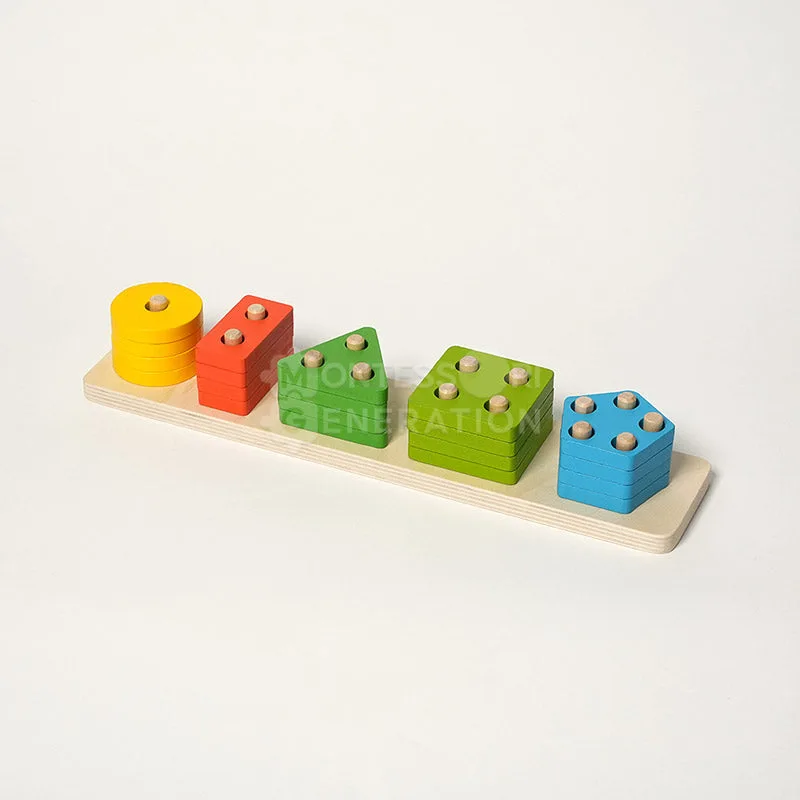
Montessori Building Blocks
Age Recommendation and What It Means
The manufacturer recommends this toy for ages 1 and up. That means a one-year-old can safely explore the pieces under supervision. At this age, children are naturally drawn to grasping, stacking, and knocking down. By age two or three, they start sorting by shape and color, naming pieces, and building simple structures. The set grows with the child because the play possibilities are open-ended.
How the Blocks Support Key Skills
The supplied information highlights several areas where this toy helps a child prepare for everyday tasks and school readiness.
- Fine motor skills and hand-eye coordination: Picking up, placing, and balancing the 20 shapes builds dexterity and control. The board provides a defined space, which helps a toddler practice precise placement.
- Problem-solving and spatial awareness: Figuring out which shape fits where, or how to stack pieces without them falling, develops logical thinking and an understanding of size and balance.
- Language and vocabulary: Adults can name shapes and colors aloud as the child plays. The product description mentions that naming shapes and colors is part of a natural play routine, which supports early language skills.
- Focus and self-discipline: The toy encourages purposeful, screen-free play. The manufacturer notes that it helps develop focus, independence, and inventiveness.
Real-World Play Example
The product description includes a scenario where a parent gives the child the blocks while cooking. The child names shapes and colors and places them on the board. This shows how the toy fits into a busy daily routine without requiring a dedicated lesson or setup time.
Care and Safety Notes
Clean the blocks with a damp cloth and mild soap, then dry immediately with a clean damp cloth. Avoid prolonged contact with liquids. The materials are natural and non-toxic, which means the toy is safe for children and can be recycled when outgrown. The manufacturer states that all materials are safe for both child and environment.
Open-Ended Toy vs. Screen-Based Play
The supplied information contrasts this toy with screen-based entertainment. Here is a quick look at the trade-offs.
- Montessori Building Blocks: Encourages active, hands-on play. Develops fine motor skills, problem-solving, and language. Requires adult interaction for full benefit. No screen time.
- Apps, games, or cartoons: Passive entertainment that can affect attention span and eyesight if overused. Easy for a parent to set up but does not build the same physical or cognitive skills.
What the Supplied Information Does Not Settle
The product record does not specify whether the shapes are all unique or if some repeat. It also does not list specific shape names (e.g., triangle, square, circle). If knowing the exact shape variety matters for your lesson plan, you may want to check the product images or contact the store. For most families, the 20-piece set offers enough variety for open-ended exploration.