Quick answer
Use the Montessori Dino Busy Board in a short, predictable session of about five to ten minutes, once or twice a day, and let your toddler lead the choice of fastenings. Keep it in the same spot so the routine becomes easy to repeat.
Why short, repeated sessions work better than one long turn
Fine motor control grows through many small attempts, not one big session. A toddler who practices buttons and buckles for five focused minutes is more likely to come back tomorrow than one who is kept at the board until attention fades. Short sessions also let you notice which fastening is still frustrating and which one is ready to be left alone.
The board is designed for age 2 and up, so the realistic goal is exploration and repetition, not mastery. Expect some sessions to be mostly opening and closing the same flap. That is still useful practice.
What the board does and does not replace
A busy board gives toddlers a safe place to practice real-life fastenings without needing a grown-up to hold the shoe or jacket steady. It does not replace dressing practice on actual clothing, and it is not a quiet-time toy that should be left with a child unsupervised. Treat it as a shared activity that gradually becomes more independent.
The soft felt surface and strong bindings make it portable enough to move between rooms, but felt is spot-clean only. Keep drinks and sticky snacks away from the board during practice.
When to skip the routine
Skip the session if your toddler is already tired, hungry, or wound up. A busy board routine works best as a calm transition, for example after breakfast or before quiet time, not as a distraction during a meltdown. If your child loses interest after one minute, put the board away and try again later rather than coaxing them to finish.
Five steps for a daily busy board routine
- Set a fixed time and place: Choose one predictable slot, such as after breakfast or before nap, and keep the board in the same reachable spot. Common mistake: introducing the board at random times, which makes it feel like a novelty rather than a routine. A consistent slot is more important than a long session.
- Start with one fastening your child can already do: Open the session with a buckle or flap your toddler has managed before, then let them choose the next one. Common mistake: starting with the hardest fastening, which can end the session in frustration. Check that the first minute feels easy.
- Narrate the action, not the answer: Use short phrases such as "push the button through" or "hold the flap and pull" instead of doing it for your child. Common mistake: correcting hand position too early; let your toddler try their own grip first. If your child asks for help, demonstrate once and hand it back.
- Stop while it is still going well: End the session after five to ten minutes or when your child moves on to another activity, whichever comes first. Common mistake: pushing for one more fastening to "finish" the board. A calm ending makes the next session easier to start.
- Store it flat and check the bindings: Put the board away flat, and spot clean only when needed. Common mistake: leaving it folded under other toys, which can bend the felt and stress the bindings. A quick weekly check of the edges keeps the board usable.
Product facts
-
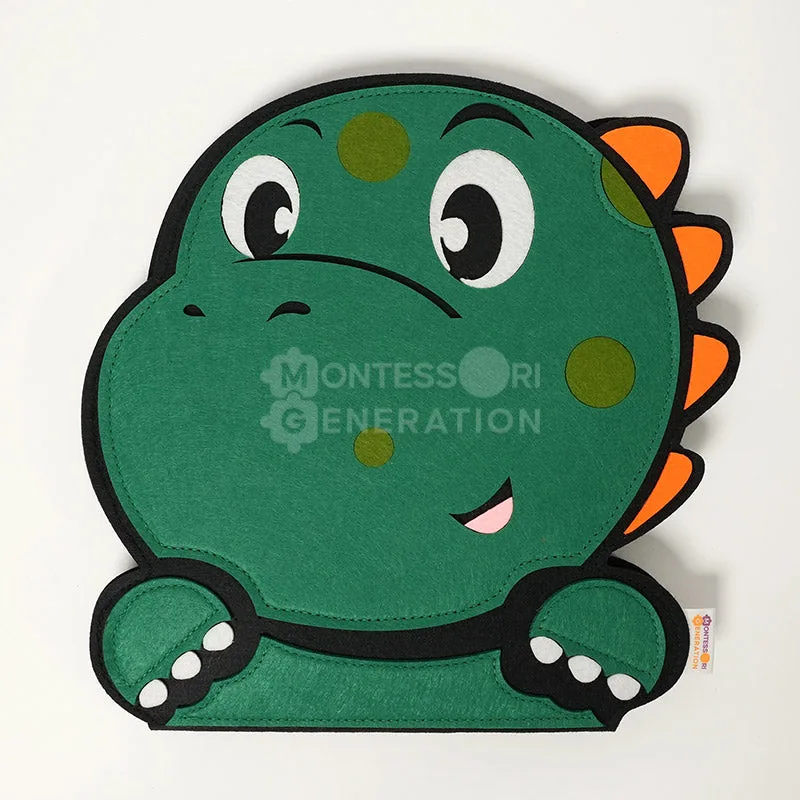
Montessori Dino Busy Board: Age: 2+; size: 23.2" x 11.6" (59cm x 29.5cm); weight: 7.8oz (220g); soft felt with strong bindings; spot clean only. The light, slim board is easy to move to a table or floor spot, and the felt surface means you should plan for spot cleaning rather than washing.
Montessori Dino Busy Board