Quick Answer
Use the Montessori Nature Explorer Kit to turn any outdoor space into a hands-on learning lab. Start with simple observation games and let your child's curiosity guide the pace.
Why Outdoor Play Matters for Toddlers
Outdoor play is more than just exercise—it's a full sensory experience. For toddlers and young children, being outside supports motor skills, language development, and emotional regulation. The Montessori approach emphasizes real-world exploration, and nature provides an ever-changing classroom.
The Nature Explorer Kit is designed for children aged 4 and up, making it a perfect bridge between guided play and independent discovery. Its child-safe materials and simple tools encourage focus and fine motor practice without screens or batteries.
Balancing Structured Activities and Free Exploration
While planned activities are helpful, the best outdoor learning often happens when children follow their own interests. Use the kit's tools to spark questions, but allow plenty of unstructured time for digging, watching, and wondering.
A common mistake is over-scheduling. Instead, offer one or two activity prompts, then step back. The kit's observation cup and wooden hand lens are perfect for spontaneous discoveries—like examining a fallen leaf or a tiny bug.
5 Steps to Outdoor Learning with the Nature Explorer Kit
- Start with a Nature Scavenger Hunt: Use the observation cup and wooden ruler to find and measure items like leaves, stones, or petals. Create a simple checklist together. Common mistake: trying to collect too many items—limit to five to keep focus. Checklist can be reused for different seasons.
- Introduce the Bug Observation House: Place a small insect inside the observation house for a few minutes. Encourage your child to observe its movements and color. Remind them to release the bug gently afterward. Common mistake: keeping the bug too long—limit observation to 5 minutes. Teach respect for living creatures.
- Practice Using the Butterfly Net: Show how to sweep the net gently through grass or low bushes. Wait for your child to master the motion before expecting catches. Common mistake: swinging too hard—demonstrate a slow, steady sweep. Patience builds coordination.
- Explore Textures with the Hand Lens: Use the wooden hand lens to examine bark, leaves, or soil. Ask open-ended questions like 'What do you see?' Common mistake: holding the lens too close—keep a few inches away for a clear view. Encourage descriptive language.
- End with a Nature Journal Entry: After your outing, have your child draw or dictate what they discovered. Use the tweezers to place a small specimen in the observation cup for further study. Common mistake: skipping the reflection—this step solidifies learning. Journaling builds memory and communication skills.
Product Facts
-
Montessori Nature Explorer Kit: The kit includes a bug observation house, telescopic butterfly net, insect catcher, observation cup, wooden hand lens, wooden ruler, tweezers, compass, and plastic ring, all in a compact 8.7" x 5.1" x 4.9" case. This all-in-one set gives your child a complete toolkit for nature study, making it easy to grab and go for any outdoor adventure.
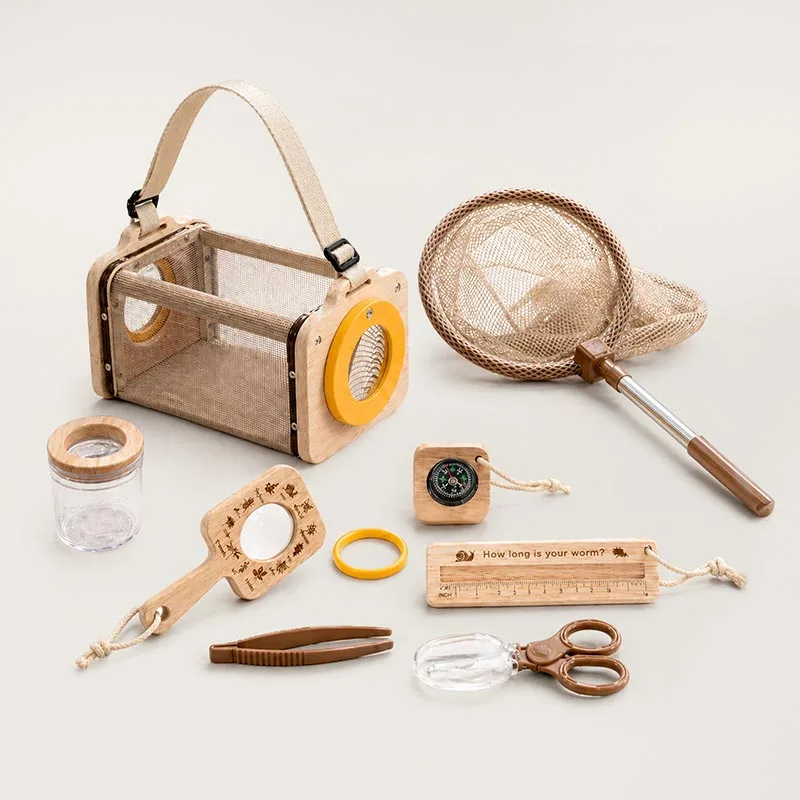
Montessori Nature Explorer Kit