Quick answer
Use the Nations At War: Stalin's Triumph 2nd Edition Companion book to run solo games by following its scenario rules, hidden setup, and event cards that simulate an opponent's decisions.
Why the Companion Book Works for Solo Play
The companion book is designed for two-player head-to-head games, but its detailed scenario briefings, order-of-battle lists, and optional rules make it adaptable for solo wargaming. By using the historical setup information and random event tables, you can create a solo experience that stays true to the Eastern Front battles of July 1943.
A common mistake is assuming you need no modifications. In reality, you must decide how to handle hidden information (like minefields or ambushes) and how to randomize the opponent's moves. The companion book gives you the raw data; you supply the solo system.
What You Need Besides the Companion Book
You will need the core Nations At War rulebook, the Stalin's Triumph 2nd Edition game components (counters, maps), and a method for randomizing actions—typically a six-sided die or a deck of cards. The companion book itself does not contain solo-specific rules, so you will use its scenario data to feed your own solo decision-making process.
If you do not have a solo system, consider using a simple 'threat response' method: for each unit, roll a die to determine its objective (attack nearest enemy, move toward objective, or hold position). The companion book's detailed unit statistics help you decide which actions are realistic.
Steps to Solo Play with the Companion Book
- Choose a scenario and read the briefing: Open the companion book to a scenario that interests you. Read the historical briefing and the special rules. Note any hidden setup instructions (e.g., minefields, ambush markers) that you must reveal during play. Write down which units are hidden and when they activate.
- Set up the map and both sides' forces: Place the map and deploy all units for both sides as described. For solo play, keep the opponent's forces face-down or off-map until they are activated. Use a die roll to determine which side moves first each turn (e.g., 1-3 Soviet, 4-6 German). This randomizes first-turn advantage, a common solo fairness issue.
- Create a simple decision table for the opponent: On a notecard, list three default actions for each opponent unit type: attack nearest enemy, advance toward objective, or hold and fire. Roll a die (1-2: attack, 3-4: advance, 5-6: hold). Apply the action to each unit in turn order. Keep the table simple so you do not slow down play.
- Play through the turn sequence: Execute the turn sequence from the core rulebook: command, movement, combat, and rally. For the opponent, use your decision table to move and fire. When hidden units are revealed, place them on the map and apply their special rules immediately. Do not second-guess the die rolls—commit to the action.
- Score the game using the scenario victory conditions: At the end of the scenario, check the victory conditions in the companion book. Count eliminated units, control of objectives, and any scenario-specific points. Record the result and note what you would change next time. Keep a log of solo games to track which scenarios are balanced for one player.
Product facts
-
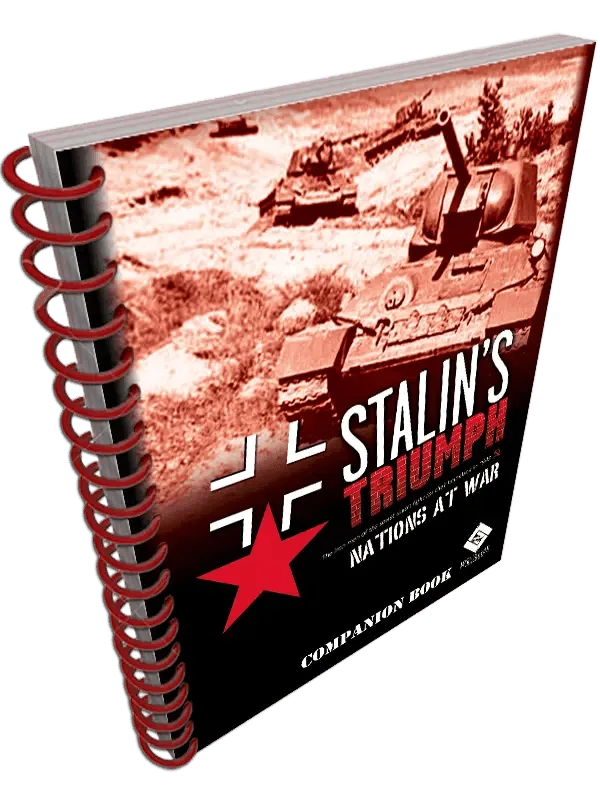
Nations At War: Stalin's Triumph 2nd Edition Companion: The companion book covers the battle of Kursk from either side, with T-34s and KV-1s against Panthers and Tiger Is, and includes Katyushas, SU-152s, and Pak 40s. This variety gives solo players enough unit types and tactical options to create unpredictable, replayable scenarios without needing a human opponent.
Nations At War: Stalin's Triumph 2nd Edition Companion