Quick Answer
The Nature Discovery Science Kit helps kids learn science concepts like light, chemistry, and observation through five guided outdoor experiments that require no extra supplies.
Why Hands-On Science Matters for Young Learners
Kids remember science better when they can see, touch, and do. The Nature Discovery Science Kit turns your backyard into a living lab where abstract ideas become concrete experiences. Instead of reading about photosynthesis, children capture sun prints. Instead of memorizing mineral names, they sculpt with air-dry clay. This kit bridges the gap between screen-based learning and real-world discovery.
What You Get in the Box
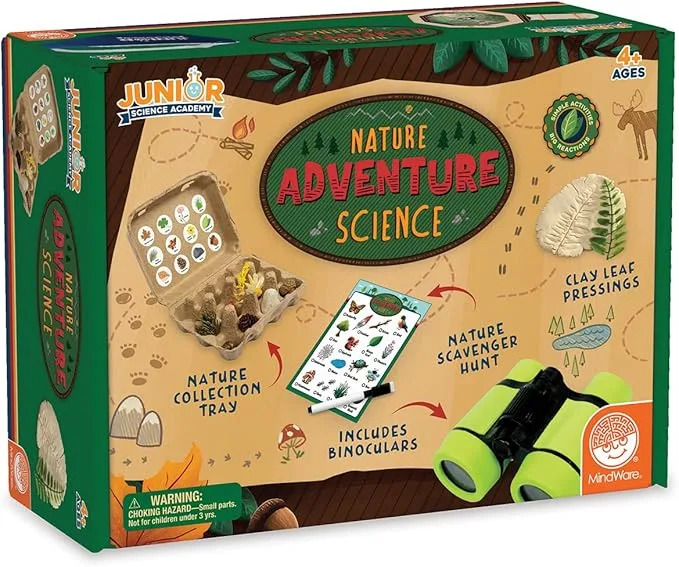
The kit includes binoculars, air-dry clay, sun print paper, wooden clips, stickers, and a collection box. A Field Guide walks children through each activity with simple instructions. No batteries, screens, or extra purchases are needed—everything is ready to use right out of the box.
5 Hands-On Experiments with the Nature Discovery Science Kit
- 1. Build a Working Kaleidoscope: Assemble the kaleidoscope using the included mirrors and tube. Point it at different objects in your backyard—leaves, flowers, stones—and observe how light reflects to create symmetrical patterns. Common mistake: kids may expect the kaleidoscope to work without the mirrors properly angled. Check that the mirrors form a triangle inside the tube before sealing. Kids learn about light reflection and symmetry while practicing fine motor assembly.
- 2. Capture Sun Prints: Place sun print paper in a sunny spot and arrange leaves, twigs, or small toys on top. Leave it for 2–3 minutes, then rinse the paper in water to reveal the white silhouettes. Common mistake: moving the objects during exposure will blur the image. Remind kids to place items gently and not touch the paper until the timer goes off. Children discover how UV light changes chemical compounds, introducing basic photochemistry.
- 3. Sculpt with Air-Dry Clay: Mold the clay into shapes inspired by nature—a leaf, a beetle, a fossil. Let it dry for 24–48 hours. Common mistake: adding too much water makes the clay sticky and hard to shape. Use just a drop if needed, and keep hands slightly damp, not wet. This activity teaches texture, form, and patience while strengthening hand muscles for writing.
- 4. Hunt for Nature Treasures: Use the binoculars and collection box to find and gather interesting natural objects like feathers, acorns, or smooth stones. Sort them by color, size, or texture in the box. Common mistake: collecting living things like insects or flowers. Teach kids to only pick up fallen objects and leave living plants and animals undisturbed. Observation and classification are core science skills that build attention to detail.
- 5. Record Findings in the Field Guide: Use the stickers and blank pages in the Field Guide to draw or write about what was discovered each day. Common mistake: skipping this step because kids want to move to the next activity. Set aside five minutes after each experiment to reflect—this cements the learning. Journaling reinforces memory and helps children connect observations to scientific concepts.
Product Facts
-
Nature Discovery Science Kit: The Nature Discovery Science Kit includes binoculars, air-dry clay, sun print paper, wooden clips, stickers, and a collection box. Children can start five different science activities immediately without needing to buy additional supplies, which reduces frustration and keeps the focus on exploration.
Nature Discovery Science Kit