Start with the lens on the camera and the subject in mind
The Nikon Z 180-600mm f5.6-6.3 VR rewards a deliberate setup rather than a menu deep-dive. Begin by mounting the lens on a Nikon Z body and confirming that the zoom ring turns freely through the full 180–600mm range. The internal zoom design means the barrel does not extend as you zoom, so balance stays consistent whether you are at 180mm for a wider habitat frame or at 600mm for a distant bird.
Decide your primary subject before you leave: wildlife, sports and aircraft photography are the uses the catalog names for this lens. That choice shapes how you use the zoom, how much you rely on vibration reduction, and whether you pack the Z TELECONVERTER TC-2.0x for extra reach. The lens weighs 1955g and measures 315.5mm, so a comfortable strap or support plan matters as much as any setting.
Catalog details that shape the setup
-
Nikon Z 180-600mm f5.6-6.3 VR Lens: Nikon Z 180-600mm f5.6-6.3 VR Lens; 5.5 stops of vibration reduction. VR is the main handheld tool for slow-shutter wildlife work; knowing the rated figure helps you decide when to raise ISO instead of pushing shutter speed lower.
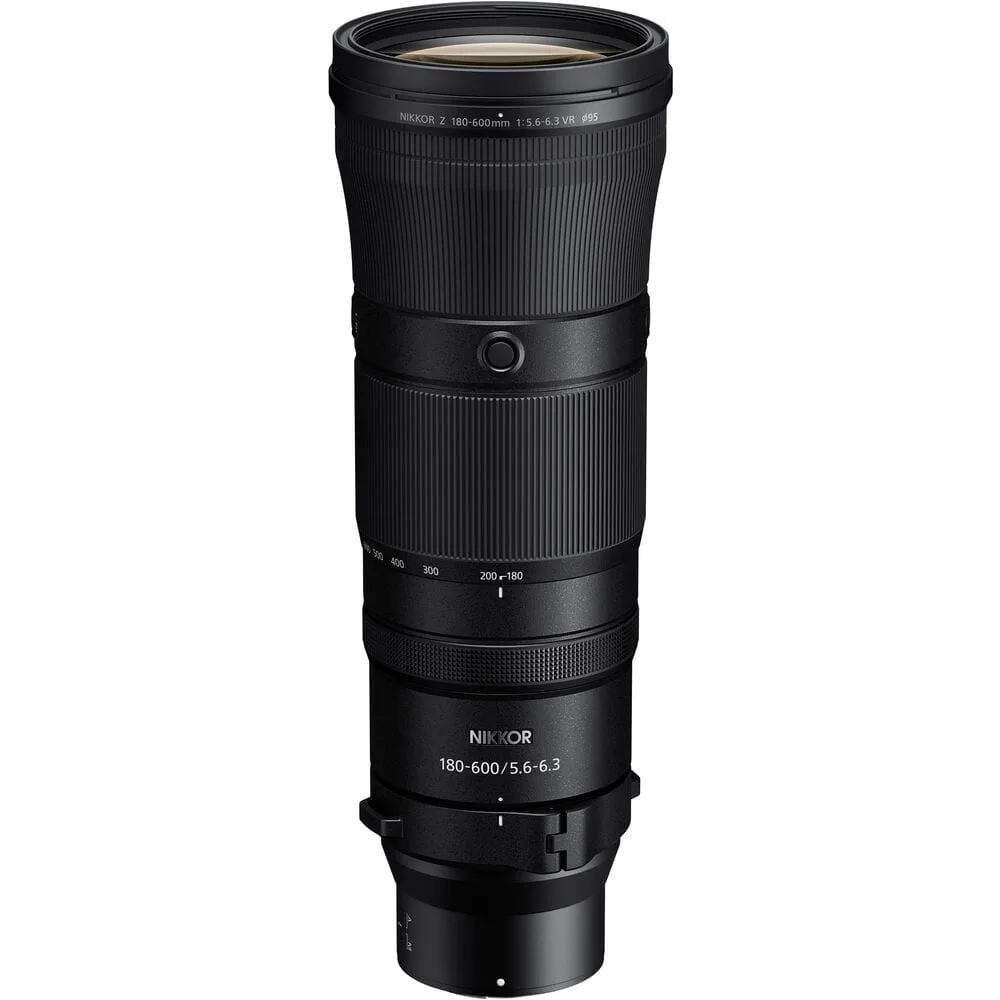
Nikon Z 180-600mm f5.6-6.3 VR Lens
-
Nikon Z 180-600mm f5.6-6.3 VR Lens: Internal zoom; the barrel does not move when zooming. Balance stays predictable during pans and tilts, and there are fewer places for dust to accumulate.
-
Nikon Z 180-600mm f5.6-6.3 VR Lens: Minimum focus distance of 1.3m at 180mm and 2.4m at 600mm. Close subjects at the wide end need less working distance than at full extension, which changes how you approach a subject.
-
Nikon Z 180-600mm f5.6-6.3 VR Lens: Compatible with the Z TELECONVERTER TC-2.0x, giving up to 1200mm. If you need more reach for distant birds, the catalog confirms this converter pairing; check your own framing and light needs before relying on it.
A practical handheld workflow for wildlife
Use this sequence when you are shooting handheld and want to get the most from the lens without guessing at settings the catalog does not specify.
- Set your zoom for the subject, not the scene: Start at 180mm for a wider view and zoom in only as needed. The internal zoom keeps the barrel length constant, so you can pan or tilt without the lens changing balance.
- Choose a shutter speed you can hold: The lens offers 5.5 stops of vibration reduction, which helps at slower shutter speeds. Still, moving wildlife needs a faster shutter than a static subject; raise ISO before you go below a speed you can hand-hold consistently.
- Use VR as a support tool, not a substitute for technique: VR helps steady the view and the shot, but it does not freeze a bird in flight. For active subjects, keep shutter speed high and use smooth panning; the internal zoom and non-extending barrel make that easier.
- Respect the close-focus distance: At 180mm you can focus down to 1.3m; at 600mm the minimum is 2.4m. If a subject is closer than that at full zoom, zoom out rather than moving in.
- Add the TC-2.0x only when reach matters more than light: The catalog confirms compatibility with the Z TELECONVERTER TC-2.0x for up to 1200mm. That extra reach can help with distant birds, but it also changes your effective aperture and framing; test it before a critical shoot.
Bird photography: what the lens supports and what it does not settle
For bird photography, the 180–600mm range covers perching birds at a distance and larger birds in flight. The 5.5-stop VR helps when you are tracking a slow-moving subject or shooting in dim light, and the internal zoom lets you adjust framing without the lens growing longer. The dust- and drip-resistant sealing is a useful safeguard in unpredictable weather, though the catalog does not specify a water-resistance rating, so treat it as protection against dust and water droplets rather than a guarantee.
What the supplied information does not settle: exact VR mode behavior, custom button assignments, and whether specific Z bodies impose crop factors or autofocus limits with this lens. Those details depend on your camera body and its firmware, so check your body’s manual rather than assuming a particular menu path. The lens record also does not list a supplied tripod collar or case, so confirm what is in the box before you plan your support setup.
Build and handling facts worth knowing before you shoot
- Nikon Z 180-600mm f5.6-6.3 VR Lens: Weighs 1955g and measures 315.5mm; constructed from 25 elements in 17 groups, including 6 ED elements, 1 aspherical element and a fluorine-coated front element. The weight and length affect how long you can hand-hold; the optical construction and fluorine coating are relevant to image quality and front-element cleaning.
- Nikon Z 180-600mm f5.6-6.3 VR Lens: Dust and drip resistant; sealed to help protect from dust and water droplets. Useful in field conditions, but the catalog does not state an ingress rating, so avoid treating it as waterproof.
- Nikon Z 180-600mm f5.6-6.3 VR Lens: Fast and quiet autofocus. Quiet focus helps with skittish wildlife; the catalog does not specify focus motor type or speed figures, so judge performance on your own body.
Where the supplied information stops
This guide sticks to what the catalog confirms: the 5.5-stop VR, internal zoom, close-focus distances, TC-2.0x compatibility, weight, dimensions, sealing and optical construction. It does not invent recommended shutter speeds, aperture values, VR mode names or menu steps, because those depend on your Z body and your subject. Use the workflow above as a starting point, then adjust based on what you see in your viewfinder and your images.