Quick answer
The Nixie Clock Oscillator uses a quartz crystal oscillator to generate a precise timing signal, which the circuit divides down to drive the Nixie tubes. This CrunchLabs Hack Pack kit gives you a hands-on way to see oscillator timekeeping in action.
Why the oscillator matters for timekeeping
The oscillator is the heart of any electronic clock. In the Nixie Clock Oscillator, a quartz crystal vibrates at a stable frequency when voltage is applied. The circuit counts those vibrations and converts them into seconds, minutes, and hours. Without a reliable oscillator, the clock would drift or stop working entirely.
Because this is a build kit, you get to see each component's role as you assemble it. That hands-on experience makes oscillator timekeeping easier to understand than reading about it in a textbook.
What to expect from the 16-part build
The Nixie Clock Oscillator arrives as a kit with 16 total parts. That includes the Nixie tubes, the oscillator circuit board, resistors, capacitors, and the quartz crystal. You will need to solder some components, so a basic soldering iron and solder are required. The build takes about 2–3 hours for a first-timer, and the instructions are step-by-step.
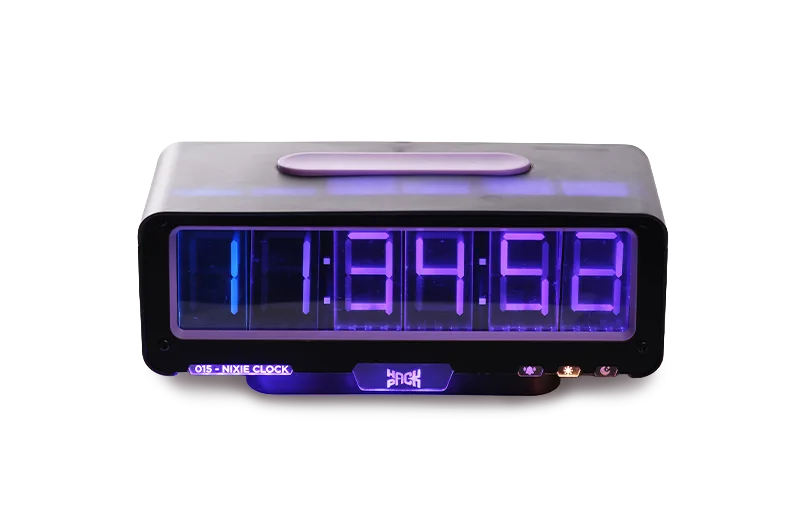
One trade-off: because it is a Hack Pack kit, the focus is on learning, not on a finished product that looks like a store-bought clock. The exposed circuit board and tubes have a distinct industrial look that some builders love and others find unfinished.
How to build and understand the Nixie Clock Oscillator
- 1. Identify the oscillator components: Lay out all 16 parts. Locate the quartz crystal (usually a small metal can with two leads) and the oscillator IC. These two parts form the timing core. Check that you have the correct resistor and capacitor values for the oscillator circuit. A common mistake is mixing up resistor values. Use the included color-code chart or a multimeter to confirm each one before soldering.
- 2. Solder the oscillator circuit first: Start with the oscillator section on the board: solder the crystal, the oscillator IC, and the supporting resistors and capacitors. Keep solder joints clean and avoid bridging adjacent pads. This section generates the base timing signal. If the clock does not run after assembly, reheat the oscillator joints. Cold solder joints are the most common cause of failure in this stage.
- 3. Add the frequency divider and driver stages: Solder the divider ICs and the transistor drivers that step down the oscillator frequency to drive the Nixie tubes. Follow the board silkscreen labels carefully. The divider chain converts the crystal's thousands of vibrations per second into a 1 Hz pulse for the seconds display. Double-check the orientation of ICs and diodes. Installing one backward can prevent the divider chain from working, and it is easy to miss until you test the clock.
- 4. Install the Nixie tubes and test: Solder the Nixie tube sockets (or tubes directly if the kit specifies). Connect power (typically 5V DC) and observe the tubes. They should glow with the characteristic orange neon color. If a digit is missing or dim, check the corresponding driver transistor and solder joint. Nixie tubes contain neon gas and operate at high voltage (around 170V). Never touch the tube pins while the clock is powered. Let the tubes warm up for a minute before judging brightness.
- 5. Calibrate the timekeeping: After the clock runs for a few minutes, compare it to a known accurate time source. If it runs fast or slow, adjust the trimmer capacitor (if your kit includes one) or replace the crystal with one of a slightly different frequency. Most kits are accurate to within a few seconds per day out of the box. Do not expect atomic-clock precision. The quartz crystal's accuracy depends on temperature and manufacturing tolerance. For a learning project, ±10 seconds per day is normal and acceptable.
Product facts
-
Nixie Clock - Oscillator: The Nixie Clock - Oscillator is a build-focused product made for kids and adults who want to learn to think like engineers. It arrives as a kit with 16 total parts. The 16-part count means the build is manageable in one sitting but still gives you enough components to understand how oscillator timekeeping works at a component level.
Nixie Clock - Oscillator