Quick answer
A power bank's mAh rating is its internal battery capacity, not the amount of charge your phone receives. Voltage conversion and heat during charging mean you typically get 60–70% of the rated capacity as usable energy. So a 10,000mAh bank often delivers about 6,000–7,000mAh to your phone, which is roughly one to one-and-a-half full charges for a modern phone. For everyday carry, 10,000mAh is the sweet spot; for multi-day trips or charging several devices, step up to 20,000mAh.
What mAh actually measures
mAh stands for milliampere-hour. It measures how much electric charge a battery can store at its nominal voltage. A 10,000mAh power bank holds 10,000mAh of charge internally, usually at 3.7V. Your phone charges at 5V or higher, so the bank's internal voltage must be boosted. That conversion loses energy as heat, which is why the mAh you see on the label is never the mAh that reaches your phone.
Think of it like a water tank with a leaky hose. The tank holds 10,000 units, but by the time water reaches the bucket, some has spilled. The spill is not a defect, it is physics. The same applies to every power bank, regardless of brand or price.
How many charges you really get
To estimate real charges, divide the power bank's usable capacity by your phone's battery capacity. Usable capacity is roughly 60–70% of the rated mAh. For example, a phone with a 4,500mAh battery paired with a 10,000mAh bank gives about 6,000–7,000mAh usable, or roughly 1.3 to 1.5 full charges. A 20,000mAh bank doubles that to about 2.6 to 3 full charges.
These are estimates, not guarantees. Charging speed, cable quality, and whether you use the phone while charging all affect the final number. If you need a precise figure for a specific phone, check the phone's battery capacity and do the math with the 60–70% rule.
Myth: a 20,000mAh power bank is always better
Verdict: false. A 20,000mAh bank gives you more charges, but it is also heavier and bulkier. If you only need one top-up per day, a 10,000mAh bank is easier to carry and often cheaper. The right capacity depends on your routine, not on chasing the biggest number.
For air travel, many airlines limit spare lithium batteries to 100Wh. A 20,000mAh bank at 3.7V is about 74Wh, so it is usually allowed in carry-on. A 10,000mAh bank is about 37Wh. Always confirm with your airline before flying.
Myth: wireless charging wastes half your capacity
Verdict: partly true, but the waste is smaller than most people think. Wireless charging is less efficient than plugging in a cable, so you may get slightly fewer charges from the same bank. However, the convenience of snapping a phone onto a magnetic power bank often outweighs the small loss.
If you want to maximize every mAh, use a cable. If you want to travel light and avoid carrying cables, wireless is a reasonable trade-off. The difference is usually a fraction of a charge, not half.
Myth: mAh is the only spec that matters
Verdict: false. Watt-hours (Wh) tell you the total energy, and watts (W) tell you how fast a device charges. A high-mAh bank with low output wattage will charge your phone slowly, even if it holds plenty of energy. For phones that support fast charging, look for a bank that can output enough wattage to trigger that speed.
Also check the number of ports and whether they can share power. A bank that claims three-device charging may split its output, so each device charges slower when all ports are in use.
How to choose the right capacity for your day
Start by counting how many times you normally need to recharge your phone before you get back to a wall outlet. One top-up: 5,000–10,000mAh. Two to three top-ups: 10,000–15,000mAh. More than three, or charging a watch and earbuds too: 20,000mAh or a multi-device bank.
If you carry a bag, a slightly larger bank is rarely a problem. If you rely on pockets, a compact 10,000mAh bank with a built-in cable or wireless pad saves space and hassle.
Verdicts on common capacity claims
- Claim: "10,000mAh gives you 10,000mAh of phone charge.": Voltage conversion and heat reduce usable capacity to roughly 60–70% of the rated mAh. A 10,000mAh bank typically delivers about 6,000–7,000mAh to your phone. Verdict: false. Expect about two-thirds of the label.
- Claim: "A bigger power bank is always the better buy.": Larger banks weigh more and take longer to recharge themselves. If you only need one top-up per day, a compact 10,000mAh bank is easier to carry and often costs less. Verdict: false. Match capacity to your routine, not to the biggest number.
- Claim: "Wireless charging wastes half your power bank's capacity.": Wireless charging is less efficient than a cable, but the loss is usually a fraction of a charge, not half. The convenience of magnetic snap-on charging often justifies the small trade-off. Verdict: mostly false. Use a cable if you want every last mAh; go wireless if you value convenience.
- Claim: "mAh is the only spec you need to compare.": Watt-hours tell you total energy, and watts tell you charging speed. A high-mAh bank with low output wattage charges slowly. Also check how many ports can share power at once. Verdict: false. Check Wh, W, and port behavior alongside mAh.
Real products that match these capacity lessons
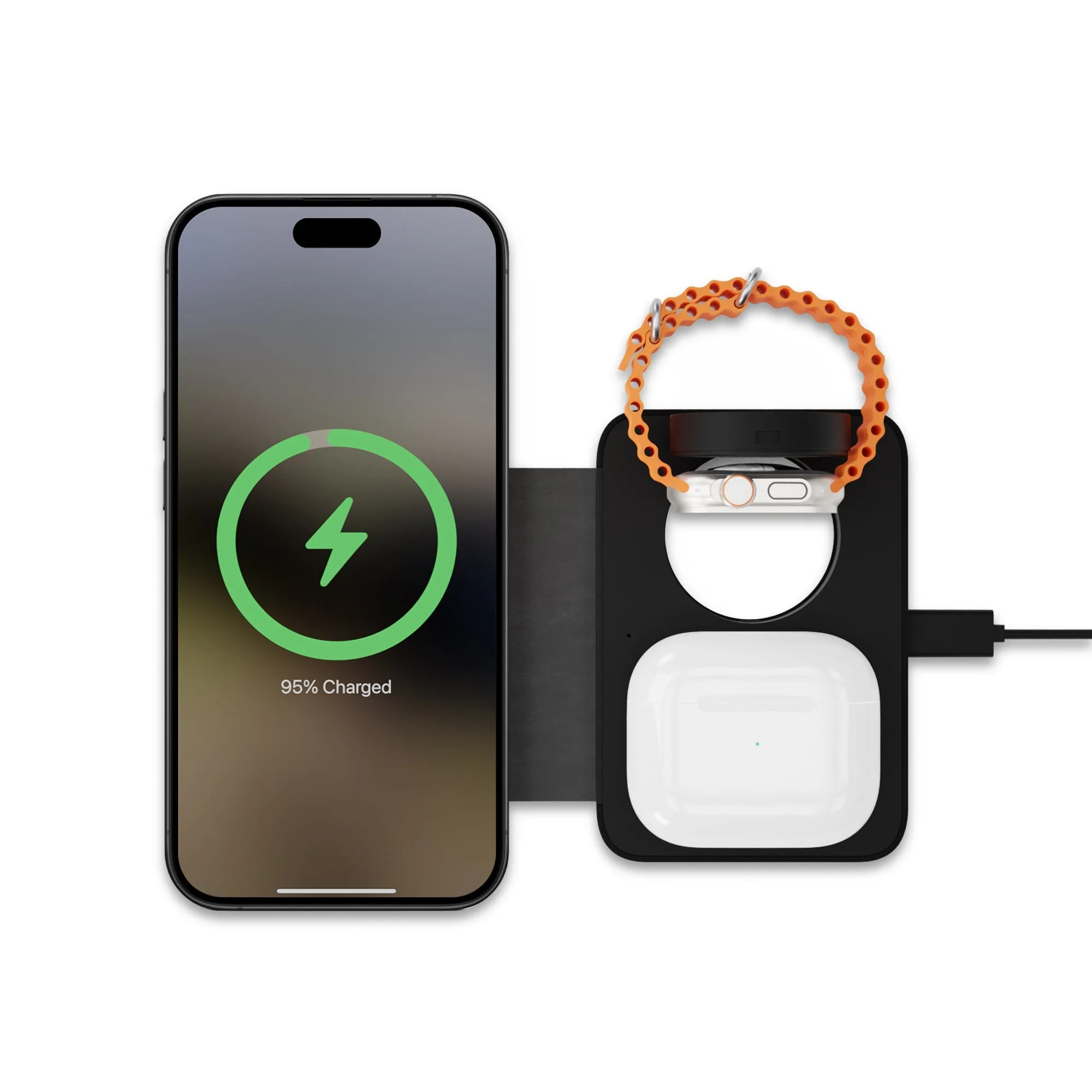
- 3-In-1 Wireless Portable Charger: A super-light and compact portable charger for wirelessly charging three devices at the same time. Features a MagSafe® compatible charging module, an Apple Watch charging module and a wireless earbuds charging module. If you carry a phone, watch, and earbuds, one 3-in-1 bank replaces three separate chargers and cables, saving space and weight in your bag.
- MagSafe® Compatible Wireless Power Bank: Snap on and go with our versatile wireless power bank. Wirelessly charge your phone while using the USB-C port for charging a second device at up to 20W. It's durable, portable, and ultra-convenient. The USB-C port at up to 20W lets you fast-charge a second device while your phone charges wirelessly, so you can top up two devices from one bank.
- Matte Black Wireless Apple Watch® Charger: Experience the fastest charge for your Apple Watch® with this convenient, sleek and lightweight charger, powered by official Apple Watch technology. Experience up to 33% faster charging for Apple Watch. A dedicated Apple Watch charger is worth packing if your watch is your main fitness tracker and you want the fastest possible recharge without carrying a separate cable.