Quick answer
Focus on three core safety features when choosing a portable space heater: automatic shutoff (tip-over and overheat), a motion sensor for energy-efficient operation, and oscillation to distribute heat evenly without creating hot spots.
Why motion sensors matter for safety and savings
A motion sensor does more than turn the heater on when you enter a room—it also turns it off when you leave. This prevents the unit from running unattended, which reduces fire risk and cuts energy waste. Models like the WOOZOO Space Heater include an integrated motion sensor that activates the heater only when motion is detected, making it a practical choice for rooms you use intermittently.
Oscillation vs. fixed-direction heating
Oscillating heaters spread warm air across a wider area, which can help maintain a consistent room temperature without running at maximum output. Fixed-direction heaters are simpler and often quieter, but they may create hot spots or require repositioning. For a bedroom or living room, an oscillating model with multiple fan modes (like Fan, Medium, and Turbo) gives you flexibility to match the heat output to the room size and your comfort level.
The trade-off: more features, more to maintain
Heaters with motion sensors and oscillation have additional moving parts and electronics, which may require more careful handling and occasional cleaning of sensor lenses. If you prefer a no-fuss unit for a single, always-occupied space, a basic fixed-direction heater with tip-over shutoff might be a simpler choice. But for households where rooms are used at different times, the convenience and safety gains of a sensor-equipped model usually outweigh the extra maintenance.
Decision rules for choosing a safe portable space heater
- Automatic shutoff is non-negotiable: Look for tip-over protection and overheat shutoff. These are the minimum safety features that prevent the heater from causing a fire if knocked over or blocked. Skip any model that lacks both tip-over and overheat shutoff, regardless of other features.
- Match the coverage to the room size: Check the manufacturer's stated coverage area (e.g., up to 200 sq ft for the WOOZOO heater). A unit that's too small will run continuously; one that's too large may cycle on and off inefficiently.
- Choose oscillation for even heat distribution: Oscillating models spread warm air more evenly, reducing cold spots and the temptation to place the heater too close to furniture or curtains. Fixed-direction heaters require careful placement to avoid overheating a single area. If you plan to use the heater in a room with multiple seating or sleeping areas, oscillation is worth the extra cost.
- Consider a motion sensor for unattended rooms: A motion sensor automatically turns the heater off when you leave the room and back on when you return. This saves energy and reduces the risk of the heater running while you're not there to monitor it. Best for home offices, living rooms, or bedrooms you enter and leave throughout the day.
- Look for multiple fan modes: Fan modes (e.g., Fan, Medium, Turbo) let you adjust airflow and noise level. A lower fan mode is quieter for nighttime use, while Turbo heats a cold room faster. A heater with at least three fan modes gives you more control over comfort and energy use.
Product facts
-
WOOZOO Space Heater – Portable, Oscillating with Motion Sensor & Safety Features: Integrated motion sensor activates the heater when motion is detected, saving time and energy on warm-up. You don't have to remember to turn the heater on or off—it responds to your presence, reducing the chance of it running empty in an unoccupied room.
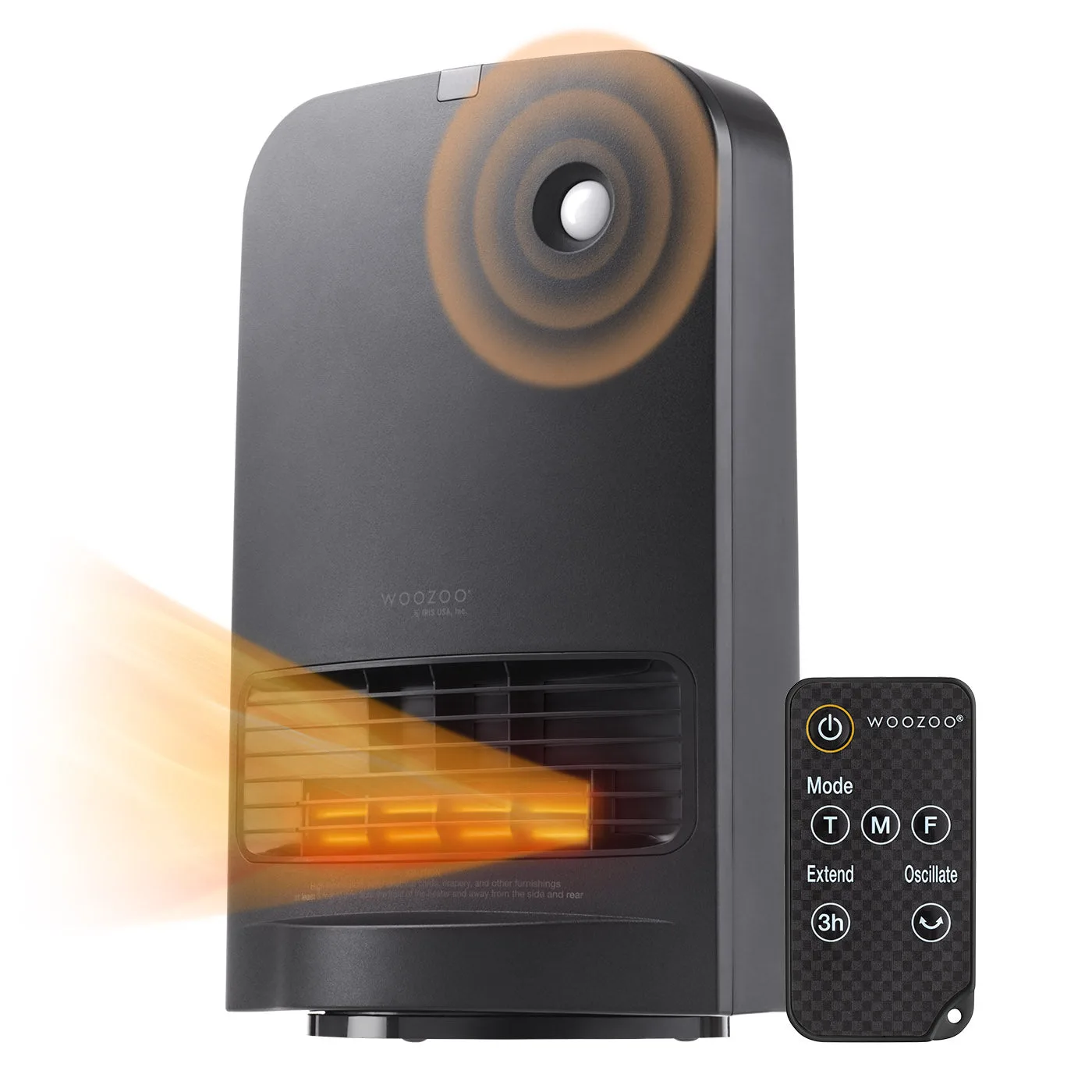
WOOZOO Space Heater – Portable, Oscillating with Motion Sensor & Safety Features
Who should buy this type of heater
Best for
- Households that want to heat specific rooms only when occupied, thanks to motion sensor automation
- Anyone who values even heat distribution and adjustable fan speeds for different times of day
Not ideal for
- People who need a single, always-on heat source for a consistently occupied room—a simpler fixed-direction heater may be more reliable
- Users who prefer a completely silent heater—oscillating models with multiple fan modes produce some noise, especially on Turbo