Quick answer
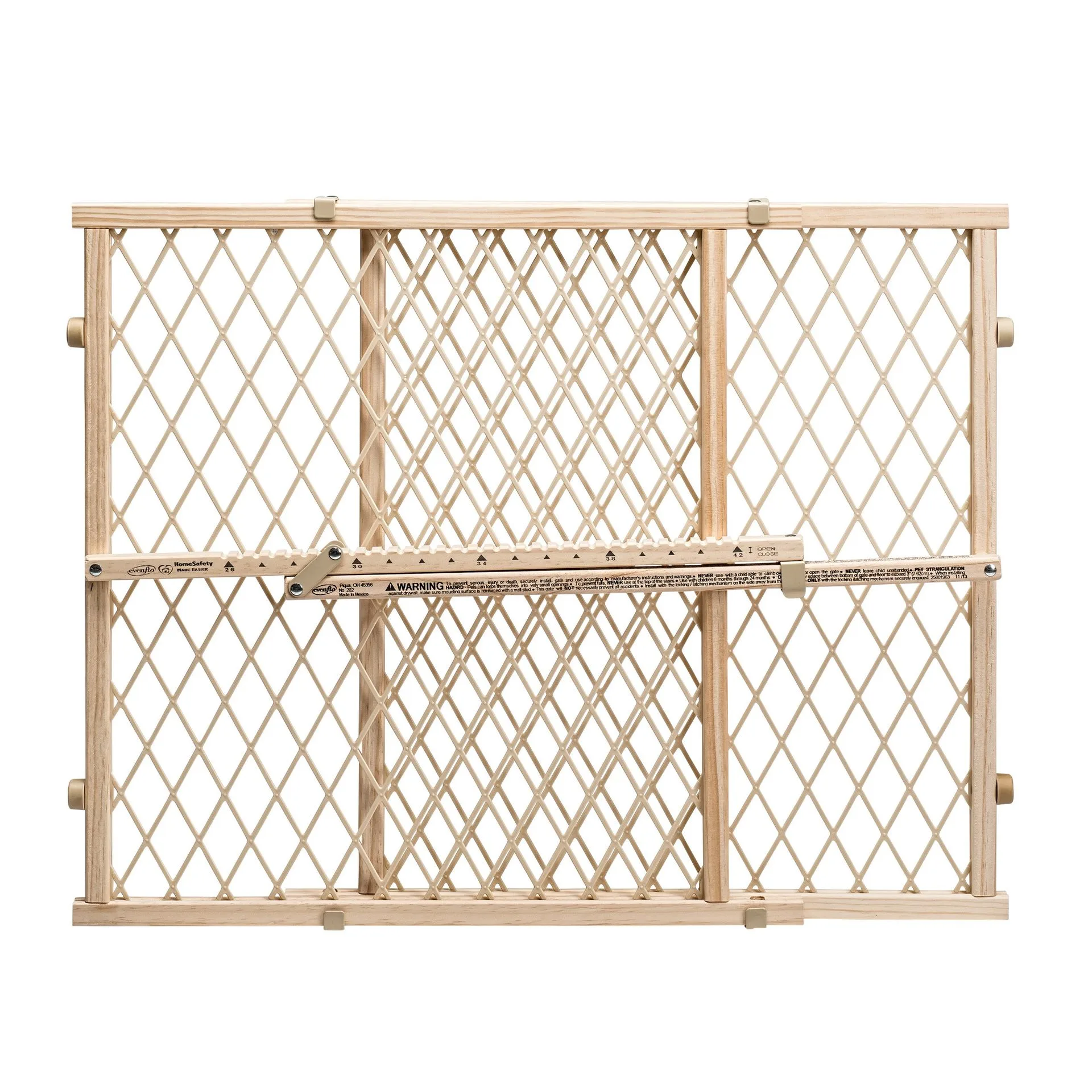
Measure the stair opening first. The Position & Lock Adjustable Wood Baby Gate fits openings 26 to 42 inches wide and stands 23 inches tall, so it can work on a narrow landing or doorway at the top or bottom of stairs only if the opening is within that range and the gate is pressed firmly against solid, flat surfaces. If the opening is smaller than 26 inches, or the gate slips no matter how you adjust it, choose a hardware-mounted stair gate instead.
Why a pressure-mounted gate can slip on stairs
Pressure-mounted gates hold by friction against two surfaces. On a narrow stair opening, the surfaces are often trim, drywall, or a banister post rather than a flat wall. If one side is uneven or gives slightly, the gate can shift when pushed. The Position & Lock gate uses a simple lift-and-lock mechanism, so the pressure depends on how squarely the gate sits in the opening and how tight the adjustment is.
A gate that slips is not automatically defective. More often, the opening is slightly wider than the gate's adjusted width, the contact surfaces are not solid, or the gate is not level. Check those three things before assuming the gate is the wrong size.
Width limits and where this gate stops being the right choice
The Position & Lock gate accommodates openings from 26 to 42 inches. If your stair opening measures less than 26 inches, the gate cannot be compressed enough to hold safely. If it measures more than 42 inches, the gate will not span the opening at all. In either case, do not force it or add makeshift extenders.
Also consider height. This gate is 23 inches tall. That is a standard low profile for blocking a doorway or landing, but it is not a substitute for a taller stair gate if your child is a climber or if the gate is the only barrier at the top of a staircase. For a top-of-stair installation, a hardware-mounted gate is generally the safer choice because it does not rely on pressure alone.
When the gate fits but still feels loose
If the opening is within 26 to 42 inches and the gate still feels loose, the issue is usually the contact surface or the adjustment. Stair trim, rounded banister posts, and hollow drywall can prevent a pressure gate from gripping. In that case, reposition the gate to a flat doorway or landing rather than forcing it onto the stairs. The Position & Lock gate is described as a lightweight, standard-size gate for blocking doorways in a pinch, so it is best suited to simple, flat openings within its width range.
Diagnose your narrow stair fit
- Symptom: gate slips or slides when pushed: Measure the opening at the point where the gate contacts the wall or trim. If it is between 26 and 42 inches, check that both contact surfaces are flat, solid, and vertical. Clean any dust or loose paint, then re-adjust the gate so it sits level and tight. If the opening is outside 26 to 42 inches, stop here and choose a different gate. Write down the exact width before you adjust anything.
- Symptom: gate fits the width but feels loose at the top or bottom: Check that the gate is level. A gate that is higher on one side will not press evenly. Loosen the adjustment, reposition the gate so the frame is square in the opening, and tighten again. If one side contacts a rounded banister post or a sloped baseboard, move the gate to a flat doorway or landing instead. Level and square matter as much as width.
- Symptom: gate is tight but you are using it at the top of stairs: This pressure-mounted gate is 23 inches tall and relies on friction. At the top of a staircase, a hardware-mounted gate is the safer choice because it does not depend on pressure against trim or drywall. Use the Position & Lock gate at a doorway or landing within its width range, not as the only barrier at the top of stairs. For top-of-stair safety, switch to a hardware-mounted gate.
- Stop point: opening is smaller than 26 inches or larger than 42 inches: Do not force the gate, add extenders not supplied with it, or wedge it into an opening outside the stated range. Choose a gate designed for that width instead.
Product facts
-
Position & Lock Adjustable Wood Baby Gate Support: Fits openings 26 in. to 42 in. (66 cm to 107 cm) wide and is 23 in. (58 cm) tall. Measure your stair opening before adjusting; if it falls outside this range, this gate is not the right fit.
Position & Lock Adjustable Wood Baby Gate Support