What Makes Transparent White Different
Pro Acryl Transparent White is not a standard opaque white paint. It belongs to the Transparent line, which offers variable opacity for filtering over base coats. This means you can subtly alter the hue underneath or amplify the vibrancy of similar colors, all while maintaining the control and consistency of a standard acrylic paint.
Unlike a wash or an ink, Transparent White behaves like a paint you can thin further for even more transparency. It dries to a beautiful matte finish, making it ideal for smooth transitions and controlled highlights.
Product Details at a Glance
-
Pro Acryl Transparent White: 22 ml of paint per bottle with a no-clog cap that combines dropper and twist-cap benefits. The volume is generous for a specialty paint, and the cap design helps prevent dried clogs during extended use.
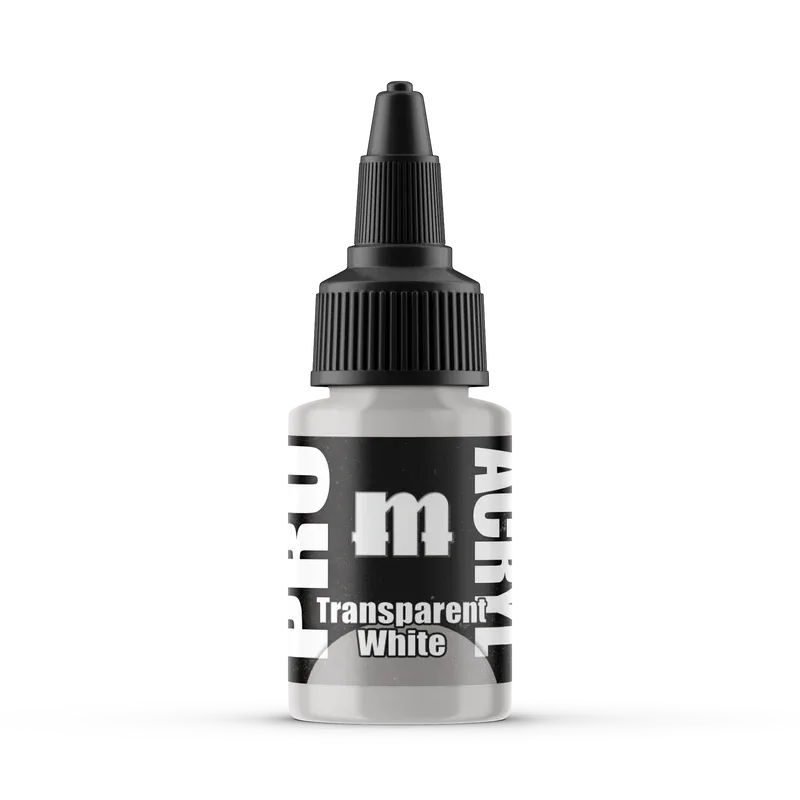
Pro Acryl Transparent White
-
Pro Acryl Transparent White: Formulated for both brush and airbrush, with consistent coverage and color. You can use the same bottle for base coating, glazing, or airbrush work without adjusting the formula.
-
Pro Acryl Transparent White: Contains a glass agitator to help mix the high-density pigments thoroughly. Shaking well ensures the transparency effect is even from the first drop to the last.
Using Transparent White for Filtering and Glazing
The primary use of Transparent White is as a filter over a base coat. When applied over a darker color, it will lighten and shift the hue slightly, creating subtle volume without a harsh edge. Over a similar light color, it amplifies the vibrancy and brightness.
For glazing, thin the paint with water or medium to increase transparency. Apply thin layers, letting each dry fully before the next. This builds up a smooth transition from shadow to highlight on raised areas like armor plates or cloth folds.
Because it dries matte, Transparent White won't leave a glossy sheen that disrupts the illusion of depth. You can also use it to soften the transition between two contrasting colors by brushing a thin layer over the border.
Step-by-Step: Highlighting Armor Panels
- Base coat your miniature: Apply a solid base color (e.g., a mid-tone blue or grey) and let it dry completely.
- Mix your transparent white: Shake the bottle well to incorporate the glass agitator. For a glaze, thin the paint 1:1 with water or a matte medium on your palette.
- Apply the first layer: Brush the thinned Transparent White onto the raised edges of the armor panel. Keep the layer thin—you can always add more.
- Build up opacity: Repeat the glaze on the brightest spots (e.g., the center of a shoulder pad) until you reach the desired brightness. Each layer dries matte, so the finish stays uniform.
- Check your results: Let the final layer dry, then assess the transition. If the edge is too stark, apply a thin glaze of the base color over the border to soften it.
Tips for Airbrush Use
Pro Acryl Transparent White works well in an airbrush with the same consistency as brush application. Thin it slightly more for airbrush use—about 2:1 paint to thinner or flow improver. Spray light, dusting coats over the raised areas of the miniature to build up a gradient. The matte finish helps subsequent layers adhere without a glossy surface.
Because the paint is already formulated for consistent coverage, you don't need to add excessive thinner. Start with a low psi (around 15-20) and test on a spare piece of plastic or primed sprue to gauge the transparency.
What the Evidence Doesn't Settle
The supplied information does not include specific drying times, thinning ratios for all mediums, or instructions for mixing Transparent White with other colors to create custom tints. For best results, test on a spare model or palette before committing to your main miniature. The paint's transparency is adjustable by thinning, but the exact ratio depends on your desired effect and the medium you use.
If you need a fully opaque white for base coating, consider a standard Pro Acryl white instead. Transparent White is designed for filtering and glazing, not for covering dark primers in one coat.