Quick answer
The Rainbow Sorting Game V3 is a hands-on activity that helps children ages 3-6 build color and shape recognition, counting, sorting, sequencing, and fine motor skills. Use the easy-grip tongs to pick up and arrange colored shapes into matching cups, progressing from simple sorting to complex sequences.
Why this game works for ages 3-6
Developed by educators, the Rainbow Sorting Game V3 turns key preschool skills into a playful, self-correcting activity. Children naturally practice observation and fine motor control as they use the tongs to pick up shapes and place them in the correct cups. The progression from sorting by color to creating patterns and sequences keeps the challenge fresh without overwhelming young learners.
One trade-off: the game requires adult setup for the first few rounds, especially to explain the sequence cards. Once children understand the pattern, they can play independently, making it a great quiet-time activity.
How to play the Rainbow Sorting Game V3: step-by-step
- 1. Set up the cups and shapes: Place the colored cups on a flat surface and scatter the shapes nearby. Show your child the tongs and explain that they will use them to pick up the shapes. Common mistake: letting children grab shapes by hand defeats the fine motor practice. Encourage tong use from the start. Check that the tongs are the right size for your child's hand; if too stiff, squeeze them a few times to loosen.
- 2. Start with color sorting: Ask your child to pick up one shape at a time and place it into the cup that matches its color. Say the color name aloud as they do it. Common mistake: rushing to sequencing before the child can confidently sort by color. Master sorting first. If your child struggles, reduce the number of cups to two or three and add more as they improve.
- 3. Introduce counting: Once all shapes are sorted, count the shapes in each cup together. Point to each shape as you count. Common mistake: counting too fast or skipping numbers. Go slowly and let your child touch each shape. Ask 'Which cup has the most?' and 'Which has the least?' to build comparison vocabulary.
- 4. Practice simple sequencing: Use the sequence cards (or create your own pattern) and have your child replicate it by placing shapes in the correct order. Start with two-color patterns like red-blue-red-blue. Common mistake: expecting perfect replication immediately. Celebrate attempts and guide gently. If a pattern is too hard, reduce it to two shapes or show the pattern side by side.
- 5. Advance to complex sequences: Once your child can handle 3-4 shape patterns, introduce sequences that include both color and shape changes, e.g., red circle, blue square, red circle, blue square. Common mistake: skipping the shape dimension too early. Keep color constant while varying shape first. Let your child create their own pattern for you to copy—this builds confidence and reinforces the concept.
Product facts
-
Rainbow Sorting Game V3 | Sorting, Counting & Sequencing Toy (ages 3-6): Rainbow Sorting is a hands-on activity that helps children build color and shape recognition, counting, sorting, sequencing, and fine motor skills. Instead of separate toys for each skill, this single game covers five developmental areas, making it efficient for both parents and educators.
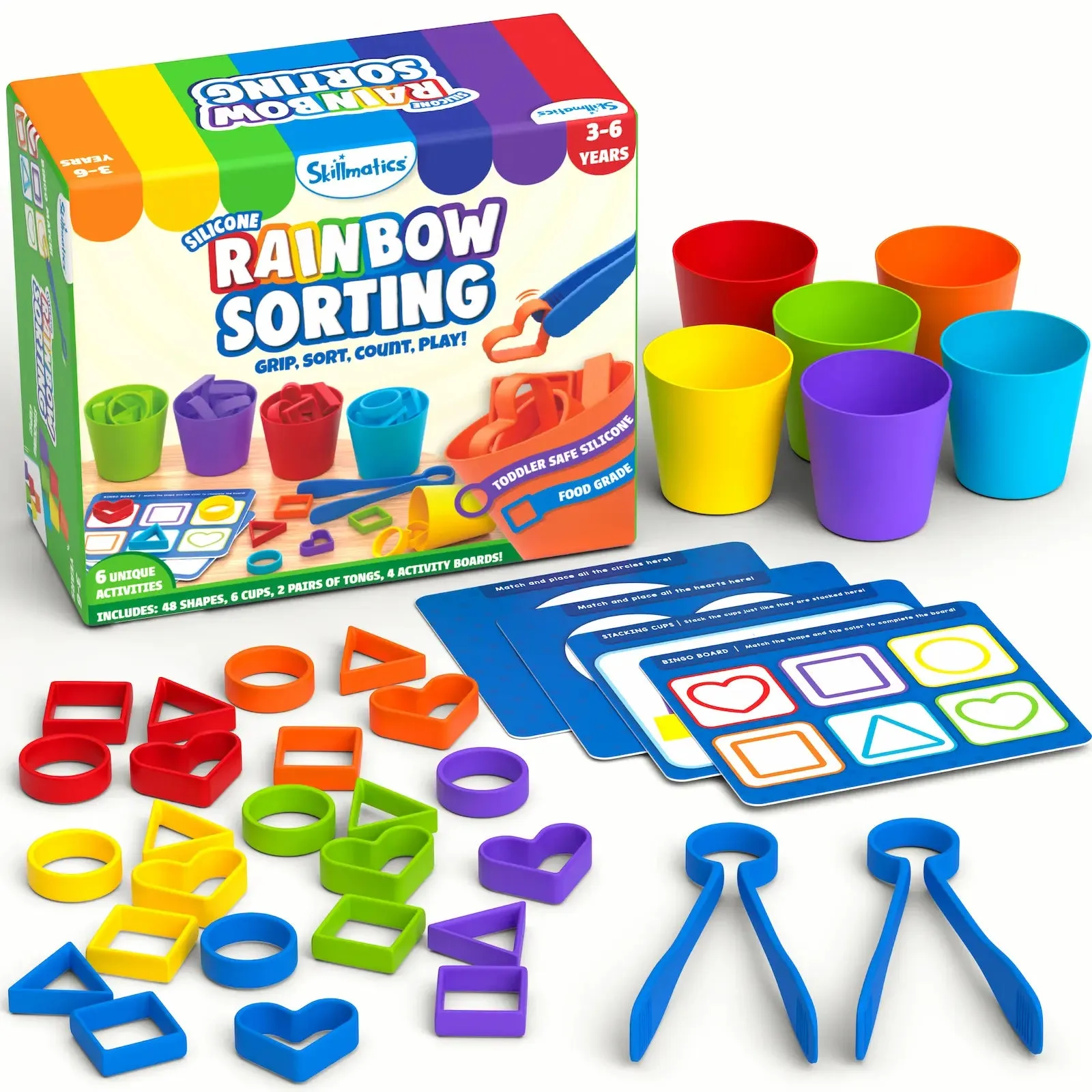
Rainbow Sorting Game V3 | Sorting, Counting & Sequencing Toy (ages 3-6)